01Facts
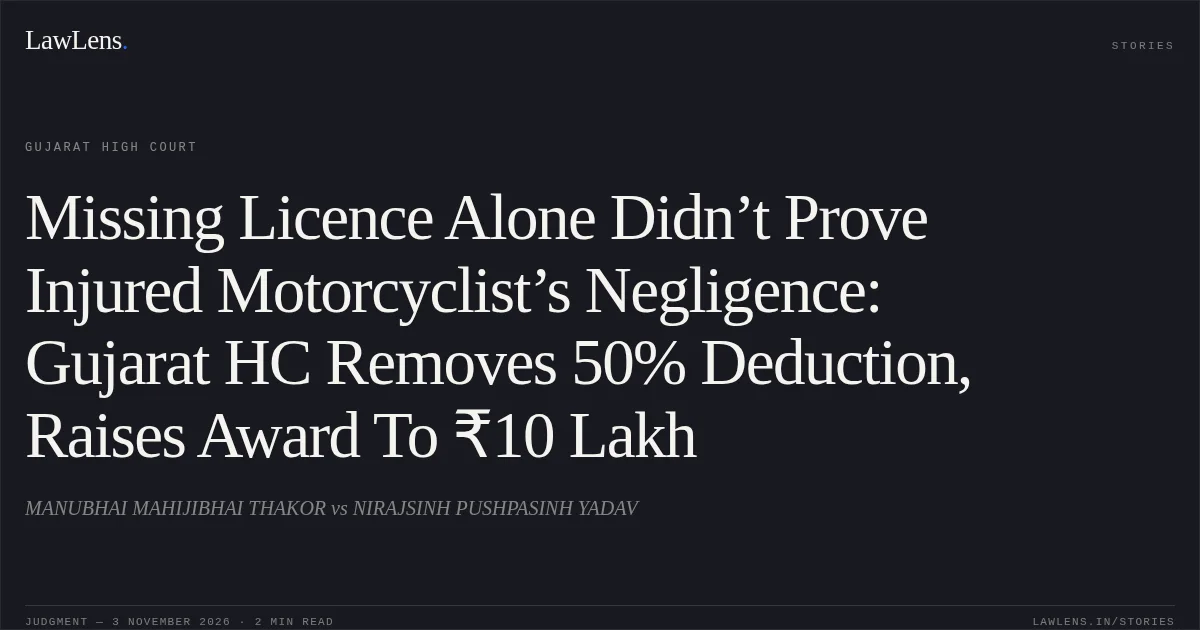
On 12 January 2021, the claimant was riding a motorcycle when it collided with a car driven by respondent No. 1.
pp. 2–4He sustained fractures and other injuries, underwent surgery, and claimed compensation for resulting disability and loss of earnings.
pp. 2–4The Motor Accident Claims Tribunal assessed his monthly income at ₹8,000, fixed disability at 28% of the body as a whole, and attributed 50% contributory negligence to him because he had not produced his driving licence.
pp. 2–4It awarded net compensation of ₹4,21,589 after that deduction.
pp. 2–4The claimant appealed, challenging the negligence finding and seeking reassessment of compensation.
pp. 2–402Issues
i.1. Whether the Tribunal was justified in finding the claimant 50% contributorily negligent because he had not produced his driving licence
pp. 7–10ii.2. Whether the compensation required enhancement by reassessing income and applying future prospects and revised amounts under the relevant heads of damages
pp. 10–1403Law Applied
Under Section 173 of the Motor Vehicles Act, 1988, an aggrieved claimant may appeal an award of the Claims Tribunal.
p. 1Contributory negligence requires proof that the claimant’s negligent conduct materially contributed to the accident or injury; the party alleging it bears the burden, and mere absence, invalidity, or non-production of a driving licence does not, without a causal connection, establish contributory negligence.
pp. 8–9In Saraswati Palariya v. New India Assurance Co. Ltd., (2019) ACJ 42, the Supreme Court held that driving without a valid licence may entail other liabilities but does not, by itself, justify an inference of contributory negligence.
p. 10Under National Insurance Co. Ltd. v. Pranay Sethi, (2017) 16 SCC 680, a 10% addition for future prospects was applied to the claimant’s income.
p. 12The Court applied the multiplier of 11 for a claimant aged 51, following Sarla Verma.
p. 13Provisions in the judgment · 1 · Linked ones open on LawLens
Motor Vehicles Act, 1988 Section 173
04Reasoning
The Tribunal’s negligence finding rested solely on the claimant’s failure to produce a licence.
pp. 9–11The High Court found no independent evidence establishing that the claimant’s conduct caused or contributed to the collision; the FIR and charge-sheet were against respondent No. 1, and the panchnama did not support a finding of contributory negligence.
pp. 9–11It therefore set aside the 50% deduction.
pp. 9–11For compensation, the Court reassessed monthly income at ₹9,079, the applicable minimum wage, and added 10% future prospects, producing a monthly income of ₹9,987.
pp. 11–14Applying the agreed 28% whole-body disability and multiplier 11, it recalculated future loss of income at ₹3,69,072.
pp. 11–14It also enhanced pain and suffering to ₹75,000, actual loss of income to ₹54,474, and special diet, transportation, and attendant charges to ₹15,000; medical expenses remained unchanged.
pp. 11–1405Holding
The appeal was partly allowed.
pp. 14–15The Court held respondent No. 1 100% negligent and reassessed total compensation at ₹10,03,045, resulting in an enhancement of ₹5,81,456 over the Tribunal’s award, with interest at 9% per annum from the date of the claim application until realization.
pp. 14–15The Insurance Company was directed to deposit the enhanced amount with interest before the Tribunal within four weeks; disbursement was ordered after verification and recovery or deduction of any deficit court fees.
pp. 15–17Original Court PDF
MANUBHAI MAHIJIBHAI THAKORvsNIRAJSINH PUSHPASINH YADAV
Click to open original judgment
Original judgment, available to read, download and summarize on LawLens.in