Facts
The petitioner was appointed as a Chowkidar in the Directorate of Census Operations, Assam, in 2000
Source reference: p. 2In 2004, he was charged under Sections 448/325/302 of the IPC, leading to his arrest and subsequent suspension
Source reference: p. 2-3In 2010, the Sessions Court convicted him under Sections 448/304 Part-I/325 of the IPC, sentencing him to ten years of rigorous imprisonment
Source reference: p. 3Consequently, the respondent authority dismissed the petitioner from service on 01.06.2011, invoking Article 311(2)(a) of the Constitution and Rule 19 of the CCS (CCA) Rules, 1965
Source reference: p. 2-3On 03.03.2020, the High Court, in criminal appeal, set aside the convictions under Sections 448 and 304 Part-I but affirmed the conviction under Section 325 IPC
Source reference: p. 4Having served the sentence for the affirmed charge, the petitioner filed an appeal on 01.06.2020 seeking reinstatement, arguing that the reduced gravity of the conviction necessitated a reconsideration of the dismissal
Source reference: p. 4Issues
1. Whether the respondent authority is legally obligated to reconsider the penalty of dismissal when the underlying criminal conviction is partially set aside or modified by an appellate court
Source reference: p. 2, 82. Whether the principles governing the exercise of power under Article 311(2)(a) of the Constitution and Rule 19 of the CCS (CCA) Rules were properly applied in light of the changed circumstances
Source reference: p. 5, 8Law Applied
The court primarily applied Article 311(2)(a) of the Constitution, which permits the dismissal of a civil servant without a departmental inquiry upon conviction on a criminal charge
Source reference: p. 4-5It further relied on Rule 19 of the CCS (CCA) Rules, 1965, which mandates that the disciplinary authority must consider the circumstances of the case before imposing a penalty following a conviction
Source reference: p. 5The court cited Union of India v. Tulsiram Patel (1985) 3 SCC 398, establishing that a criminal conviction does not automatically entail dismissal; the authority must independently determine if the conduct warrants such a severe penalty
Source reference: p. 5-6This was reinforced by Union of India v. Sunil Kumar Sarkar (2001) 3 SCC 414 and Ponaram Borah v. State of Assam (2024), which emphasized that the disciplinary authority has the discretion to impose major, minor, or even no penalty depending on the facts, even if a conviction exists
Source reference: p. 6-7Reasoning
The court reasoned that while the initial dismissal was based on a conviction for a serious offence (Section 304 Part-I), the legal landscape shifted significantly when the appellate court acquitted the petitioner of the most grave charges
Source reference: p. 7-8It noted that the power under Article 311(2)(a) is discretionary and not mandatory; the authority must apply its mind to the "entire circumstances" to ensure the penalty is proportionate to the conduct
Source reference: p. 7The court observed that the respondent authority failed to exercise this discretion or consider the petitioner’s pending appeal regarding the modified conviction
Source reference: p. 8By failing to act on the appeal filed in 2020, the authority ignored the requirement to evaluate whether a conviction under Section 325 IPC alone—for which the petitioner had already served the sentence—still warranted the maximum penalty of dismissal
Source reference: p. 8Holding
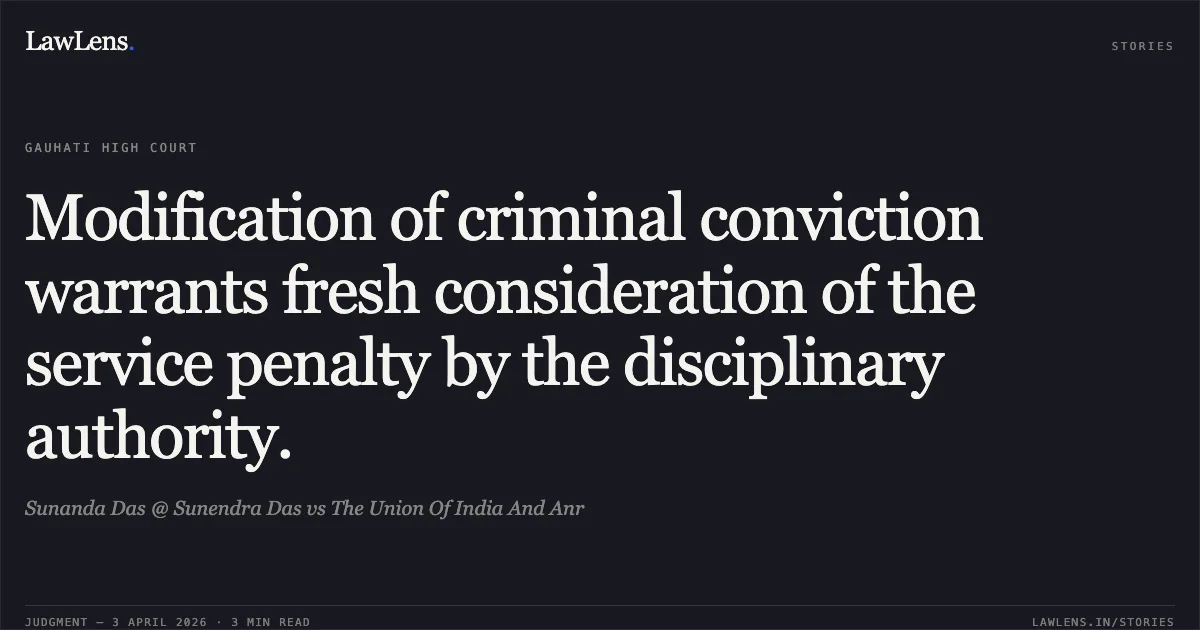
The court held that the respondent authority must reconsider the petitioner's dismissal in light of the modified conviction and the established legal principles of proportionality
The court did not quash the dismissal directly but directed the Director of Census Operations, Assam, to dispose of the petitioner’s appeal dated 01.06.2020 by passing a reasoned and speaking order within three months
Source reference: p. 8The authority is required to specifically address the principles laid down in Tulsiram Patel regarding whether the conduct leading to the surviving conviction under Section 325 IPC warrants the continuation of the order of dismissal
Source reference: p. 8Acts & Sections Cited
4 provisions across 1 statute referred to in this judgment. Each provision opens on LawLens.
Indian Penal Code, 18604
Original Court PDF
Sunanda Das @ Sunendra DasvsThe Union Of India And Anr
Click to open original judgment
Original judgment, available to read, download and summarize on LawLens.in