Facts
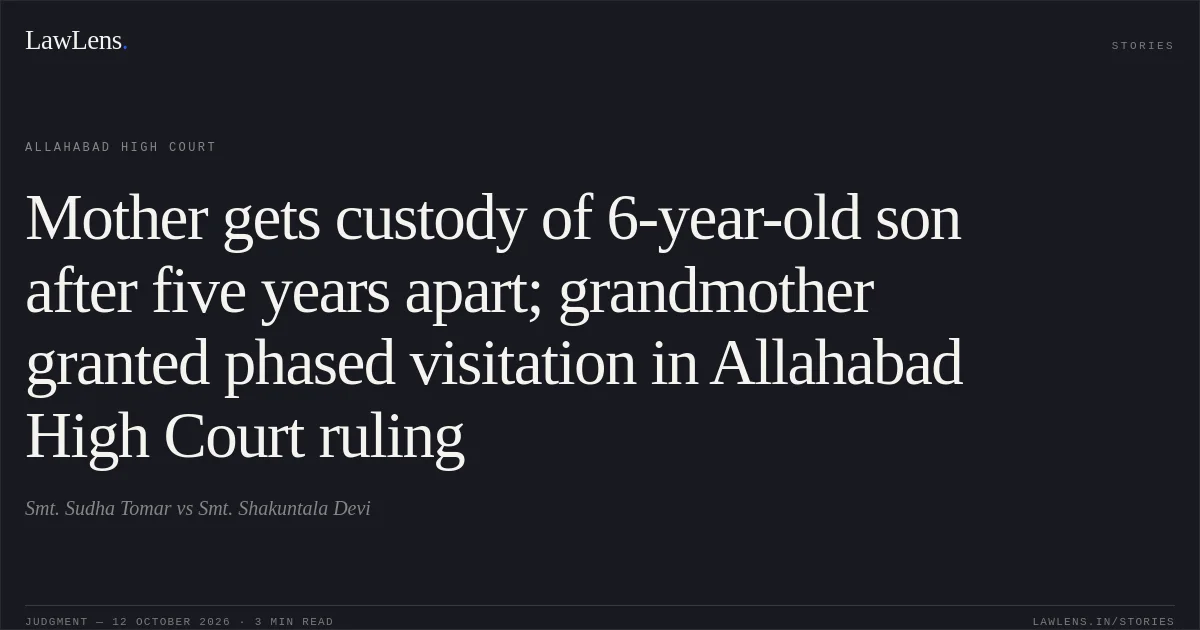
Sudha Tomar, the child’s natural mother, appealed against the Family Court’s refusal of her application for custody of her six-year-old son, Shreyansh, under Sections 7 and 25 of the Guardians and Wards Act, 1890.
Source reference: paras. 2–4, 7The child’s father died in September 2020, when the child was eight months old, and the child thereafter remained with his paternal grandmother.
Source reference: paras. 2–4, 7The mother alleged that she had been prevented from seeing him and that an agreement said to relinquish her claim to custody had been procured by obtaining her signatures on blank paper.
Source reference: paras. 2–4, 7The grandmother relied on that agreement, an alleged will by the father, the child’s statement expressing a wish to remain with her, and the child’s settled circumstances.
Source reference: paras. 2–4, 7The appeal was brought under Section 19 of the Family Courts Act, 1984 and Section 47 of the Guardians and Wards Act, 1890.
Source reference: paras. 2–4, 7Issues
1. Whether the child’s welfare required custody to be given to his natural mother rather than his paternal grandmother, having regard to the child’s age, circumstances, and relationship with each party.
Source reference: paras. 22–302. Whether the child’s expressed preference and his residence with the grandmother for several years outweighed the mother’s claim, and what transitional visitation arrangements were appropriate.
Source reference: paras. 18–23, 26–32Law Applied
Under Sections 7 and 25 of the Guardians and Wards Act, 1890, the child’s welfare is the paramount consideration in deciding guardianship and custody; the court must assess welfare in light of all relevant circumstances, including care, health, education, comfort, and the guardian’s capacity, rather than apply a rigid rule.
Source reference: paras. 2, 22; Tejaswini Gaud v. Shekhar Jagdish Prasad Tewari, para. 29Section 6(a) of the Hindu Minority and Guardianship Act, 1956, as interpreted in Githa Hariharan v. Reserve Bank of India, treats “after” as “in the absence of,” so a mother may act as natural guardian when the father is absent from the care of the minor.
Source reference: paras. 9–12The court also relied on the principle that a young child’s stated preference may not amount to an intelligent preference where the child has been separated from a parent and has lived only with the current caregivers; custody may be transferred where welfare favours the parent, with visitation used to ease the transition.
Source reference: paras. 20–21, 28–29Reasoning
The Court treated the mother as the natural guardian in the father’s absence and assessed the competing claims by the child’s welfare, not by the disputed agreement or alleged will.
Source reference: paras. 11, 13–15It found those documents of limited assistance because the agreement was disputed and the will had not been produced in original or proved.
Source reference: paras. 11, 13–15Although the child had lived with the grandmother for over five years and expressed a wish to remain with her, the Court considered that he was only six, had been denied access to his mother, and might not be capable of making an intelligent preference in those circumstances.
Source reference: paras. 17–23, 30The Court also considered the parties’ financial circumstances broadly balanced and found no demonstrated unfitness on the mother’s part; the grandmother’s care of the child and the child’s existing bond with her did not, by themselves, justify denying the mother custody.
Source reference: paras. 24–25, 30Relying on the principle that initial disruption may be overcome over time, the Court provided for continuing contact with the grandmother during the transition.
Source reference: paras. 27–31Holding
The Court allowed the appeal, set aside the Family Court’s judgment, rejected the grandmother’s counterclaim, and directed that custody be handed over to the mother forthwith.
For the first six months, the grandmother was granted one full day of access each week, from 8 a.m. to 6 p.m., at the mother’s residence; for the following six months, she could visit on every second weekend.
Source reference: paras. 31–32The parties could mutually extend those arrangements, and the grandmother could seek further modification after one year.
Source reference: paras. 31–32Acts & Sections Cited
6 provisions across 3 statutes referred to in this judgment. Each provision opens on LawLens.
Family Courts Act, 19841
Guardians and Wards Act, 18903
Original Court PDF
Smt. Sudha TomarvsSmt. Shakuntala Devi
Click to open original judgment
Original judgment, available to read, download and summarize on LawLens.in