Facts
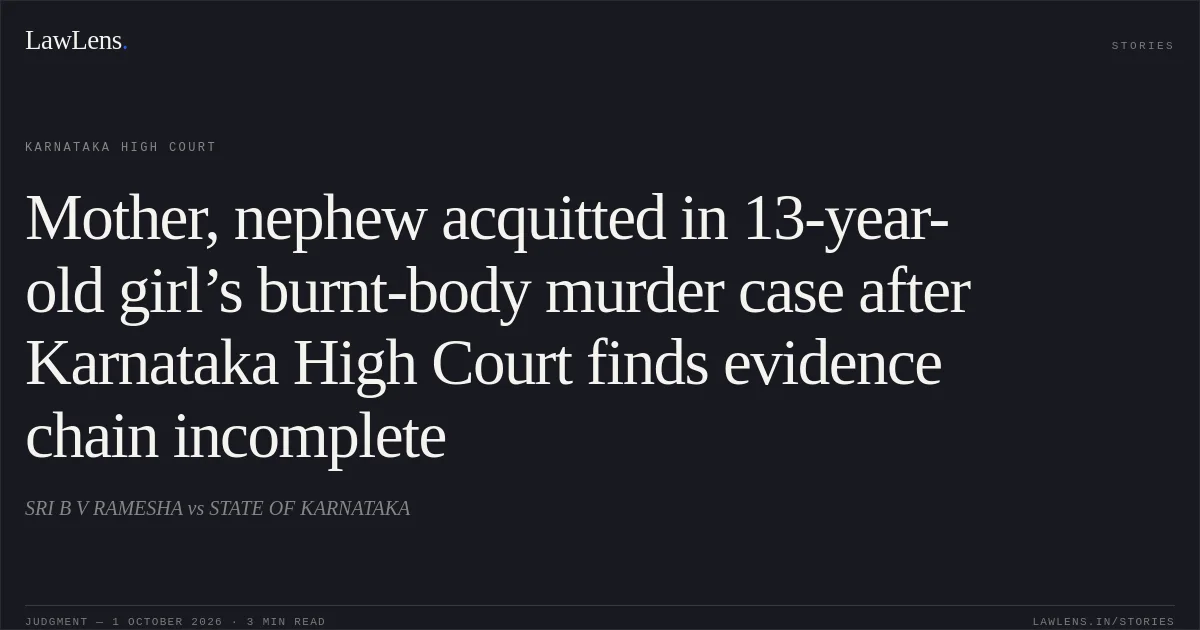
The prosecution alleged that the appellants—Accused Nos. 1 and 2—conspired to murder Accused No. 2’s minor daughter after Accused No. 1 allegedly sexually assaulted and impregnated her.
Source reference: p. 5–7, 11–12The victim’s pregnancy was terminated pursuant to an order of the High Court, and the fetus was preserved for DNA testing.
Source reference: p. 5–7, 11–12The prosecution alleged that Accused No. 2 took the victim from her hostel on 23 June 2018, after which both appellants transported and killed her, and Accused No. 1 later burned her body to destroy evidence.
Source reference: p. 5–7, 11–12The Sessions Court convicted both appellants under Sections 120-B and 302 read with Section 34 of the IPC, and Accused No. 1 under Section 201 read with Section 34; it acquitted Accused No. 1 of the POCSO charge and Accused No. 3 of the Section 201 charge.
Source reference: p. 3–4, 8–9The appellants appealed, challenging their convictions.
Source reference: p. 4Issues
1. Whether the prosecution proved beyond reasonable doubt that the victim’s death was homicidal.
Source reference: p. 15–162. Whether the evidence, including the alleged “last seen” circumstance, established a complete chain connecting the appellants to the murder and related offences.
Source reference: p. 16–24Law Applied
The prosecution must prove beyond reasonable doubt that the death was homicidal and, where a case rests on circumstantial evidence, establish a complete chain of circumstances pointing only to the accused’s guilt.
Source reference: p. 20–23The “last seen” circumstance, standing alone, is insufficient to sustain a conviction; Section 106 of the Evidence Act may require an explanation from an accused only when the prosecution has first established circumstances that support the inference of guilt.
Source reference: p. 20–23The Court considered Satpal Singh v. State of Haryana and Surajdeo Matho v. State of Bihar on the qualified use of the last-seen theory and the accused’s duty to explain, and Kanhaiya Lal v. State of Rajasthan, (2014) 4 SCC 715, on the insufficiency of last-seen evidence by itself.
Source reference: p. 20–23The charges arose under Sections 120-B, 302 and 201 read with Section 34 of the IPC.
Source reference: p. 3–4Reasoning
The medical evidence did not establish the cause of death: the post-mortem report stated that an opinion could not be given because the body was burnt, and the doctor’s estimate of the time of death did not fix it with sufficient certainty.
Source reference: p. 15–16, 23–24Although the victim’s mother took her from the hostel, the evidence did not show that Accused No. 1 was with them at that point, and the witnesses said to link the appellants to the subsequent journey or events did not support the prosecution.
Source reference: p. 17–19, 21–23The Court also noted the absence of incriminating recoveries linking the appellants to the crime and the lack of proof of the alleged motive; the DNA material relied on by the defence matched the fetus with Abhishek, against whom a separate rape case had been registered.
Source reference: p. 21–22Consequently, the last-seen circumstance and the appellants’ lack of explanation could not fill the gaps in the prosecution’s case or establish a complete chain of guilt.
Source reference: p. 20–24Holding
The Court held that the prosecution had not proved beyond reasonable doubt that the victim died a homicidal death or that the circumstances formed a complete chain establishing the appellants’ guilt.
It allowed the appeal, set aside the convictions and sentences of Accused Nos. 1 and 2 under Sections 120-B and 302 read with Section 34 of the IPC and Accused No. 1 under Section 201 read with Section 34, and acquitted the appellants of the charged offences.
Source reference: p. 24–25They were directed to be released if not required in another case.
Source reference: p. 24–25Acts & Sections Cited
5 provisions across 3 statutes referred to in this judgment. Each provision opens on LawLens.
Code of Criminal Procedure, 19731
Indian Penal Code, 18603
Protection of Children from Sexual Offences Act, 20121
Original Court PDF
SRI B V RAMESHAvsSTATE OF KARNATAKA
Click to open original judgment
Original judgment, available to read, download and summarize on LawLens.in