01Facts
The husband (petitioner) married the first respondent (wife) on 11.10.2015; two children (respondents 2 and 3) were born
¶ 3The wife alleged physical and mental ill-treatment and neglect after the births. She claimed the husband ousted her and the children from the matrimonial home, and her complaint was not registered
¶ 3–4The husband denied ill-treatment and desertion, asserting that the wife left voluntarily to reside with her parents
¶ 4He pleaded that he had no income or avocation, that the wife is able-bodied, qualified, and earns ₹10,000 per month in the private sector, and that he had filed O.S. No. 45/2021 for restitution of conjugal rights, which remained pending
¶ 5The wife examined herself as PW1 and marked Exs. P1–P4; the husband examined himself as RW1 and marked no documents
¶ 6The Family Court (I Addl. Principal Judge, Belagavi) on 21.11.2025 in Crl. Misc. No. 181/2022 awarded ₹5,000 per month to the wife and ₹2,000 per month to each child
¶ 1, 6The husband filed this revision petition under Section 19(4) of the Family Courts Act, 1984, seeking to quash that order
p. 1The husband argued that the wife had previously married and divorced another man, received ₹3,25,000 as permanent alimony, is educated and capable of earning, is not supporting the elder child who is studying in a madrasa, and refuses to return to the marital home
¶ 8The respondents contended that the husband has not paid any maintenance since the November 2025 order despite having income, and that his restitution suit was dismissed for default
¶ 9The husband's own pleading in O.S. No. 45/2021 described his occupation as business
¶ 1002Issues
i.1. Whether the Family Court's maintenance order dated 21.11.2025 (₹5,000 to the wife; ₹2,000 each to the two children) warrants interference in revision under Section 19(4) of the Family Courts Act, 1984
¶ 1, 13–14ii.2. Whether the husband can avoid or reduce his maintenance obligation on the ground that the wife is employed and earning ₹10,000 per month, where no documentary proof of such employment was produced
¶ 11–12iii.3. Whether the husband's claim of having no income or avocation is sustainable, given his own pleading that he is engaged in business
¶ 10–1103Law Applied
The court relied on the husband's personal obligation, as husband and father, to maintain his wife and minor children; it held that he "cannot say that he has no obligation to maintain them"
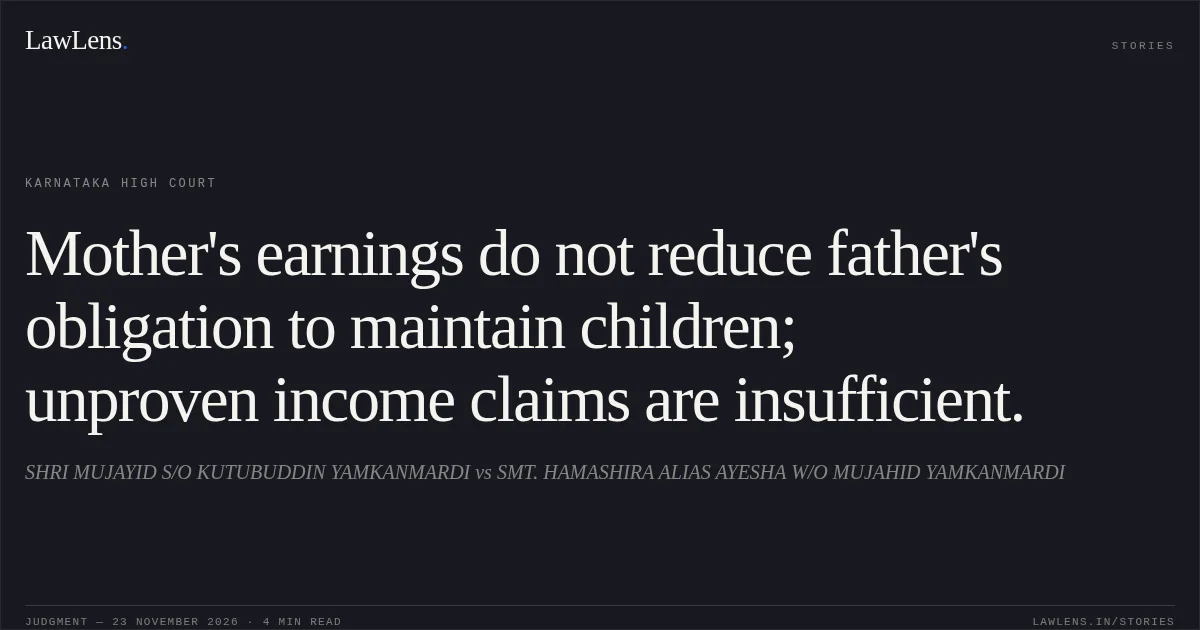
¶ 11It applied the principle, as stated in Sujata Kumari (2026 SCC OnLine SC 1675, as cited in the judgment), that a mother's earnings do not by themselves reduce the father's liability to maintain the children
¶ 12The court treated the standard of proof as requiring documentary evidence of a party's income or employment, observing that oral submissions were insufficient
¶ 11The petition was filed under Section 19(4) of the Family Courts Act, 1984, which governs appeals/revision from Family Court orders
p. 1The court referred to the scope of interference with a maintenance order that rests on appreciation of evidence
¶ 13Provisions in the judgment · 1 · Linked ones open on LawLens
Family Courts Act, 1984 Section 19
04Reasoning
The court first noted that the husband's assertion that the wife earns ₹10,000 per month was unsupported by any document; he produced none before the Family Court, and his position rested on oral submission alone
¶ 11Even if employment were established, the court held that this would not extinguish the father's duty to maintain the children, following Sujata Kumari
¶ 12The husband's own description of his occupation as business in O.S. No. 45/2021 undermined his plea of having no avocation
¶ 10The court then assessed the quantum: the awards of ₹5,000 for the wife and ₹2,000 per child were characterised as "meager" and the Family Court was found to have appreciated the evidence correctly
¶ 13The judgment does not expressly deal with the husband's allegations about the wife's prior marriage, alimony received, or her conduct regarding the elder child, and gives no reasoning on those points
¶ 8, 14The court's refusal to interfere therefore rests on the evidentiary deficiency and the husband's continuing obligation rather than on those allegations
05Holding
The court held that the Family Court's order dated 21.11.2025 is correct on the evidence and does not call for interference
¶ 13The husband's contention regarding the wife's employment was rejected for want of documentary proof, and the duty to maintain the children was held not to be reduced by the mother's earnings
¶ 11–12The petition, being devoid of merits, was dismissed, and the maintenance award of ₹5,000 per month to the wife and ₹2,000 per month to each child was left intact
¶ 14The judgment does not record any direction on costs or on the pending restitution suit (O.S. No. 45/2021)
Original Court PDF
SHRI MUJAYID S/O KUTUBUDDIN YAMKANMARDIvsSMT. HAMASHIRA ALIAS AYESHA W/O MUJAHID YAMKANMARDI
Click to open original judgment
Original judgment, available to read, download and summarize on LawLens.in