01Facts
The father (petitioner) and mother (respondent) are parents of a minor daughter. The father filed IA No. 9 in G No. 80/2025 under Section 12 of the Guardians and Wards Act, 1890, read with Section 151 CPC, seeking permission to visit the child's school for Parent-Teacher Meetings (PTM) and other occasions, and a direction to the school to send all school-related communications to him.
¶ 1The Principal Judge, Family Court, Bengaluru rejected IA No. 9 by order dated 24.11.2025.
¶ 1, 3The Family Court relied on the mother's objections that the child is extremely scared of the father, that his presence at school would disturb her peace of mind and academics, and that she has a history of severe stress resulting in hospitalisation.
¶ 3The Family Court also relied on an earlier order dated 12.08.2025 in IA No. 5, under which the child was referred to a Senior Child Psychiatrist at NIMHANS, where she reportedly cried when the father entered the chamber.
¶ 3The father contended that regular contact existed until 2024 while the parties lived in Hyderabad, that "parental alienation" set in after relocation to Bengaluru, and that he wishes to pay the entire school fee.
¶ 4The mother stated that the father earlier paid the fees, insisted on a cheaper school, and "brainwashed" the child; she had no objection to the father paying fees and would facilitate bonding, though the child showed reluctance.
¶ 5The High Court noted that it had earlier interacted with the parties and granted parenting time, which reportedly went well.
¶ 602Issues
i.1. Whether the Family Court was justified in rejecting the father's request to attend school PTMs/occasions and to receive school communications, given the child's welfare and reported distress.
¶ 3, 6ii.2. Whether, in the absence of school visits, the father may be granted limited participation in the child's school life through WhatsApp group membership and direct payment of school fees.
¶ 6 · Order cl. ii–iii03Law Applied
The petition was filed under Article 227 of the Constitution of India to challenge an order passed under Section 12 of the Guardians and Wards Act, 1890, read with Section 151 CPC.
Cause title · p. 2The governing principle, as applied by both the Family Court and the High Court, is that the welfare and best interest of the minor child is paramount and prevails over the rights and liabilities of the disputing parents.
¶ 3, 6The Family Court treated the child's psychological condition and prior NIMHANS referral as relevant evidence bearing on that welfare.
¶ 3The High Court further applied the principle that parental bonding must develop gradually, and that interim measures should be calibrated to the child's present condition and the father's relationship with her.
¶ 6The judgment cites no statutory provision on welfare and no precedent.
Provisions in the judgment · 2 · Linked ones open on LawLens
Guardians and Wards Act, 1890 Section 12
Code of Civil Procedure, 1908 Section 151
04Reasoning
The Family Court refused school access because the mother's evidence of the child's fear, stress, and prior hospitalisation, supported by the NIMHANS referral, indicated that the father's presence at school would harm the child's education and wellbeing.
¶ 3The High Court accepted that, at present, school visits and teacher interaction "may not yield a positive result" and would not serve the best interest of either the father or the child, so it declined to interfere with that part of the order.
¶ 6However, the Court found that the father needs to develop his bond with the child and that complete exclusion from her school life was not necessary.
¶ 6It therefore modified the order: membership of the parents' WhatsApp group would let the father track the child's academics and activities without direct school contact, and direct fee payment addressed the father's stated concern and the mother's stated lack of objection.
¶ 5, 6To avoid disturbing the child, the father was restricted to receiving information in the group and barred from communicating in it.
Order cl. ivThe Court also left the father free to renew the school-access request before the Family Court once the relationship strengthens.
¶ 6 · Order cl. v05Holding
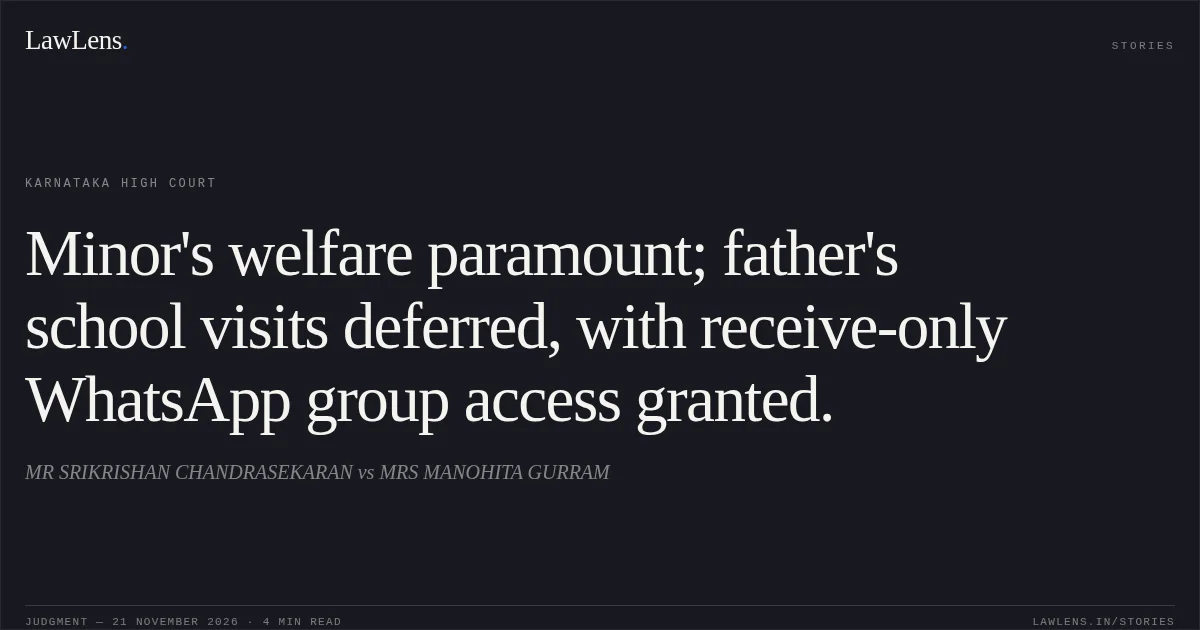
The High Court held that school visits and teacher interaction were not appropriate at this stage, given the child's welfare and reported distress.
¶ 6The High Court modified the Family Court order dated 24.11.2025 in IA No. 9 to permit limited participation. Directions: (i) the order is modified; (ii) the father is to be added to the parents' WhatsApp school group; (iii) the father is to pay school fees directly to the school, and the mother is to provide the necessary particulars; (iv) the father may receive but not post in the group; (v) the father may renew the school-access request before the Family Court as the bond develops.
Order cl. i–vThe writ petition is disposed of, and pending IAs, if any, stand disposed of.
Order cl. vi–viiOriginal Court PDF
MR SRIKRISHAN CHANDRASEKARANvsMRS MANOHITA GURRAM
Click to open original judgment
Original judgment, available to read, download and summarize on LawLens.in