01Facts
The petitioner, proposed defendant No. 7 and son of Nanjundappa, challenged the order dated 05.06.2023 of the Principal Senior Civil Judge and CJM, Davanagere, rejecting I.A. No. 26 under Order 1 Rule 10(2) read with Section 151 CPC in O.S. No. 99 of 2018
p. 3The suit is a partition suit filed by a daughter of defendant No. 1, G. Nijalingappa
¶ 3The petitioner admitted that a registered Partition Deed dated 23.04.2001 was executed among the male coparceners, under which his father Nanjundappa was allotted his legitimate share
¶ 4His impleadment claim rested on the contention that, despite the partition, certain properties stood in the name of defendant No. 1 because they were purchased in his name to clear family debts, and therefore retained joint family character and remained available for partition
¶ 4 · pp. 4–5The respondents contended that the deed contains no recital supporting this plea
¶ 5 · pp. 5–6When the Court required the petitioner to identify such a recital, counsel, on instructions, conceded that none exists in the registered Partition Deed
¶ 6 · pp. 6–702Issues
i.1. Whether the petitioner, claiming through a coparcener who was separated by a registered partition, has any independent locus or right to seek partition of properties allotted to another branch of the family, and consequently a necessity for impleadment in the pending suit.
¶ 7 · pp. 7–8 · ¶ 8 · p. 9ii.2. Whether the rejection of the impleadment application warrants interference in exercise of jurisdiction under Article 227 of the Constitution of India.
¶ 8 · p. 9 · p. 303Law Applied
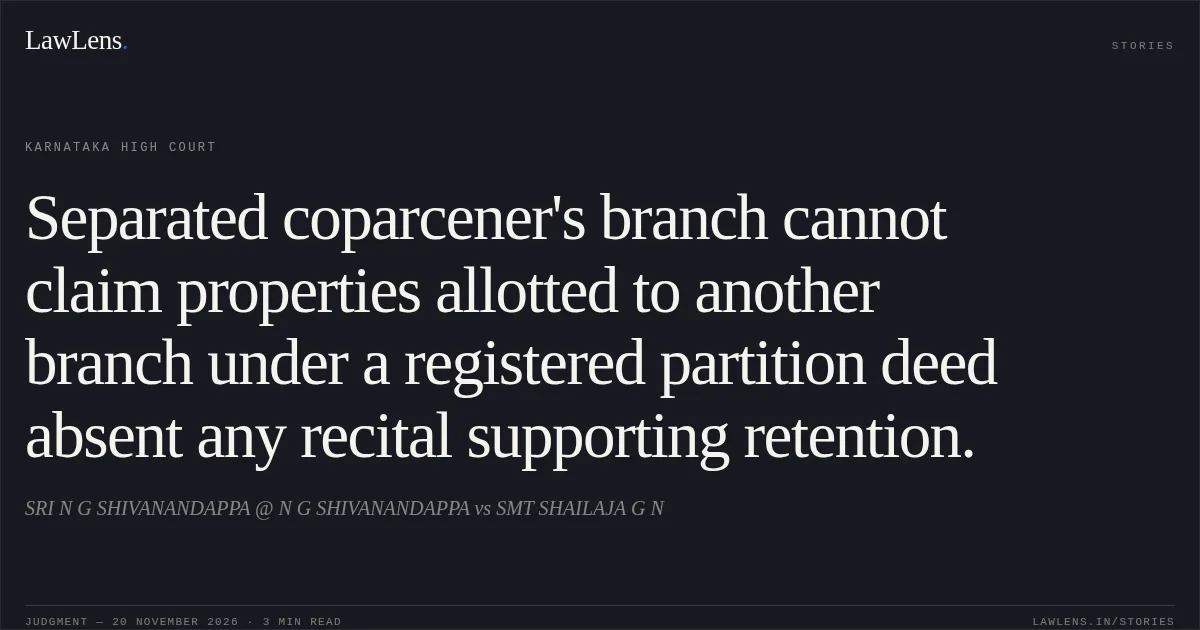
Once a partition is effected and a coparcener is allotted his legitimate share, resulting in severance of status, the separated branch cannot, by virtue of its former coparcenary relationship, assert rights over properties allotted to other branches; consequently, the legal heirs of a separated coparcener cannot claim an independent right in properties exclusively allotted to another branch under a registered partition deed.
¶ 7 · pp. 7–8A claim to such properties must be traced only to the share allotted to the petitioner's own father, and severed branches cannot reopen partition absent a legally sustainable basis.
¶ 7 · pp. 7–8The recitals of the registered Partition Deed were treated as determinative of whether the alleged retention of properties for family debts was part of the partition.
¶ 6 · pp. 6–7 · ¶ 8 · p. 9The petition was filed under Article 227 of the Constitution.
p. 3No statutory provision or precedent is expressly cited for the proposition in paragraph 7.
Provisions in the judgment · 1 · Linked ones open on LawLens
Code of Civil Procedure, 1908 Section 151
04Reasoning
The petitioner's own pleadings admitted the 2001 partition and the allotment of a legitimate share to his father. His claim to the properties in defendant No. 1's branch depended entirely on an assertion that those properties were retained for clearing family debts and kept outside the partition.
¶ 4 · pp. 4–5 · ¶ 6 · pp. 6–7Because counsel conceded that the registered deed contains no such recital, the assertion was unsupported by the operative instrument that effected the severance.
¶ 6 · pp. 6–7 · ¶ 8 · p. 9Applying the rule of severance, the petitioner's status was derivative of his father's share alone and could not extend to the branch allotted to defendant No. 1. Lacking any independent locus over those properties, the petitioner had no necessity for impleadment in the partition suit.
¶ 7 · pp. 7–8 · ¶ 8 · p. 9The Trial Court had correctly appreciated the effect of the registered partition and the absence of material to substantiate the claim.
¶ 8 · p. 905Holding
The petitioner has no independent locus to seek partition of properties allotted to defendant No. 1, and no necessity for impleadment exists. Both issues are answered against the petitioner.
¶ 8 · p. 9No infirmity is found in the order dated 05.06.2023 rejecting I.A. No. 26, and no interference under Article 227 is warranted. The writ petition, being devoid of merit, is dismissed.
¶ 8 · p. 9Original Court PDF
SRI N G SHIVANANDAPPA @ N G SHIVANANDAPPAvsSMT SHAILAJA G N
Click to open original judgment
Original judgment, available to read, download and summarize on LawLens.in