Facts
The appellant sought compensation under Section 166 of the Motor Vehicles Act for the death of his wife, Anitha J., alleging that a motorcycle struck her on 24 February 2016.
Source reference: paras. 3–5, pp. 3–4The Tribunal initially awarded compensation, but the High Court set that award aside and remanded the matter for fresh consideration after noting circumstances raising suspicion about the claim.
Source reference: paras. 8–9, pp. 5–7On remand, the Tribunal dismissed the claim, finding that the accident and the motorcycle’s involvement had not been established. It relied, among other matters, on the deceased’s school attendance record, inconsistencies in the medical and accident accounts, and delay in reporting the incident.
Source reference: para. 11, pp. 8–10The appellant appealed against the dismissal.
Source reference: para. 12, p. 10Issues
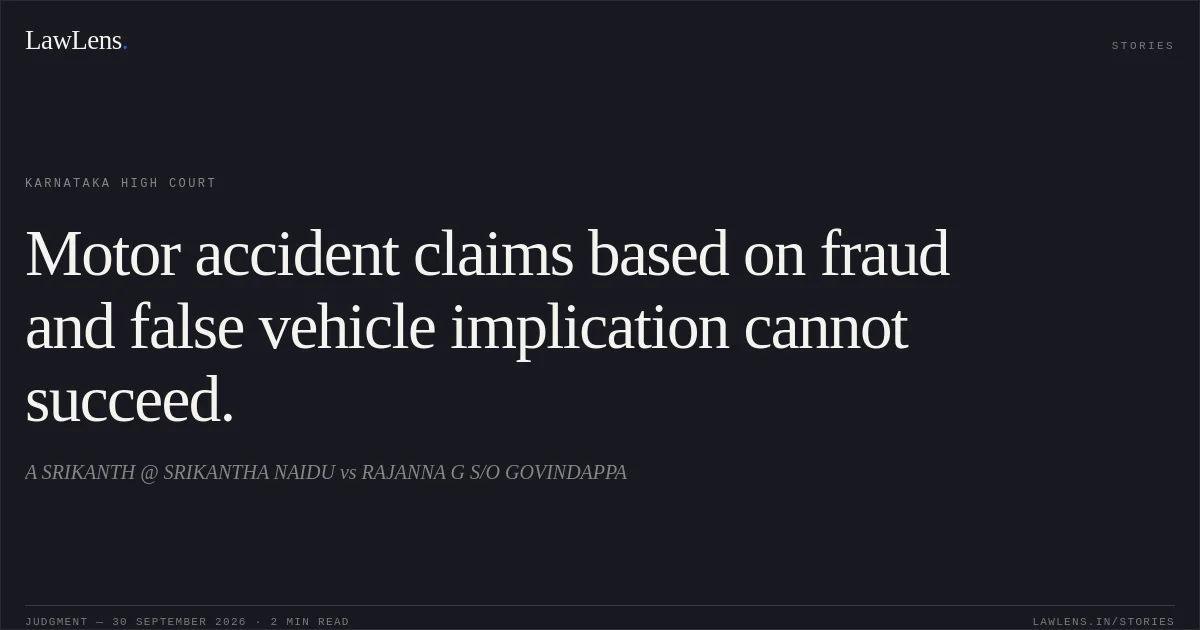
Whether the Tribunal was justified in dismissing the claim petition upon finding that the claim involved fraud, collusion, and false implication of the insured motorcycle.
Source reference: para. 14, p. 10Whether the appellant established that he was the deceased’s legally wedded husband and lawful heir.
Source reference: para. 20, p. 13Law Applied
Under Section 166 of the Motor Vehicles Act, a claimant seeking compensation must establish entitlement to compensation arising from the alleged motor accident.
Source reference: para. 3An appeal from the Tribunal’s award lies under Section 173(1).
Source reference: para. 12The Court relied on Section 35 of the Indian Evidence Act, under which entries in an official record made by a public servant in the discharge of official duty are relevant evidence, and applied the maxim fraus omnia corrumpit—fraud vitiates solemn acts—when considering whether the claim was fraudulent.
Source reference: paras. 17–18, pp. 11–12Reasoning
The Court held that the remand was for fresh consideration, not limited to obtaining hospital records, and that the Tribunal could examine the entire evidentiary record once fraud was suspected.
Source reference: para. 17, p. 11The certified attendance register showed the deceased at school on the date of the alleged accident, contradicting the appellant’s and his brother’s account that she attended a wedding in Chitradurga.
Source reference: para. 18, p. 12The Court also considered the conflict between the alleged head injuries and the hospital record, the unexplained six-day delay in lodging the FIR, and the decision to transport the injured person to Bengaluru without first seeking local emergency care.
Source reference: para. 19, p. 12The service book recorded the deceased as divorced and did not name the appellant as her spouse; the appellant had not established his status as her legally wedded husband and lawful heir.
Source reference: para. 20, p. 13Taken together, these matters supported the Tribunal’s finding that the motorcycle had been falsely implicated.
Source reference: para. 21, p. 13Holding
The Court answered the principal issue in the affirmative, finding no basis to interfere with the Tribunal’s dismissal of the claim.
The appeal was dismissed, and the Tribunal’s judgment and award dated 26 November 2021 were affirmed.
Source reference: p. 14Acts & Sections Cited
2 provisions across 1 statute referred to in this judgment. Each provision opens on LawLens.
Motor Vehicles Act, 19882
Original Court PDF
A SRIKANTH @ SRIKANTHA NAIDUvsRAJANNA G S/O GOVINDAPPA
Click to open original judgment
Original judgment, available to read, download and summarize on LawLens.in