Facts
On 25 October 2022, the appellant was riding a two-wheeler with his brother when a mini-truck driven by Respondent No. 2 collided with them at Thatimaakulapalli Cross Road, District Tirupati, Andhra Pradesh. The appellant sustained injuries and subsequently filed a claim petition under Section 166 of the Motor Vehicles Act, 1988 before the Motor Accidents Claims Tribunal, Chennai
Source reference: p. 1; paras. 1, 5The insurer objected to the territorial jurisdiction of the Chennai Tribunal, contending that the accident occurred in Andhra Pradesh and that no part of the cause of action arose in Chennai. The Tribunal rejected the objection on the ground that the insurer had an office at Chennai. In revision, the Madras High Court held that the Tribunal at Chennai lacked territorial jurisdiction and directed transfer of the proceedings to the Tribunal at Chittoor. The claimant appealed to the Supreme Court.
Source reference: p. 2; para. 1The claim petition stated the claimant’s address as Chittoor District, Andhra Pradesh. It contained no averment that the claimant resided, carried on business, or that any part of the cause of action arose within Chennai.
Source reference: p. 5; para. 5Issues
Whether an insurer impleaded as a party-respondent in a claim petition under Section 166 of the Motor Vehicles Act, 1988 may object to the territorial jurisdiction of the Claims Tribunal.
Source reference: pp. 6–8; para. 6Whether, under Section 166(2) of the Motor Vehicles Act, 1988, the mere fact that the insurer carries on business or has an office within the territorial limits of a Tribunal confers jurisdiction on that Tribunal.
Source reference: pp. 8–11; paras. 7–9Whether the Chennai Tribunal had territorial jurisdiction where the accident occurred in Tirupati District, the claimant resided in Chittoor District, and no relevant jurisdictional fact was pleaded in relation to Chennai.
Source reference: pp. 17–18; paras. 14–15Law Applied
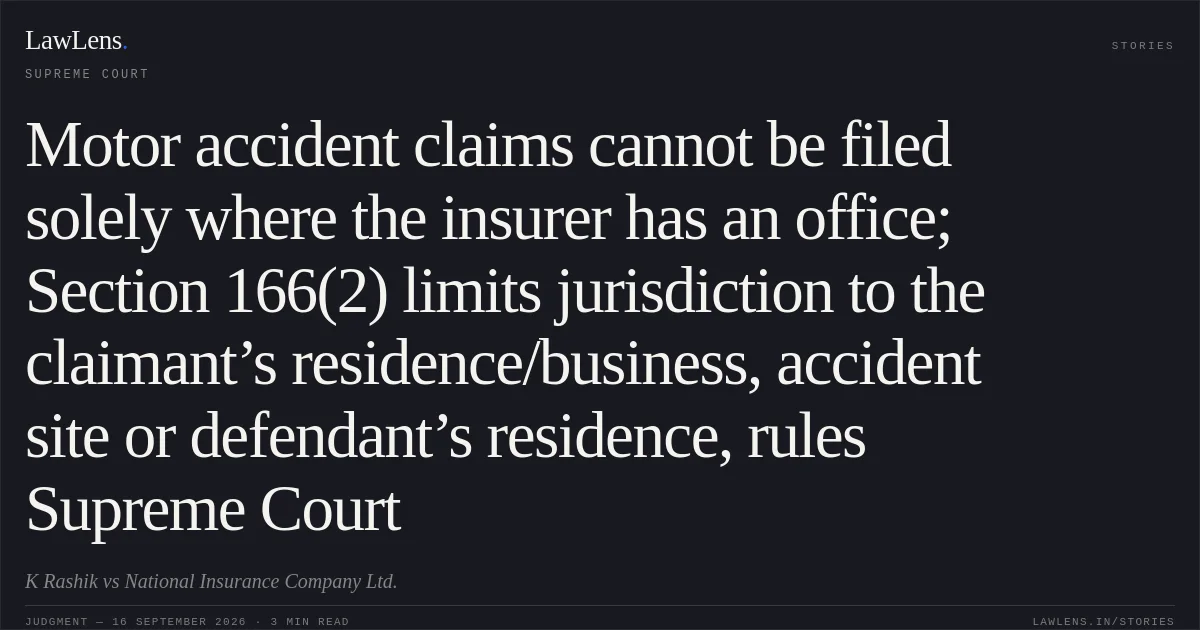
Section 166(2) of the Motor Vehicles Act, 1988 permits a claimant to file a compensation application before the Tribunal having jurisdiction over the area where the accident occurred, where the claimant resides, where the claimant carries on business, or where the defendant resides.
Source reference: p. 8; para. 7The provision specifically refers to the defendant’s residence and does not include the place where the defendant carries on business; accordingly, the insurer’s business presence or branch office does not independently confer jurisdiction.
Source reference: pp. 9–10; para. 8Under United India Insurance Co. Ltd. v. Shila Datta, once an insurer is voluntarily impleaded as a party-respondent, it may contest the claim on all legally available grounds, including territorial jurisdiction.
Source reference: pp. 6–8; para. 6Section 21(1) of the Code of Civil Procedure, 1908 applies where a territorial-jurisdiction objection is raised at the appellate or post-award stage and requires proof of consequent failure of justice; it does not displace the requirements of Section 166(2) when the objection is raised before adjudication on merits.
Source reference: pp. 11–18; paras. 10–14Reasoning
The insurer was impleaded by the claimant as a defendant and was therefore entitled to raise the objection to territorial jurisdiction.
Source reference: pp. 6–8; para. 6Since the objection was raised before the claim was adjudicated, the Tribunal had to determine jurisdiction directly under Section 166(2), without applying the prejudice or failure-of-justice threshold under Section 21(1) of the Code.
Source reference: pp. 17–18; para. 14The statutory alternatives were not satisfied in Chennai: the accident occurred in Tirupati District; the claimant’s pleaded residence was in Chittoor District; no place of business of the claimant in Chennai was pleaded; and the driver was also stated to reside in Chittoor District.
Source reference: p. 18; para. 15The insurer’s office at Chennai could not confer jurisdiction because Section 166(2) refers to the defendant’s residence, not the place where the defendant carries on business, and an insurer is not the relevant “defendant” for this purpose merely because it has been impleaded.
Source reference: pp. 9–11; para. 9A beneficial interpretation of the Motor Vehicles Act could not override the plain statutory language.
Source reference: p. 18; para. 15Holding
The Supreme Court held that the insurer, having been impleaded as a party-respondent, was entitled to challenge the Chennai Tribunal’s territorial jurisdiction.
The mere presence of the insurer’s office at Chennai did not confer jurisdiction under Section 166(2) of the Motor Vehicles Act. As none of the statutory jurisdictional connecting factors existed in Chennai, the Chennai Tribunal lacked territorial jurisdiction.
Source reference: p. 19; para. 16The Madras High Court’s order was upheld, the proceedings were directed to be transferred to the Tribunal at Chittoor, and the civil appeal was dismissed without costs.
Source reference: p. 19; para. 16Acts & Sections Cited
8 provisions across 2 statutes referred to in this judgment. Each provision opens on LawLens.
Motor Vehicles Act, 19886
Code of Civil Procedure, 19082
Original Court PDF
K RashikvsNational Insurance Company Ltd.
Click to open original judgment
Original judgment, available to read, download and summarize on LawLens.in