01Facts
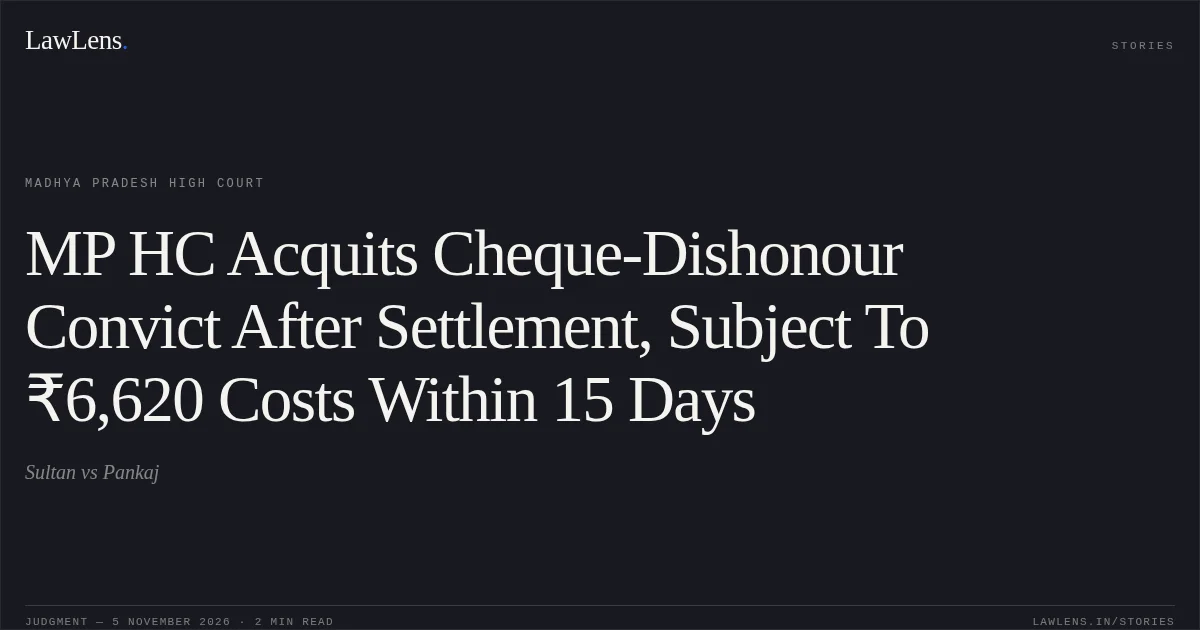
Sultan was convicted under Section 138 of the Negotiable Instruments Act, 1881, and fined ₹7,94,605 by the Judicial Magistrate First Class, Garoth.
pp. 1–3 · ¶ 02–06The II Additional Sessions Judge, Garoth, dismissed his appeal and affirmed the conviction.
pp. 1–3 · ¶ 02–06Sultan challenged those decisions in revision under Sections 438 read with 442 of the Bharatiya Nagarik Suraksha Sanhita, 2023.
pp. 1–3 · ¶ 02–06During the revision, the parties reached a settlement; the Principal Registrar verified that it was voluntary, without threat, inducement, or coercion. Sultan had paid the entire settled amount to the complainant
pp. 1–3 · ¶ 02–0602Issues
i.Whether the parties’ verified compromise could be accepted at the revision stage, resulting in the setting aside of the conviction under Section 138 of the NI Act
¶ 04–07ii.Whether acceptance of the compromise should be conditioned on Sultan depositing costs, and what consequence should follow if he failed to do so
¶ 08–1003Law Applied
Section 147 of the Negotiable Instruments Act permits compounding of offences under the Act.
¶ 04–05In Damodar S. Prabhu v. Sayed Babalal H., (2010) 5 SCC 663, the Supreme Court prescribed a graded costs scheme to discourage delayed compounding: at the revision or appeal stage, costs of 15% of the cheque amount may ordinarily be imposed; it also recognised that the competent court may reduce costs in light of the case’s circumstances, recording reasons.
¶ 04–05The Court applied those principles to the compromise and directed a deposit of 1% of the cheque amount
¶ 08–10Provisions in the judgment · 5 · Linked ones open on LawLens
Bharatiya Nagarik Suraksha Sanhita, 2023 Section 438Section 442
Negotiable Instruments Act, 1881 Section 138Section 147
Code of Criminal Procedure, 1973 Section 320
04Reasoning
The Court accepted the compromise because it had been verified as voluntary, the parties had resolved their dispute, and the complainant had received the full settled amount.
¶ 03–08, 10Treating the matter as a private dispute suitable for compounding, the Court set aside the lower courts’ judgments and acquitted Sultan.
¶ 03–08, 10Because the compromise was reached at the revision stage, it imposed costs under the principles in Damodar S. Prabhu, fixing them at ₹6,620—1% of the cheque amount—and made the benefit of acquittal subject to timely payment
¶ 03–08, 1005Holding
The revision was allowed, the judgments of the courts below were set aside, and Sultan was acquitted of the offence under Section 138 of the NI Act on the basis of the compromise.
¶ 07–12He was directed to deposit ₹6,620 with the Secretary, High Court Legal Services Authority, Indore, within 15 days; his bail bonds were to stand discharged subject to compliance.
¶ 07–12If he failed to deposit the amount within that period, the acquittal would not enure to his benefit and he would be liable to undergo the trial court’s sentence in accordance with law.
¶ 07–12The revision and any pending interlocutory application were disposed of
¶ 07–12Original Court PDF
SultanvsPankaj
Click to open original judgment
Original judgment, available to read, download and summarize on LawLens.in