01Facts
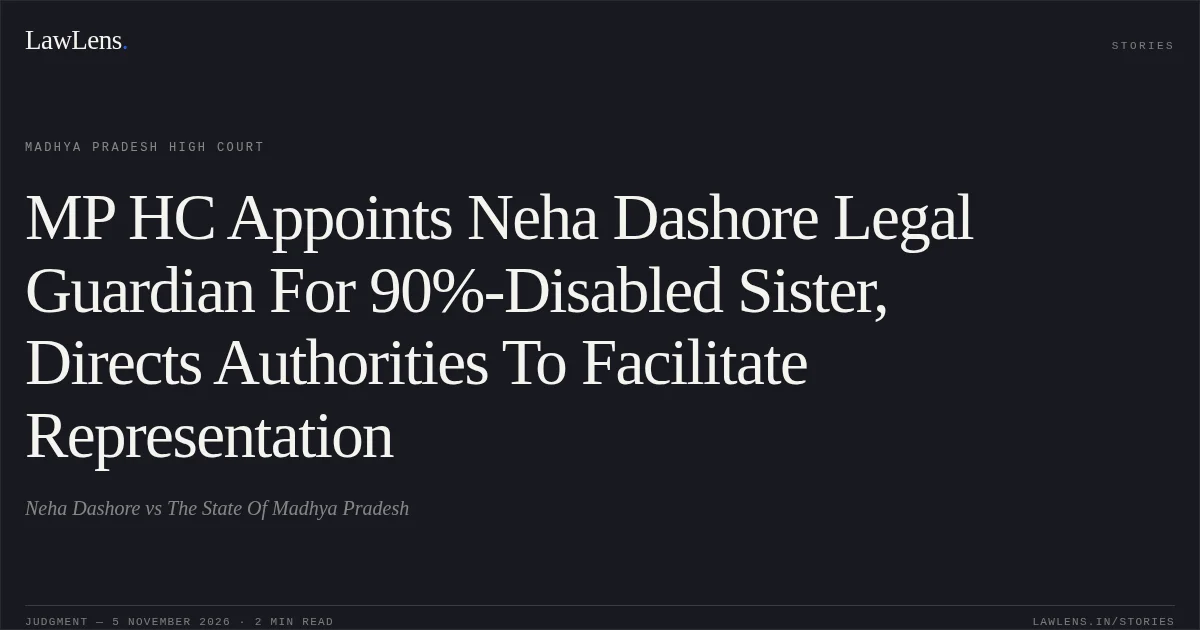
The petitioner, Neha Dashore, is the sister of Kopal Dashore.
¶ 2After the deaths of their parents, she cared for Kopal and managed her maintenance, medical treatment, welfare, and daily needs.
¶ 2Kopal had a 90% disability certificate and an intellectual disability that, according to the petitioner, prevented her from independently undertaking legal, financial, banking, medical, and administrative decisions.
¶ 3, 6The petitioner sought relief under Article 226, including recognition as legal guardian for the purpose of representing Kopal’s lawful interests before public authorities and other institutions.
¶ 102Issues
i.Whether the petitioner should be appointed as legal guardian to represent her sister’s lawful interests, given her sister’s intellectual disability and the petitioner’s caregiving role.
¶ 3, 6–7ii.Whether the authorities should be directed to facilitate the petitioner in that capacity before government and semi-government authorities, banks, financial institutions, medical institutions, and other competent authorities.
¶ 1, 703Law Applied
The Court exercised its jurisdiction under Article 226 of the Constitution and relied on the parens patriae principle, under which a constitutional court may act to protect the interests of a person unable to manage them independently.
¶ 4It referred to decisions including Philomena Leo Lobo v. Union of India, 2017 SCC OnLine Bom 8836; R. Usha v. State of Tamil Nadu, W.P. No. 13060/2020 (Madras High Court, 5 February 2021); Rajni Hariom Sharma v. Union of India, 2020 SCC OnLine Bom 880; Sairabanu Mohammad Rafi v. State of M.P., 2016 SCC OnLine Mad 8091; Sayardevi Chaudhary v. State of Tamil Nadu, W.P. No. 4238/2016 (Madras High Court, 29 June 2016); Shobha Gopalakrishnan v. State of Kerala, W.P. No. 37278/2018 (Kerala High Court, 20 February 2019); Uma Mittal v. Union of India, 2020 SCC OnLine All 777; and Vandana Tyagi v. Government of NCT of Delhi, W.P.(C) No. 11003/2019 (Delhi High Court, 7 January 2020).
¶ 4, 7The judgment does not identify a separate statutory provision governing the appointment.
04Reasoning
The Court considered the disability certificate showing 90% disability, the stated impact of Kopal’s intellectual disability, and the petitioner’s ongoing care and support.
¶ 6–7Applying the parens patriae principle and the cited decisions, it concluded that the petitioner could be appointed to represent Kopal’s lawful interests.
¶ 7The Court’s reasoning in para. 4 includes an apparent inconsistency: it states that there was no reason to exercise Article 226 jurisdiction, but para. 7 reaches the opposite conclusion and grants relief.
¶ 4, 7The operative decision is the allowance of the petition in para. 7.
¶ 705Holding
The Court allowed and disposed of the petition, appointing Neha Dashore as legal guardian for the limited purpose of representing Kopal Dashore’s lawful interests.
¶ 7–8It directed the respondent authorities and other concerned departments to facilitate her in that capacity before government and semi-government authorities, banks, financial institutions, medical institutions, and other competent authorities, to the extent permissible under law.
¶ 7–8Original Court PDF
Neha DashorevsThe State Of Madhya Pradesh
Click to open original judgment
Original judgment, available to read, download and summarize on LawLens.in