01Facts
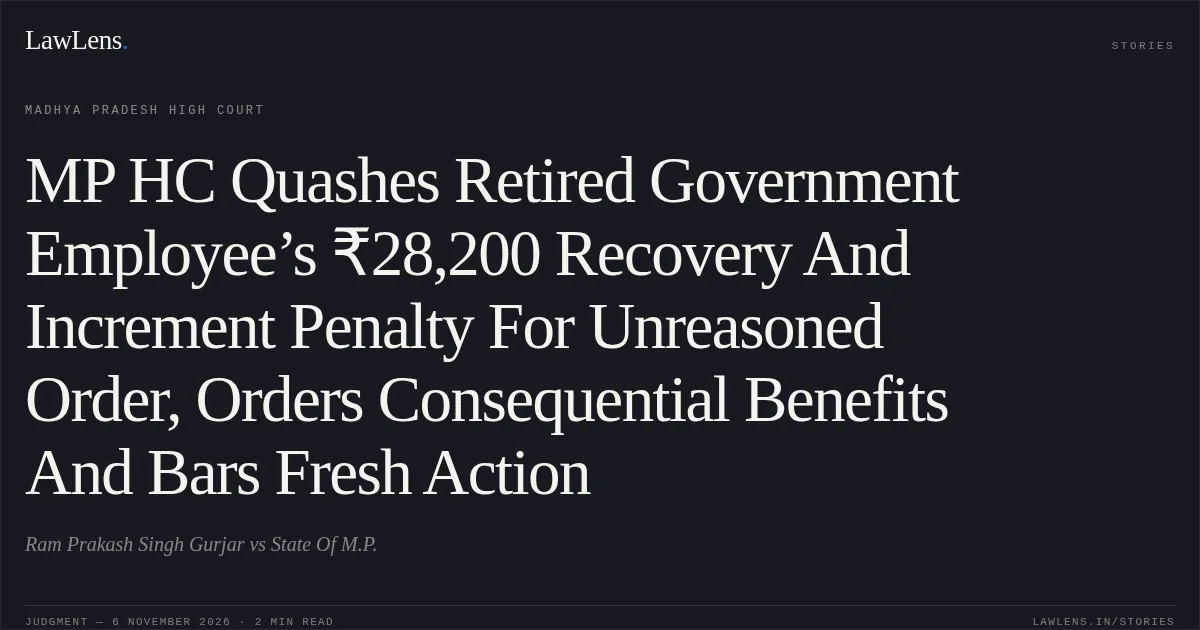
A show-cause notice was issued to the petitioner under Rule 16 of the Madhya Pradesh Civil Services (Classification, Control and Appeal) Rules, 1966.
¶ 2He submitted written explanations and attended a personal hearing.
¶ 2The Disciplinary Authority imposed recovery of ₹28,200 and withholding of one annual increment without cumulative effect.
¶ 3The petitioner’s appeal was rejected.
¶ 3He challenged both orders under Article 226, contending that they were non-speaking and failed to consider his explanations.
¶ 1, 302Issues
i.1. Whether the Disciplinary Authority’s punishment order was invalid for failing to give reasons and address the petitioner’s defence.
¶ 7–9ii.2. Whether the appellate order could cure the absence of reasons in the original punishment order.
¶ 13–1403Law Applied
The Madhya Pradesh Civil Services (Classification, Control and Appeal) Rules, 1966 governed the disciplinary proceedings and the imposition of punishment.
¶ 2, 6A quasi-judicial authority must give reasons for an order affecting a person’s rights; the reasons must show that relevant matters were considered and facilitate judicial review.
The Court relied on State of Punjab v. Bandip Singh, (2016) 1 SCC 724, for the requirement that decisions be informed by reasons.
¶ 10–11Kranti Associates Pvt. Ltd. v. Masood Ahmed Khan, (2010) 9 SCC 496, on reasoned decision-making as an element of fairness.
¶ 12Oryx Fisheries Pvt. Ltd. v. Union of India, (2010) 13 SCC 427, for the principle that reasons in an appellate order cannot remedy their absence in the original order.
¶ 1304Reasoning
The punishment order recorded that the petitioner’s explanations had been examined but concluded, without adequate reasoning, that he had produced no evidence supporting his defence.
¶ 6–8The Court held that this did not disclose the Disciplinary Authority’s consideration of the defence or the basis for imposing punishment, so the order was non-speaking.
¶ 7–9Even if the appellate order contained reasons, it could not cure that defect in the original disciplinary decision.
¶ 1305Holding
The Court allowed the challenge to the extent of setting aside the punishment order dated 23 December 2006 and the appellate order dated 20 November 2007.
¶ 14The respondents were directed to provide all consequential benefits within three months of receiving the certified copy; as the petitioner had retired, the Court granted no liberty to take further action against him.
¶ 15The petition was disposed of.
¶ 16Original Court PDF
Ram Prakash Singh GurjarvsState Of M.P.
Click to open original judgment
Original judgment, available to read, download and summarize on LawLens.in