01Facts
The petitioner claimed ownership and possession of the disputed land through successive transfers, relying on rights said to have been recognized in favour of her predecessor-in-title, Bhairavlal, in 1961.
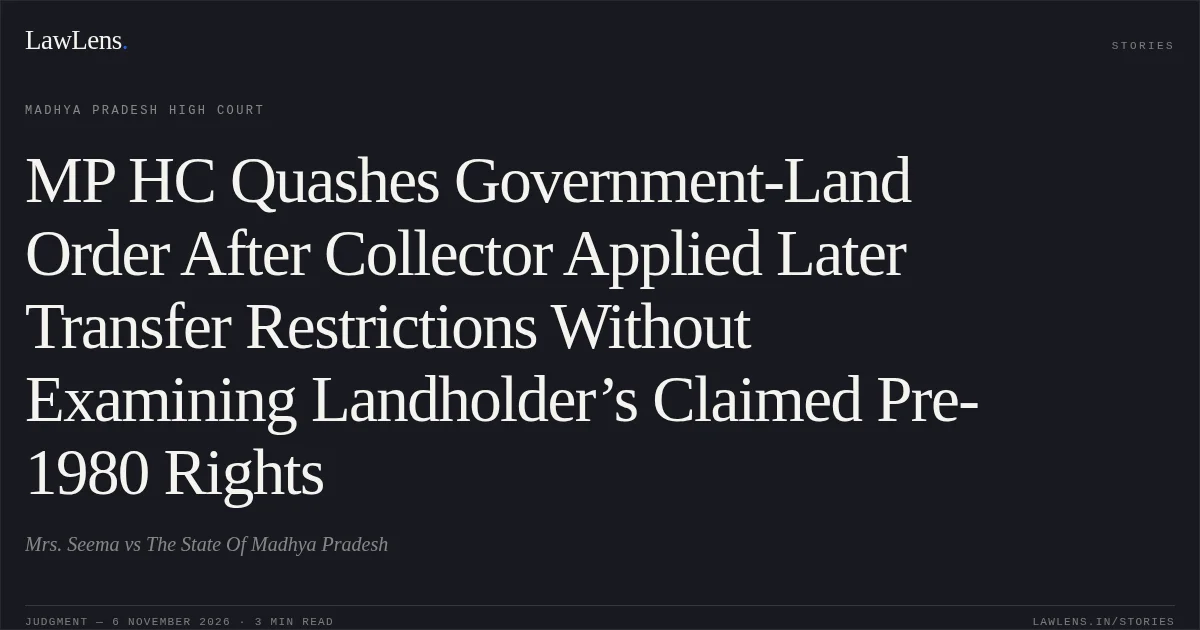
¶ 2After a Tahsildar’s report stated that 10 Bigha 10 Biswa had been recorded as Government land in the 1956–57 Bandobast records, the Collector initiated proceedings and, by order dated 6 November 2019, held that the land was originally Government land and that transfers without permission under Section 165(7-b) of the Madhya Pradesh Land Revenue Code, 1959 (“the Code”) were illegal. The Collector also directed that the remaining land in Survey No. 17/2 be declared Government land, subject to an exception, and ordered steps concerning possession and mutation entries. The petitioner challenged that order under Article 226.
¶ 202Issues
i.1. Whether Sections 158(3) and 165(7-b) of the Code could be applied to divest or restrict rights allegedly acquired before those provisions were introduced
¶ 6–7ii.2. Whether the Collector’s exercise of suo motu revisional jurisdiction was sustainable when the order did not identify when the authority acquired knowledge of the alleged illegality
¶ 8iii.3. Whether the impugned order was invalid for failing to address the petitioner’s objections and reply with cogent reasons
¶ 903Law Applied
Sections 158(3), 165(7-b), and 50 of the Code governed the dispute.
Relying on the Division Bench decision in Writ Appeal No. 275/2013 (order dated 4 March 2024), the Court held that Section 165(7-b), as a restriction affecting substantive rights, operates prospectively and cannot take away rights already accrued; the later introduction of Section 158(3) likewise cannot retrospectively divest rights acquired under the earlier law.
¶ 7The Division Bench had considered Hitendra Vishnu Thakur v. State of Maharashtra, AIR 1994 SC 2623, Zile Singh v. State of Haryana, (2004) 8 SCC 1, and K.S. Paripoornan v. State of Kerala, AIR 1995 SC 1012.
¶ 7Under Ranveer Singh v. State of Madhya Pradesh, 2010 (4) MPLJ 178, suo motu revisional powers under Section 50 must be exercised within 180 days from the authority’s knowledge of the alleged illegality, impropriety, or irregularity.
¶ 8An authority must also consider relevant material and address the affected party’s objections with reasons.
¶ 9Provisions in the judgment · 3 · Linked ones open on LawLens
MP Land Revenue Code 1959 Section 50Section 158Section 165
04Reasoning
The petitioner’s case was that her predecessor’s rights were recognized in 1961 and that later transfers followed from those rights. The Collector applied Section 165(7-b) without examining the nature of the rights acquired under the law then in force; the Court found this inconsistent with the prospective operation of the statutory restrictions established by the Division Bench.
¶ 7Further, the impugned order did not record when the authority learned of the alleged illegality, preventing the Court from finding that the 180-day limit under Ranveer Singh had been observed.
¶ 8The order also failed to deal with the petitioner’s reply and objections through reasoned findings.
¶ 9The Court did not determine the petitioner’s title; it found the impugned order legally unsustainable.
05Holding
The Court allowed the petition and quashed the Collector’s order dated 6 November 2019.
¶ 10The respondents were directed not to take coercive action against the petitioner solely on the basis of that order.
¶ 10The Court clarified that its observations did not declare title in the petitioner’s favour or resolve any independent title dispute requiring adjudication by a competent Civil Court.
¶ 11No order as to costs was made.
¶ 12Original Court PDF
Mrs. SeemavsThe State Of Madhya Pradesh
Click to open original judgment
Original judgment, available to read, download and summarize on LawLens.in