01Facts
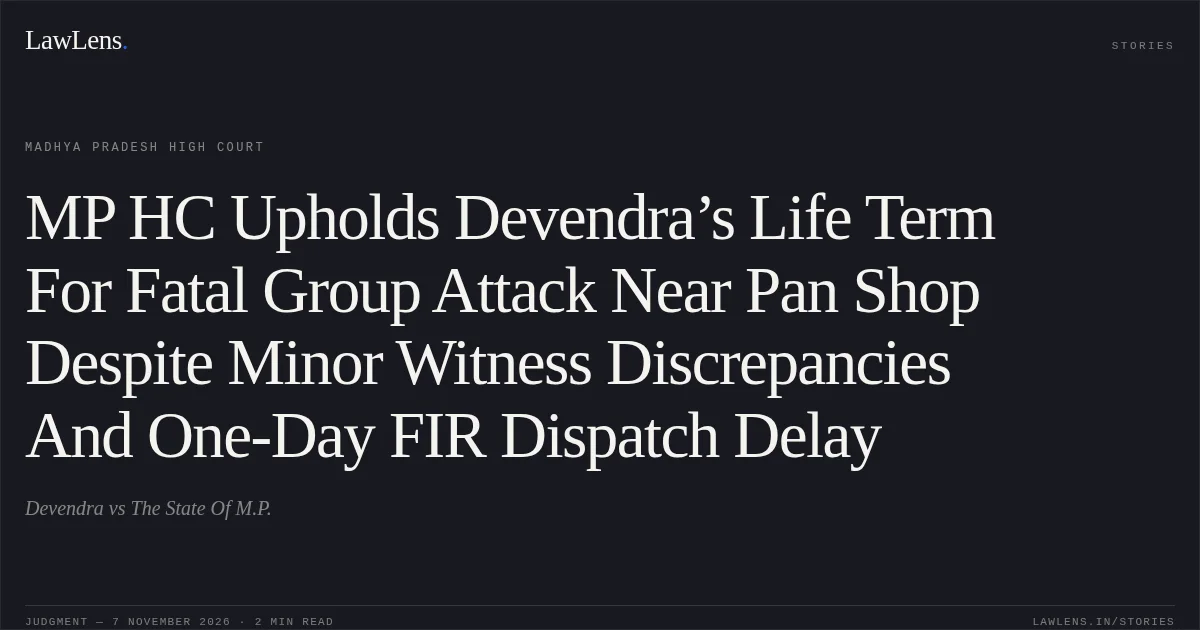
On 18 May 2000, Tuntun alias Dinesh was assaulted near a pan shop at Rannod bus stand by a group of persons.
pp. 7–9The post-mortem recorded multiple injuries caused by a hard and blunt object and identified head injuries as sufficient to cause death.
pp. 7–9The appellants—Rishi Upadhyay, Awadh and Giltu alias Ajay—were tried in S.T. No. 207/2001 and convicted under Sections 148 and 302/149 of the Indian Penal Code (IPC), with sentences including life imprisonment.
pp. 2–4, 6On appeal, they challenged, among other matters, the reliability of the two eyewitnesses, who were related to the deceased, and relied on alleged inconsistencies, non-examination of another person said to have been present, enmity, and delay in sending the FIR to the Magistrate.
pp. 6, 11, 17–18, 20, 24, 27, 30, 39–4102Issues
i.1. Whether the prosecution evidence established that the appellants participated in the assault resulting in the deceased’s death and supported their convictions under Sections 148 and 302/149 IPC
p. 8 · ¶ 13 · pp. 44–45 · ¶ 66–69ii.2. Whether the alleged inconsistencies, the eyewitnesses’ relationship to the deceased, the non-examination of another person said to have been present, or the delayed transmission of the FIR rendered the prosecution evidence unreliable
pp. 11, 17–18, 20, 24, 30, 39–4403Law Applied
Sections 148 and 302/149 IPC were applied to the alleged armed assembly and the murder committed in prosecution of its common object.
p. 2, 5The Court applied the principle that omissions and discrepancies warrant rejection of testimony only when material and sufficiently serious to affect its core or create substantial doubt; minor variations do not, by themselves, undermine credibility (*Mritunjoy Biswas v. Pranab*; *Shyamal Ghosh v. State of W.B.*).
pp. 12–16The quality, not the number, of witnesses governs proof, and failure to examine another witness does not automatically justify an adverse inference (*Sarwan Singh v. State of Punjab*; *Khema v. State of U.P.*).
pp. 21–24Related or interested testimony must be scrutinised with care, but is not to be rejected merely because of relationship or enmity if it is credible (*Raju v. State of T.N.*; *State of U.P. v. Kishanpal*).
pp. 30–39A delay in forwarding the FIR under Section 157 of the Code of Criminal Procedure (CrPC) is not, by itself, fatal absent demonstrated prejudice; the FIR’s prompt lodging and the overall evidence remain relevant to its reliability (*Jafel Biswas v. State of W.B.*).
pp. 40–44Provisions in the judgment · 6 · Linked ones open on LawLens
Indian Penal Code, 1860 Section 148Section 302Section 149
Code of Criminal Procedure, 1973 Section 157Section 161Section 162
04Reasoning
The Court found that the post-mortem evidence established a homicidal death and that Banwarilal (PW1) and Pradeep Pandey (PW10) gave direct evidence identifying the assailants.
pp. 7–11Their presence was considered natural given their proximity to the scene, and the FIR was lodged within approximately fifteen minutes of the incident, supporting their presence and reducing the likelihood of deliberation or fabrication.
pp. 26–28The differences in the witnesses’ accounts concerning the number of assailants and the precise point of attack were treated as minor in context; the non-examination of Rajiv did not displace otherwise reliable eyewitness evidence.
pp. 18–23The Court held that relationship and prior enmity called for careful scrutiny, not automatic rejection, and found no material contradiction sufficient to undermine the witnesses’ credibility.
pp. 25–26, 30–40Nor did the one-day delay in sending the FIR to the Magistrate, without demonstrated prejudice, invalidate the prosecution case.
pp. 40–4405Holding
The Court answered the issues in favour of the prosecution, affirmed the appellants’ convictions under Sections 148 and 302/149 IPC and the sentences imposed by the trial court, and dismissed both appeals.
pp. 44–45 · ¶ 66–71As the appellants were on bail, their bail bonds were cancelled and they were directed to surrender before the trial court to serve the remaining sentence.
p. 45 · ¶ 70Original Court PDF
AwadhvsThe State Of M.P.
Click to open original judgment
Original judgment, available to read, download and summarize on LawLens.in