Facts
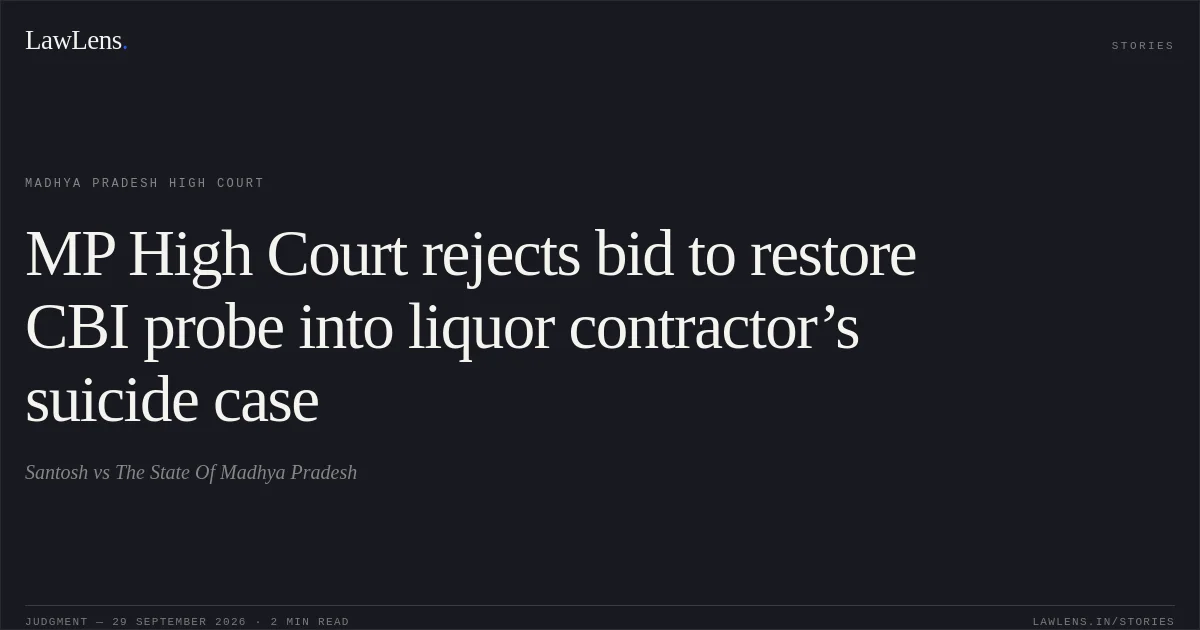
The petitioner sought review of the Division Bench’s order dated 17 July 2026 allowing respondent No. 6’s writ appeal and setting aside the Single Judge’s direction to transfer the investigation into the petitioner’s son’s death to the CBI.
Source reference: para. 3–6The Single Judge had directed the CBI to register an FIR and investigate allegations that an Excise Department officer had extorted money from the deceased, who later died by suicide.
Source reference: para. 3–6The petitioner argued that the Division Bench had overlooked the exceptional circumstances, including the alleged coercion and a video recording made by the deceased, and had wrongly relied on alternative remedies under the CrPC/BNSS.
Source reference: para. 3–6Respondent No. 6 opposed review on the ground that it sought a rehearing of issues already decided.
Source reference: para. 3–6Issues
Whether the petitioner established a ground for review under Order 47 Rule 1 CPC, including an error apparent on the face of the record or another sufficient reason.
Source reference: para. 7, 10–13Whether the grounds raised sought impermissibly to reopen the merits of the writ appeal and obtain appellate reconsideration through review.
Source reference: para. 10–13Law Applied
Order 47 Rule 1 CPC permits review on discovery of new and important matter or evidence despite due diligence, a mistake or error apparent on the face of the record, or another sufficient reason analogous to the specified grounds.
Source reference: para. 7, 10–11An apparent error must be patent and self-evident; an error requiring extended reasoning, or a merely erroneous decision, is not enough.
Source reference: para. 9–11Review is not an appeal in disguise and does not permit rehearing, reappreciation of evidence, or correction of a decision merely because another view is possible.
Source reference: para. 9–11The Court relied on Kamlesh Verma v. Mayawati, Parsion Devi v. Sumitri Devi, Meera Bhanja v. Nirmala Kumari Choudhury, Jain Studios Ltd. v. Shin Satellite Public Co. Ltd., Kerala State Electricity Board v. Hitech Electrothermics & Hydropower Ltd., Malleeswari v. K. Suguna and Shri Ram Sahu v. Vinod Kumar Rawat for these principles.
Source reference: para. 9–11The order also referred to Sections 154(3), 156(3) and 200 CrPC in describing the alternative remedies considered in the writ appeal.
Source reference: para. 12Reasoning
The Court found that the petitioner’s complaints about the treatment of the alleged video, the need for an independent investigation, and the availability of alternative remedies concerned the merits of the writ appeal rather than a patent error in its order.
Source reference: para. 10–13It concluded that the Division Bench had considered the submissions and that the review petition sought appellate reconsideration.
Source reference: para. 10–13The Court also noted that the factual and legal grounds had already been discussed in the writ appeal; their reconsideration would therefore exceed the limited review jurisdiction under Order 47 Rule 1 CPC.
Source reference: para. 10–13Holding
The Court held that no error apparent on the face of the record, or other ground warranting review, had been established.
The review petition was dismissed.
Source reference: para. 13Acts & Sections Cited
8 provisions across 2 statutes referred to in this judgment. Each provision opens on LawLens.
Code of Criminal Procedure, 19733
Code of Civil Procedure, 19085
Original Court PDF
SantoshvsThe State Of Madhya Pradesh
Click to open original judgment
Original judgment, available to read, download and summarize on LawLens.in