Facts
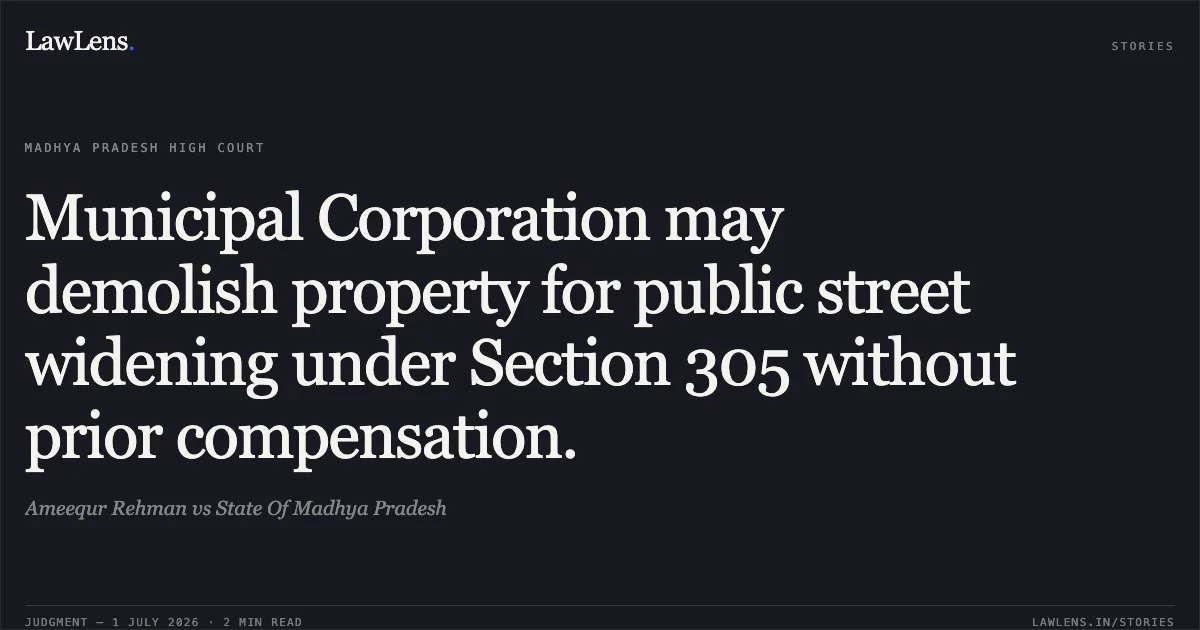
The petitioners challenged a demolition order dated June 9, 2026, and a communication dated May 5, 2026, issued by the Indore Municipal Corporation (Respondent No. 4).
Source reference: para. 1The petitioners alleged that the Corporation intended to take possession of and demolish portions of their property beyond the scope of the Master Plan without following due process or providing fair compensation.
Source reference: para. 4During the hearing, the Corporation submitted that the demolition was already 95% complete to facilitate road development and traffic management.
Source reference: para. 5, 11The petitioners argued this action violated Article 300-A and the procedural requirements of the M.P. Municipal Corporation Act, 1956.
Source reference: para. 4Issues
1. Whether the Municipal Corporation is authorized under Section 305 of the M.P. Municipal Corporation Act to demolish property for road widening beyond the Master Plan.
Source reference: para. 4, 112. Whether the demolition without prior compensation violates Article 300-A of the Constitution of India.
Source reference: para. 6, 103. Whether the petition became infructuous due to the substantial completion of the demolition process.
Source reference: para. 5, 12Law Applied
Section 305 of the M.P. Municipal Corporation Act, 1956, which empowers the Corporation to regulate building lines and provides that land added to a street through setbacks vests in the Corporation subject to reasonable compensation.
Source reference: para. 7Article 300-A of the Constitution was invoked to ensure no person is deprived of property save by authority of law.
Source reference: para. 6Kolkata Municipal Corporation v. Bimal Kumar Shah (2024).
Source reference: para. 9Ravindra Ramchandra Waghmare v. Indore Municipal Corporation (2017), which held that Section 305 is a special, valid provision for public interest that does not require the Corporation to offer compensation prior to removal and vesting.
Source reference: para. 10Reasoning
The court reasoned that while Article 300-A protects property rights, private interest must yield to public interest, specifically for urban development and traffic management.
Source reference: para. 12It found that Section 305 of the Act does not explicitly restrict the Corporation's power solely to the Master Plan and provides an inherent mechanism for vesting property in the State.
Source reference: para. 11Applying the Waghmare precedent, the court determined that the procedure under Section 305 is neither arbitrary nor onerous and that compensation can be determined and paid post-demolition as per Collector Guidelines.
Source reference: para. 10, 12Furthermore, the court noted the factual reality that 95% of the structure had already been removed, rendering the prayers for injunctive relief academic.
Source reference: para. 11-12Holding
The court answered that the Corporation’s actions were in consonance with the law and not arbitrary.
It held that the petition had become infructuous due to the near-total completion of the demolition.
Source reference: para. 12The court dismissed the writ petition, denying any interference with the respondent's actions, but noted the petitioners' entitlement to seek compensation as per the Collector Guidelines for the portion demolished.
Source reference: para. 5, 13Acts & Sections Cited
14 provisions across 5 statutes referred to in this judgment. Linked provisions open on LawLens.
CONSTITUTION (FORTY-FOURTH AMENDMENT) ACT, 19781
Land Acquisition Act, 18941
M.P. Municipal Corporation Act, 19568
M.P. Town and Country Planning Act, 19733
Taxation On Income (Investigation Commission) Act, 19471
Original Court PDF
Ameequr RehmanvsState Of Madhya Pradesh
Click to open original judgment
Original judgment, available to read, download and summarize on LawLens.in