Facts
On 6 June 2018, Shabnam Kumari and her family were travelling in the Purvanchal Express when an unidentified person allegedly snatched her purse.
Source reference: para. 3Her husband, Gautam Kumar Chaudhary, pursued the person and engaged in a scuffle with him near Rampur-Dumra Railway Station.
Source reference: para. 3The informant stated that several persons were assaulting her husband, who subsequently died.
Source reference: para. 3His body was found near the railway line on 7 June 2018, and the post-mortem recorded that his head had been severed from the root of the neck and that death resulted from haemorrhage and shock caused by injuries from a heavy, hard and blunt object.
Source reference: paras. 22, 28An FIR was initially registered against unknown persons under Sections 379 and 304 IPC. Sections 394 and 302 IPC were subsequently added.
Source reference: paras. 4–7The appellants, Pathaliya Sao and Ankaj Kumar, were later chargesheeted and convicted by the Additional Sessions Judge-XVI, Patna, under Sections 394/34 and 302/34 IPC.
Source reference: paras. 11–14They were sentenced to life imprisonment for both offences, with the sentences directed to run concurrently.
Source reference: paras. 11–14In appeal, the appellants challenged the delayed FIR, the absence of a test identification parade, the informant’s inability to witness the fatal assault, the non-examination of material witnesses, and the allegedly defective investigation.
Source reference: paras. 15–19The High Court also noted that the informant was not cross-examined on behalf of the appellants during trial and that no legal aid was provided to them at that stage.
Source reference: para. 25Issues
Whether the prosecution proved beyond reasonable doubt that the appellants participated in the robbery and murder of the deceased under Sections 394/34 and 302/34 IPC?
Source reference: paras. 22–24, 39–40Whether the informant’s in-court identification of the appellants, made several years after the occurrence and without a prior test identification parade, could safely sustain the convictions?
Source reference: paras. 24, 26, 40Whether the delayed FIR, contradictions in the informant’s testimony, non-examination of material witnesses, and defective investigation created reasonable doubt regarding the appellants’ involvement?
Source reference: paras. 26–38, 40Whether the appellants were denied a fair opportunity of cross-examining the informant when the trial court proceeded without providing them legal representation?
Source reference: para. 25Law Applied
The Court applied Sections 394 and 302 read with Section 34 of the Indian Penal Code, which respectively address voluntarily causing hurt while committing robbery or dacoity, murder committed with common intention, and joint criminal liability arising from shared intention.
Source reference: paras. 2, 7The prosecution was required to establish the appellants’ identity and participation through reliable direct or circumstantial evidence beyond reasonable doubt; suspicion, criminal antecedents, or uncorroborated police information could not substitute proof.
Source reference: paras. 36–40The Court reiterated that a test identification parade is not substantive evidence by itself, but its absence may be significant where the witness had limited opportunity to observe the offender and the subsequent dock identification is inherently unsafe.
Source reference: para. 40The Court also relied on State of Gujarat v. Kishanbhai, (2014) 5 SCC 108, regarding institutional accountability for investigative and prosecutorial lapses following an acquittal.
Source reference: paras. 44–46Reasoning
The Court accepted that the post-mortem established that the deceased had been murdered, but found no reliable evidence connecting either appellant with that crime.
Source reference: paras. 28, 39The informant had not witnessed the actual killing; she had only seen a scuffle from the moving train at night and had not stated in the written report that she could identify the offender.
Source reference: paras. 22, 26, 40Her delayed FIR, contradictory account regarding the number of mobile phones, failure to promptly report the alleged snatching to the police or family members, and the absence of any independent eyewitness weakened the prosecution case.
Source reference: paras. 23, 32–34The alleged identification of the appellants in court was considered unsafe because no test identification parade was conducted, the occurrence took place in darkness, the informant had only a brief opportunity to observe the persons involved, and the identification occurred more than three years later.
Source reference: paras. 24, 40The investigation did not cure these deficiencies: the first Investigating Officer made an inconsistent claim regarding recovery of the deceased’s mobile phone, while the second Investigating Officer relied on information from an undisclosed “spy,” recorded no witness statements, and admitted that no evidence had been found against Pathaliya Sao on the basis of the alleged confessional statement.
Source reference: paras. 35–38The non-examination of seizure-list and inquest witnesses further weakened the prosecution evidence.
Source reference: paras. 26–31Additionally, the appellants’ denial of cross-examination of the informant without provision of legal aid violated the fairness of the trial process.
Source reference: para. 25On the cumulative assessment of these deficiencies, the Court held that the convictions could not be sustained beyond reasonable doubt.
Source reference: paras. 38–40Holding
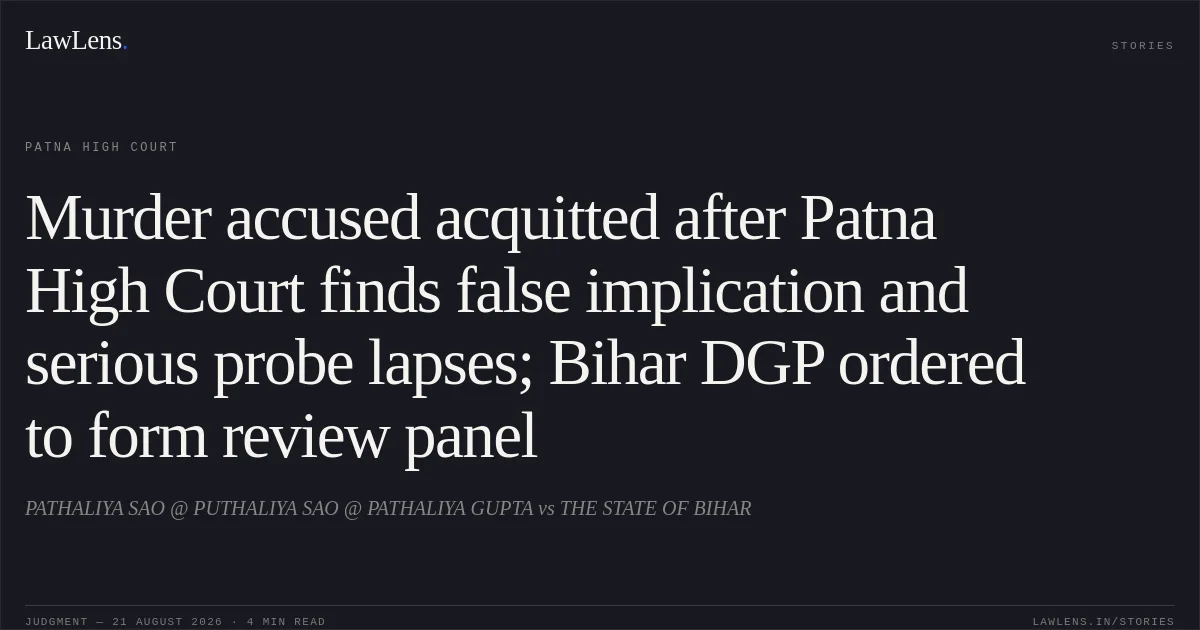
The High Court allowed both appeals and set aside the judgment of conviction dated 31 January 2023 and the order of sentence dated 17 February 2023.
The appellants were acquitted of the charges under Sections 394/34 and 302/34 IPC for want of reliable evidence and were directed to be released forthwith, unless wanted in any other case.
Source reference: paras. 41–43In view of the serious investigative deficiencies, the Court directed the Director General of Police, Bihar, to constitute a three-member committee of senior police officers to review the conduct of both Investigating Officers and to take appropriate administrative action within three months.
Source reference: paras. 45–47A copy of the judgment was also directed to be sent to the trial court and the Director General of Police, Bihar.
Source reference: paras. 48–49Acts & Sections Cited
6 provisions across 2 statutes referred to in this judgment. Each provision opens on LawLens.
Indian Penal Code, 18605
Code of Criminal Procedure, 19731
Original Court PDF
PATHALIYA SAO @ PUTHALIYA SAO @ PATHALIYA GUPTAvsTHE STATE OF BIHAR
Click to open original judgment
Original judgment, available to read, download and summarize on LawLens.in