Facts
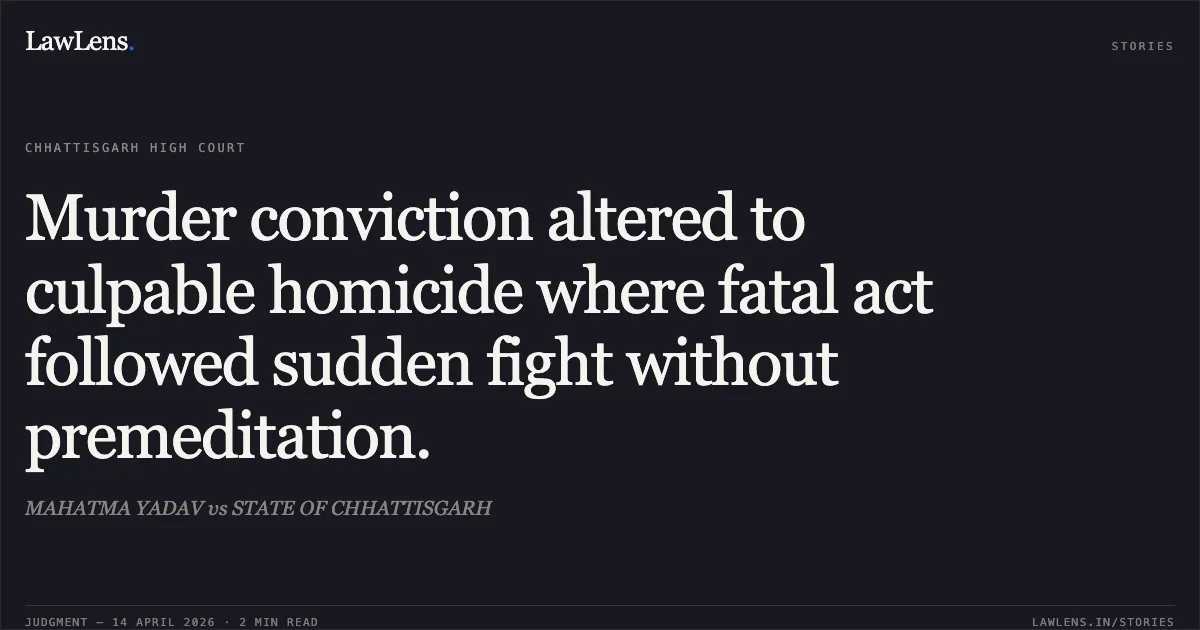
The appellant, Mahatma Yadav, was convicted of murder under Section 302 of the Indian Penal Code (IPC) for causing the death of his father, Jangli Yadav.
Source reference: para 2On the date of the incident, the appellant arrived at his parental house in a pickup vehicle and entered into a verbal altercation with his sister (PW-1) regarding the storage of firewood.
Source reference: para 3When the deceased intervened to restrain the appellant, the appellant drove the vehicle over him, causing grave injuries.
Source reference: para 3The deceased succumbed to neurogenic shock and brain injury nine days later while undergoing treatment.
Source reference: para 13The Trial Court sentenced the appellant to life imprisonment.
Source reference: para 2The appellant challenged the conviction, contending that the act occurred in the heat of passion without premeditation and should be categorized as culpable homicide not amounting to murder.
Source reference: para 9Issues
1. Whether the death of the deceased was homicidal in nature?
Source reference: para 122. Whether the appellant was the perpetrator of the crime?
Source reference: para 183. Whether the case falls under Exception 4 to Section 300 of the IPC, warranting the conversion of the conviction from Section 302 to Section 304 of the IPC?
Source reference: para 20Law Applied
The Court applied the distinction between "murder" (Section 300 IPC) and "culpable homicide" (Section 299 IPC), noting that while all murders are culpable homicides, the reverse is not true (Rampal Singh v. State of Uttar Pradesh).
Source reference: para 21It relied on Exception 4 to Section 300 IPC, which requires four conditions: (i) a sudden fight, (ii) absence of premeditation, (iii) an act committed in the heat of passion, and (iv) no undue advantage or cruelty by the offender (Arjun v. State of Chhattisgarh; Rambir v. State (NCT of Delhi)).
Source reference: para 27, 29The Court further applied the "intention vs. knowledge" test established in Anbazhagan v. State, where an act done with the knowledge that death is likely, but without premeditated intent, may fall under Section 304 IPC.
Source reference: para 30Reasoning
The Court affirmed the Trial Court's finding that the death was homicidal based on medical testimony from PW-12, who cited brain injury and fractures as the cause of death.
Source reference: para 13, 17It also upheld the appellant's identity as the perpetrator based on the eyewitness testimony of the deceased's granddaughter (PW-2).
Source reference: para 18-19It observed that the incident arose from a "sudden quarrel" over firewood storage with no evidence of prior enmity or premeditation.
Source reference: para 31The Court found that while the appellant had the intention to cause bodily injury likely to cause death, the act was committed in the "heat of passion".
Source reference: para 31Since the appellant did not act in a "cruel or unusual manner" and the incident satisfied all four ingredients of Exception 4 to Section 300 IPC, the Court determined the offense was culpable homicide not amounting to murder.
Source reference: para 31-32Holding
The Court partly allowed the appeal, setting aside the conviction under Section 302 IPC.
It held that the appellant’s conduct fell within Exception 4 to Section 300 IPC.
Source reference: para 31Consequently, the conviction was altered to Section 304 Part-I of the IPC.
Source reference: no citationThe Court modified the sentence from life imprisonment to 10 years of rigorous imprisonment, noting the appellant had already served approximately six years in jail.
Source reference: para 32-33Acts & Sections Cited
6 provisions across 2 statutes referred to in this judgment. Each provision opens on LawLens.
Indian Penal Code, 18604
Code of Criminal Procedure, 19732
Original Court PDF
MAHATMA YADAVvsSTATE OF CHHATTISGARH
Click to open original judgment
Original judgment, available to read, download and summarize on LawLens.in