Facts
The Respondent filed a complaint under Section 138 of the Negotiable Instruments Act, alleging that the Revisionist borrowed a friendly loan of ₹5,00,000 on 25.03.2015
Source reference: p. 1-2To discharge this liability, the Revisionist issued a cheque dated 16.02.2016, which was dishonored by HDFC Bank due to "insufficiency of funds"
Source reference: p. 2Despite a statutory notice, the amount remained unpaid. The Trial Court convicted the Revisionist on 17.09.2022, sentencing him to imprisonment till the rising of the court and a compensation of ₹7,40,000 (with 8% interest p.a.), with a default sentence of four months' simple imprisonment
Source reference: p. 2The Appellate Court upheld this conviction on 21.09.2023
Source reference: p. 1The Revisionist challenged these orders on the grounds that the loan was not reflected in income tax returns and that the cheque was misused following a separate property dispute
Source reference: p. 2-3Issues
1. Whether the failure of the complainant to file income tax returns reflecting the loan transaction is fatal to a conviction under Section 138 of the Negotiable Instruments Act.
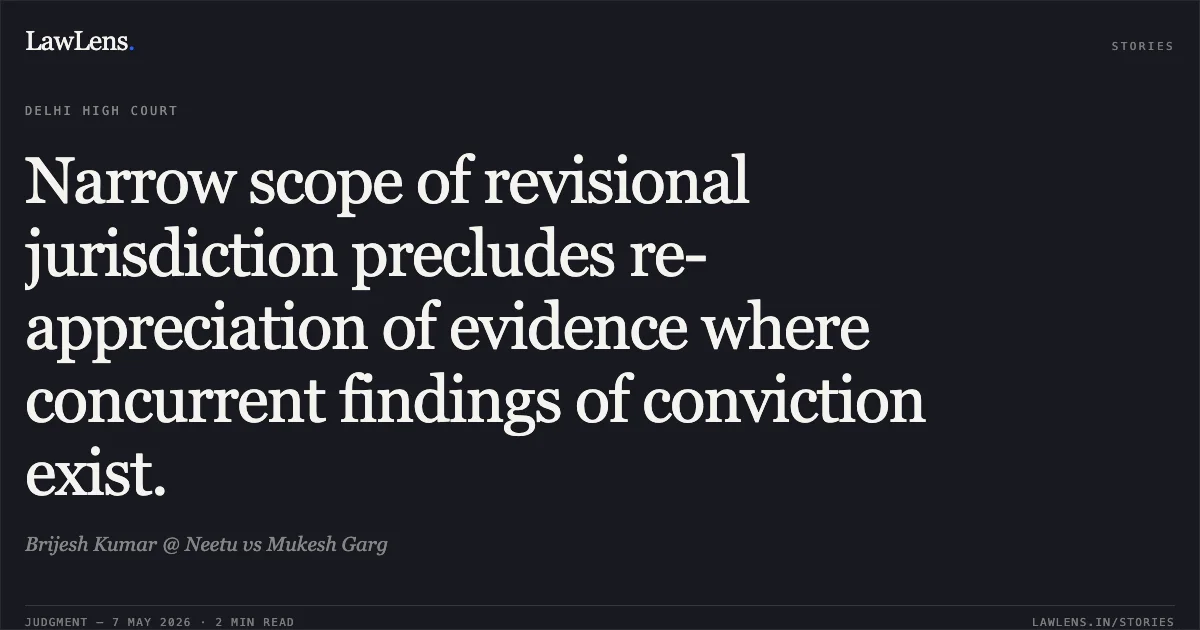
Source reference: p. 22. Whether the High Court, in its revisional jurisdiction, can re-appreciate evidence or interfere with concurrent findings of lower courts in the absence of perversity.
Source reference: p. 3Law Applied
The court primarily applied Section 138 of the Negotiable Instruments Act regarding the dishonor of cheques for insufficiency of funds
Source reference: p. 2It adhered to the principles governing Revisional Jurisdiction, which stipulate that unlike an appellate court, a revisional court cannot re-appreciate evidence unless there is visible perversity, incorrectness, illegality, or impropriety in the sub-ordinate court's judgment
Source reference: p. 3, 4Furthermore, the court relied on the principle that the mere filling of particulars on a signed cheque by a complainant does not constitute material alteration if the signatures are admitted
Source reference: p. 4Reasoning
The Court observed that the Revisionist’s defenses were inconsistent; while he argued misuse of a "property dispute" cheque before the High Court, his defense before the Trial Court was that blank signed cheques were stolen from his office drawer
Source reference: p. 3The Court noted that the Revisionist admitted to signing the cheque and, during his Section 313 CrPC statement, admitted to receiving the statutory notice—contradicting his previous claims
Source reference: p. 4Regarding the income tax argument, the Court found it insufficient to unsettle the conviction. The Court determined that the Trial and Appellate courts had conducted a detailed analysis of the evidence and precedents, and since the Revisionist failed to demonstrate any "perversity" or "illegality" in those findings, there was no ground for interference under revisional jurisdiction
Source reference: p. 4Holding
The High Court answered the issues in the negative, holding that there was no illegality or impropriety in the concurrent findings of the lower courts
The Court dismissed the revision petition as "frivolous" and upheld both the conviction and the sentence. The Revisionist was ordered to pay the respondent a litigation cost of ₹10,000 within three days, failing which the Trial Court was directed to ensure the execution of the default sentence
Source reference: p. 4-5Acts & Sections Cited
2 provisions across 2 statutes referred to in this judgment. Each provision opens on LawLens.
Negotiable Instruments Act, 18811
Code of Criminal Procedure, 19731
Original Court PDF
Brijesh Kumar @ NeetuvsMukesh Garg
Click to open original judgment
Original judgment, available to read, download and summarize on LawLens.in