01Facts
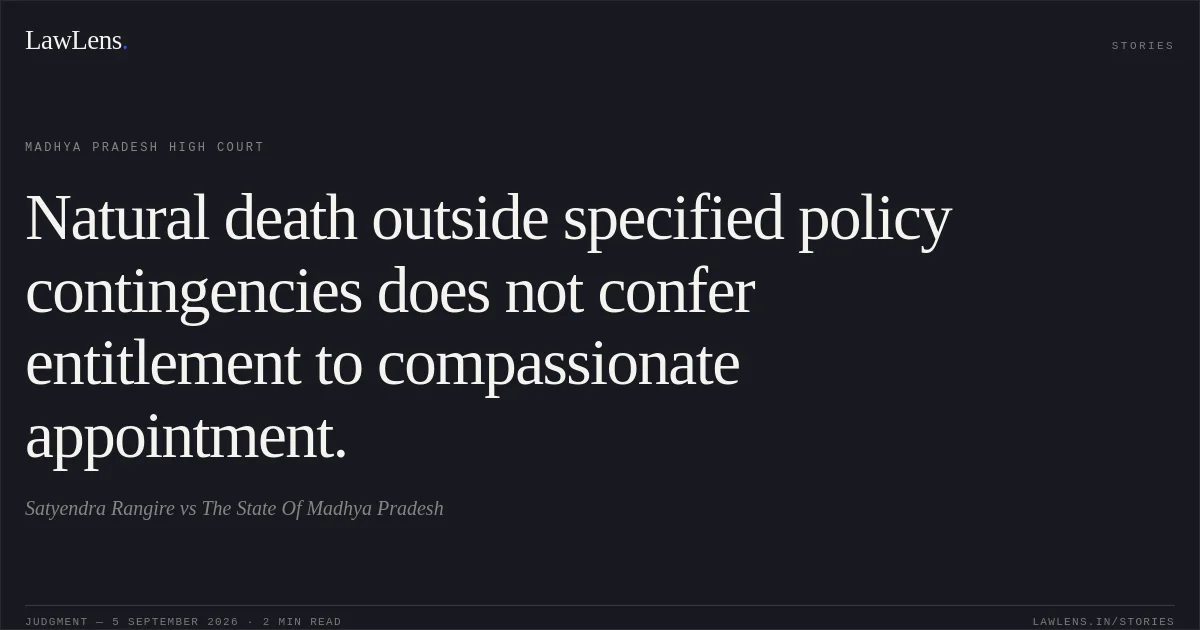
The petitioner’s father was appointed in the respondent department in May 1989 and died while in service on 26 March 2010.
¶ 1–2The petitioner claimed eligibility for compassionate appointment and asserted that he submitted representations dated 25 May 2010, 16 September 2013 and 11 June 2018.
¶ 1–2His claim was rejected by order dated 21 June 2018 on the ground that compassionate appointment was not permissible under the applicable policy.
¶ 1–2The petitioner challenged the rejection under Article 226 of the Constitution and sought quashing of the order and appointment with consequential benefits.
¶ 1–2The respondents relied on the policy of Madhya Pradesh Transmission Company Limited, under which compassionate appointment was available in specified circumstances, including death due to an accident, electrocution, assault, or a motor-vehicle accident during the course of employment.
¶ 4–502Issues
i.Whether the petitioner was entitled to compassionate appointment under the applicable policy despite his father’s death being a natural death in the ordinary course and not arising from any specified employment-related contingency
¶ 4–5, 7ii.Whether the rejection order dated 21 June 2018 was illegal, arbitrary or otherwise liable to be quashed under Article 226 of the Constitution
¶ 1, 7–803Law Applied
The Court applied Article 226 of the Constitution, under which interference with an administrative decision is warranted only where the decision is illegal, arbitrary, or contrary to the governing policy.
¶ 1, 8It applied the compassionate-appointment policy of the Madhya Pradesh Transmission Company Limited, which restricts eligibility to dependants of employees whose death occurred in specified circumstances, including an accident, electrocution, assault by miscreants, or a motor-vehicle accident while on duty or in the course of employment.
¶ 4Compassionate appointment is therefore governed by the applicable policy and cannot be claimed as an unrestricted or automatic right outside its prescribed conditions.
¶ 4–5, 704Reasoning
The Court found that the petitioner neither pleaded nor produced any material showing that his father died due to an accident, electrocution, assault, motor-vehicle accident, or any other employment-related contingency covered by the policy.
¶ 7The record instead indicated that the death was natural and occurred in the ordinary course.
¶ 7Since the petitioner’s case did not satisfy the policy conditions, the respondents’ rejection of his claim was consistent with the governing rules.
¶ 7–8In the absence of evidence establishing a qualifying contingency, the Court held that it could not substitute its view for that of the competent authority or interfere under Article 226.
¶ 7–805Holding
The Court answered both issues against the petitioner.
¶ 8–9It held that the petitioner was not entitled to compassionate appointment because his father’s death did not fall within any of the contingencies specified in the applicable policy.
¶ 8–9The order dated 21 June 2018 was held to be lawful and free from any jurisdictional or legal infirmity.
¶ 8–9The writ petition was consequently dismissed as meritless, with no direction for appointment or consequential benefits.
¶ 8–9Original Court PDF
Satyendra RangirevsThe State Of Madhya Pradesh
Click to open original judgment
Original judgment, available to read, download and summarize on LawLens.in