Facts
The Appellants (tenants) challenged a First Appellate Court judgment which affirmed a Trial Court decree for recovery of possession and arrears of rent in favor of the Respondents (landlords).
Source reference: p. 3The suit property, 75 sq. yards in Khampur Village, New Delhi, was originally let out in 1955 at a monthly rent of Rs. 117.
Source reference: p. 3The Respondents terminated the tenancy via legal notice in 2005.
Source reference: p. 4The Appellants contended that while the land was initially vacant, they had raised permanent residential structures with oral permission, thereby bringing the property under the protection of the Delhi Rent Control (DRC) Act, 1958, and creating an irrevocable license under Section 60(b) of the Indian Easements Act, 1882.
Source reference: p. 4Issues
1. Whether the suit was barred by Section 50 of the Delhi Rent Control Act, 1958, given the subsequent residential construction on the land.
Source reference: p. 10, para 37(i)2. Whether the tenancy/license became irrevocable under Section 60(b) of the Indian Easements Act, 1882, due to the execution of permanent works and incurred expenses.
Source reference: p. 10, para 37(ii)Law Applied
Section 50 of the Delhi Rent Control Act, 1958, which bars civil court jurisdiction for "premises" (excluding vacant land) where rent is below Rs. 3,500.
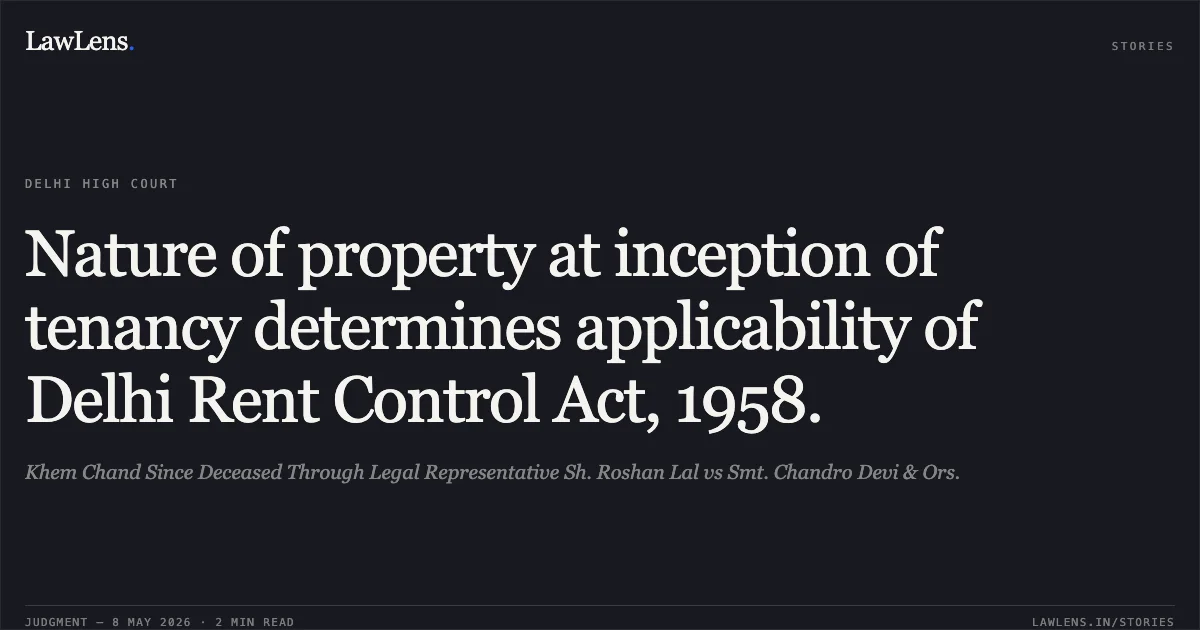
Source reference: p. 4, 11The principle that the nature of the property at the inception of the tenancy determines the applicability of the DRC Act.
Source reference: p. 12Section 60(b) of the Indian Easements Act, 1882, which renders a license irrevocable only if the licensee, "acting upon the license," executed work of a permanent character and incurred expenses.
Source reference: p. 15Associated Hotels of India Ltd. v. R.N. Kapoor, to distinguish between lease and license.
Source reference: p. 14Shankar Gopinath Apte v. Gangabai Hariharrao Patwardhan to establish that construction must be executed specifically in the capacity of a licensee to claim irrevocability.
Source reference: p. 16Reasoning
The Court found that the Appellant (DW-1) admitted the suit property was vacant land at the time of letting in 1955.
Source reference: p. 11, para 39The Court analyzed the rent receipts (Ex.PW-1/D1 and D2) and noted that while the term "residential" was used, the word "premises" was struck out and "vacant land" was explicitly retained, confirming the landlord's intent to let land, not a building.
Source reference: p. 12On the second issue, the Court held that the Appellants failed to prove an independent license. Even if the construction was permanent, it was not "acting upon the license" as required by law; rather, it was a tenant raising structures without written permission.
Source reference: p. 17-18The Court observed that the structure (built with 'kadi' and 'silli') was temporary and that mere oral claims of permission do not satisfy the strict evidentiary burden of Section 60(b).
Source reference: p. 18-19Holding
Since the inception of the tenancy involved vacant land, the DRC Act did not apply, and the Civil Court had jurisdiction.
No irrevocable license was created under Section 60(b) of the Easements Act because the Appellant failed to prove the construction was authorized or permanent in nature.
Source reference: p. 19-20The High Court dismissed the Second Appeal and the concurrent findings of the lower courts were upheld.
Source reference: p. 20Acts & Sections Cited
8 provisions across 4 statutes referred to in this judgment. Each provision opens on LawLens.
Code of Civil Procedure, 19083
delhi rent control act, 19581
Indian Easements Act, 18822
Transfer of Property Act, 18822
Original Court PDF
Khem Chand Since Deceased Through Legal Representative Sh. Roshan LalvsSmt. Chandro Devi & Ors.
Click to open original judgment
Original judgment, available to read, download and summarize on LawLens.in