Facts
Cheers Interactive (India) Private Limited was a closely held family company operating in the market-research/KPO sector and was treated by both sides as a quasi-partnership.
Source reference: paras. 2.6–2.12The original shareholders and founders were Respondent No. 2, Hitesh Shah; Respondent No. 3, Chunilal Shah; and Appellant No. 2, Jigna Shah. Following gifts of shares by Respondent No. 3, Appellant No. 2 held approximately 53.67%, Respondent No. 2 held 40.19%, and Respondent No. 3 held approximately 0.44% of the company.
Source reference: paras. 2.6–2.10; pp. 20–21Appellant No. 1, Nayan Shah, was the company’s CEO but was not a shareholder, while Respondent No. 2 had acted as its COO and participated in its management.
Source reference: paras. 2.1–2.5; para. 9Disputes arose between the two family groups regarding management, remuneration, access to records, board meetings, competing businesses, and alleged diversion of employees and clients.
Source reference: paras. 3.1–3.2; pp. 6–16On 13 October 2022, the parties entered into a settlement under which Respondent No. 2 was to exit the company against payment of ₹60 crore by 27 January 2023.
Source reference: paras. 11–14; pp. 21–23The balance consideration was not paid. Respondent No. 2 subsequently offered either to complete the exit or to purchase Appellant No. 2’s shares at the agreed consideration with a 10% premium.
Source reference: para. 13; pp. 22–23Respondent No. 2 filed a petition under Sections 241 and 242 of the Companies Act, 2013, alleging oppression and mismanagement, exclusion from management, non-payment of remuneration, denial of access to records, and improper conduct of the company’s affairs.
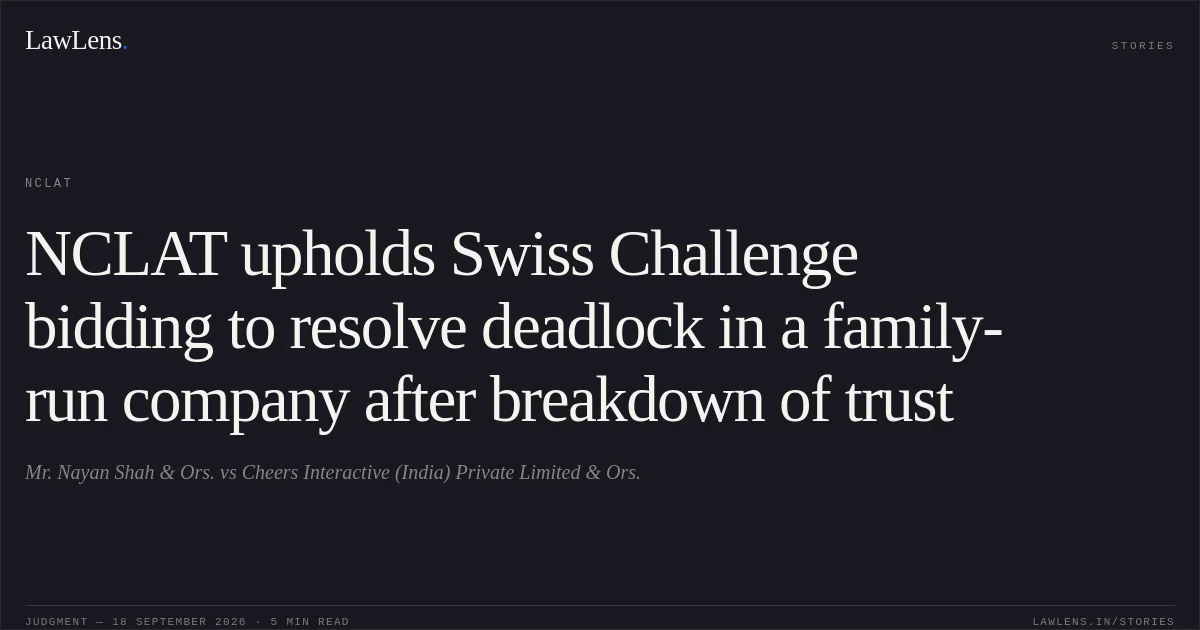
Source reference: paras. 3.1–3.2The NCLT found a breakdown of trust and confidence and directed both groups to participate in a Swiss Challenge bidding process for the purchase of the other group’s shareholding, under the supervision of an independent observer.
Source reference: para. 3.3; pp. 4–6Issues
Whether the exclusion of Respondent No. 2 from the company’s management, cessation of remuneration, and denial of access to company records constituted oppression and mismanagement in a family-owned company having the character of a quasi-partnership?
Source reference: paras. 15–17; pp. 23–26Whether Respondent No. 2 had vacated his office as director under Section 167(1)(b) of the Companies Act, 2013, by failing to attend board meetings?
Source reference: para. 15; pp. 23–25Whether Respondent No. 2’s establishment of competing businesses and alleged employee/client solicitation amounted to breach of fiduciary duties or otherwise disentitled him to relief?
Source reference: paras. 12, 14, 16; pp. 21–26Whether the NCLT was authorised under Section 242(2)(b) of the Companies Act, 2013, to direct an inter se Swiss Challenge bidding process for the purchase of shares by one shareholder group from the other?
Source reference: paras. 20–23; pp. 27–29Whether the bidding direction was contrary to Articles 11 and 12 of the company’s Articles of Association, which prescribed pre-emptive rights in relation to transfer of shares?
Source reference: paras. 18–20; pp. 26–28Law Applied
The Tribunal applied Sections 241 and 242 of the Companies Act, 2013, which empower the NCLT to grant relief against oppressive and prejudicial conduct and, under Section 242(2)(b), to order the purchase of shares or interests of members by other members or by the company.
Source reference: paras. 17, 22; pp. 25–29It applied Section 167(1)(b), holding that vacation of office for non-attendance requires valid notice of the relevant board meetings; absence from meetings for which notice was not proved cannot result in statutory vacation of office, relying on Raj Singh Chopra v. Jagat Singh Chopra, (2018) 206 Comp Cas 440.
Source reference: para. 15; pp. 23–25The Tribunal also recognised the equitable principles applicable to a closely held family company functioning as a quasi-partnership, particularly the legitimate expectation of substantial shareholders to participate in management and receive the economic benefits of the enterprise.
Source reference: paras. 9–10, 17; pp. 20–26Articles 11 and 12 were interpreted as providing a pre-emptive mechanism for transfer of shares, which was substantially satisfied by the parties’ settlement and subsequent buyout offers.
Source reference: paras. 18–19; pp. 26–27The Tribunal distinguished Rajeev Kapur v. Grentex because the present settlement expressly contained no non-compete restriction.
Source reference: para. 20; pp. 27–28It further relied on M.S.D.C. Radharamanan v. M.S.D. Chandrasekara Raja, (2008) 6 SCC 750; Yashovardhan Saboo v. Groz-Beckert Saboo Ltd.; G. Govindraj v. Venture Graphics (P) Ltd.; and the authorities approving Swiss Challenge mechanisms, including Ravi Development v. Shree Krishna Prathisthan, (2009) 7 SCC 462, to uphold a fair and transparent buyout process.
Source reference: paras. 20–23; pp. 27–29Reasoning
The NCLAT held that Respondent No. 2 was a founder and substantial shareholder holding over 40% of the company, and that the company’s quasi-partnership character gave rise to a legitimate expectation of participation in management and receipt of the economic benefits historically paid through remuneration.
Source reference: paras. 9–10, 17; pp. 20–26His exclusion from management, stoppage of remuneration, denial of records, and the taking of material financial decisions without his participation supported the finding of oppression.
Source reference: para. 17; p. 26The allegation that Respondent No. 2 had vacated office under Section 167 was rejected because the appellants failed to prove service of notices of the board meetings or minutes upon him.
Source reference: para. 15; pp. 23–25The company’s own statutory filings continued to show him as a director.
Source reference: para. 15; pp. 23–25Similarly, the competing-business allegations did not defeat his claim: the 13 October 2022 settlement expressly permitted competition and prohibited only use of company data.
Source reference: paras. 12, 14, 16; pp. 21–26No evidence established misuse of confidential information or direct solicitation of employees; the departure of employees, by itself, was insufficient to establish poaching.
Source reference: paras. 12, 14, 16; pp. 21–26The Tribunal further held that the settlement and subsequent offers were consistent with the pre-emptive rights under Articles 11 and 12.
Source reference: paras. 18–19; pp. 26–27Given the admitted irretrievable breakdown of trust and the fact that both groups were experienced and willing to run the company, an inter se Swiss Challenge process was considered a fair, transparent, and commercially appropriate method of determining value.
Source reference: paras. 20–23; pp. 27–29Section 242(2)(b) empowered the NCLT to structure such a buyout remedy, and the order did not compulsorily direct one predetermined group to sell to the other.
Source reference: paras. 20–23; pp. 27–29Holding
The NCLAT dismissed the appeal and upheld the NCLT’s order directing the two shareholder groups to participate in a Swiss Challenge bidding process for the purchase of the other group’s shares under the supervision of an independent observer.
It held that Respondent No. 2 had not been shown to have vacated his directorship under Section 167, that the allegations concerning competition and misuse of company data were unsupported by sufficient evidence, and that the appellants’ conduct amounted to oppression in the context of the company’s quasi-partnership structure.
Source reference: paras. 15–17; pp. 23–26The interim orders were vacated, pending interlocutory applications were closed, and no order as to costs was made.
Source reference: para. 24; p. 29Acts & Sections Cited
5 provisions across 1 statute referred to in this judgment. Each provision opens on LawLens.
Companies Act, 20135
Original Court PDF
Mr. Nayan Shah & Ors.vsCheers Interactive (India) Private Limited & Ors.
Click to open original judgment
Original judgment, available to read, download and summarize on LawLens.in