Facts
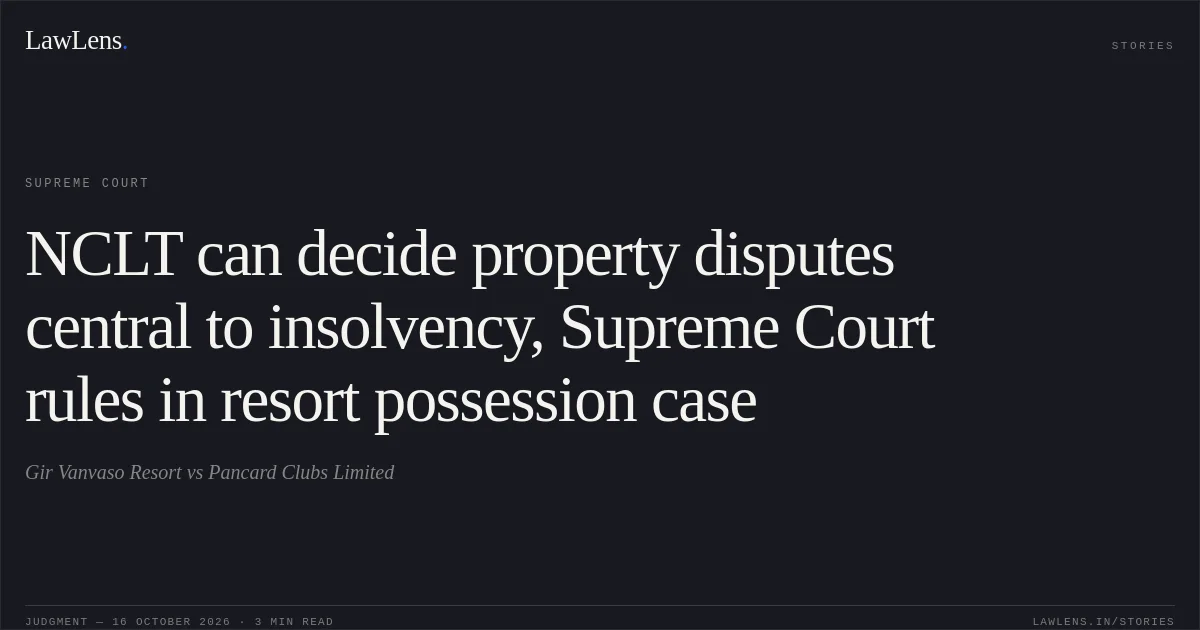
Pancard Clubs Limited, the corporate debtor, owned a developed resort.
Source reference: p. 1–3During the corporate insolvency resolution process (CIRP), the Interim Resolution Professional (later the Resolution Professional) sought information about the property and, after receiving no satisfactory response, applied to the NCLT for vacant possession and usage charges.
Source reference: p. 1–3The appellant claimed possession and ownership through an MoU said to have been executed in 2013, under which ₹80 lakh was allegedly paid in cash to a company director.
Source reference: p. 1–3The NCLT ordered vacant possession and payment of fair usage charges, while permitting the respondent to claim its alleged investment as a set-off.
Source reference: p. 1–3The NCLAT dismissed the appeal.
Source reference: p. 1–3After approval of the resolution plan, the Successful Resolution Applicant (SRA) was substituted for the Resolution Professional in the pending proceedings.
Source reference: p. 1–3Issues
1. Whether the NCLT could continue to determine the Resolution Professional’s pending application after approval of the resolution plan and substitution of the SRA.
Source reference: p. 32. Whether the NCLT had jurisdiction under the IBC to determine the appellant’s asserted rights under the MoU, including the claim to protection under Section 53A of the Transfer of Property Act, 1882.
Source reference: p. 3–63. Whether the MoU and the alleged possession established a right to retain the resort or invoke Section 53A.
Source reference: p. 6–114. Whether the directions to hand over possession and pay usage charges were sustainable.
Source reference: p. 2, 5–6, 115. Whether the MoU’s alleged undervaluation for stamp duty required further action.
Source reference: p. 11–12Law Applied
Section 60(5)(c) of the Insolvency and Bankruptcy Code, 2016 permits the NCLT to decide disputes that arise solely from, or relate to, the corporate debtor’s insolvency, but does not confer general jurisdiction over unrelated contractual disputes.
Source reference: p. 4–5Gujarat Urja Vikas Nigam Ltd. v. Amit Gupta, (2021) 7 SCC 209, recognizes NCLT jurisdiction where the dispute has the requisite insolvency nexus; Tata Consultancy Services Ltd. v. Vishal Ghisulal Jain, (2021) ibclaw.in 167 SC, cautions against using that jurisdiction to resolve ordinary contractual disputes, while recognizing the significance of contracts central to the CIRP.
Source reference: p. 4–5Section 53A of the Transfer of Property Act protects a transferee in possession in part performance only where the statutory requirements—including a contract to transfer immovable property for consideration and established part performance—are met.
Source reference: p. 7–11The Court also considered Section 17(aa) of the Registration Act, 1908, as amended in Gujarat, requiring registration of instruments purporting or operating to effect a contract for transfer of immovable property; the SEBI attachment and Rule 48 of the Second Schedule to the Income Tax Act, 1961, which restrict transfer or benefit under a transfer or charge; and the applicable Stamp Act requirements for instruments produced before a court or tribunal.
Source reference: p. 7–11Reasoning
The NCLT could proceed because the Resolution Professional’s application pre-dated approval of the resolution plan and the SRA was substituted to continue it.
Source reference: p. 3–11The ownership and possession of the resort were central to the corporate debtor’s assets and insolvency resolution, giving the NCLT jurisdiction to consider the MoU-based claim.
Source reference: p. 3–11On the merits, the MoU was unclear as to whether default would transfer ownership or merely permit operation of the resort to recover an investment; it was unregistered, and the alleged ₹80 lakh cash payment was unsupported by reliable company records.
Source reference: p. 3–11The Court also noted the SEBI attachment, the absence of evidence that the contractual options had been exercised or that possession was taken in accordance with the MoU, and the absence of a specific-performance claim or pleaded readiness to pay any balance consideration.
Source reference: p. 3–11These matters defeated the asserted Section 53A protection.
Source reference: p. 3–11The appellant therefore had no basis to retain the property, and the party in possession could be required to pay usage charges to the rightful owner.
Source reference: p. 3–11The apparent stamp-duty undervaluation separately warranted examination by the NCLT.
Source reference: p. 3–11Holding
The Supreme Court found no reason to interfere with the NCLAT’s decision and rejected the appeal.
It upheld the directions for vacant possession to be handed over to the SRA and for usage charges to be paid.
Source reference: p. 11–12It also directed the NCLT to examine the MoU under the stamp law applicable in Gujarat and, if it was undervalued, to refer it to the District Collector or other competent adjudicating authority for proper stamping and any applicable penalty; the appellant’s representative could appear before the NCLT on that limited issue.
Source reference: p. 11–12Acts & Sections Cited
2 provisions across 2 statutes referred to in this judgment. Each provision opens on LawLens.
Insolvency and Bankruptcy Code, 2016.1
Registration Act, 19081
Original Court PDF
Gir Vanvaso ResortvsPancard Clubs Limited
Click to open original judgment
Original judgment, available to read, download and summarize on LawLens.in