Facts
Customs officials conducting routine screening of passengers arriving at LGBI Airport, Guwahati, from Vientiane, Laos, detected a suspicious item in the petitioner’s baggage on 22 September 2025. The petitioner claimed ownership of the baggage and stated that it contained only personal belongings. On dismantling a hard-case trolley bag, Customs officials allegedly recovered two concealed packages containing a white powdered substance suspected to be heroin, weighing approximately 2,540 grams, a commercial quantity under the NDPS Act.
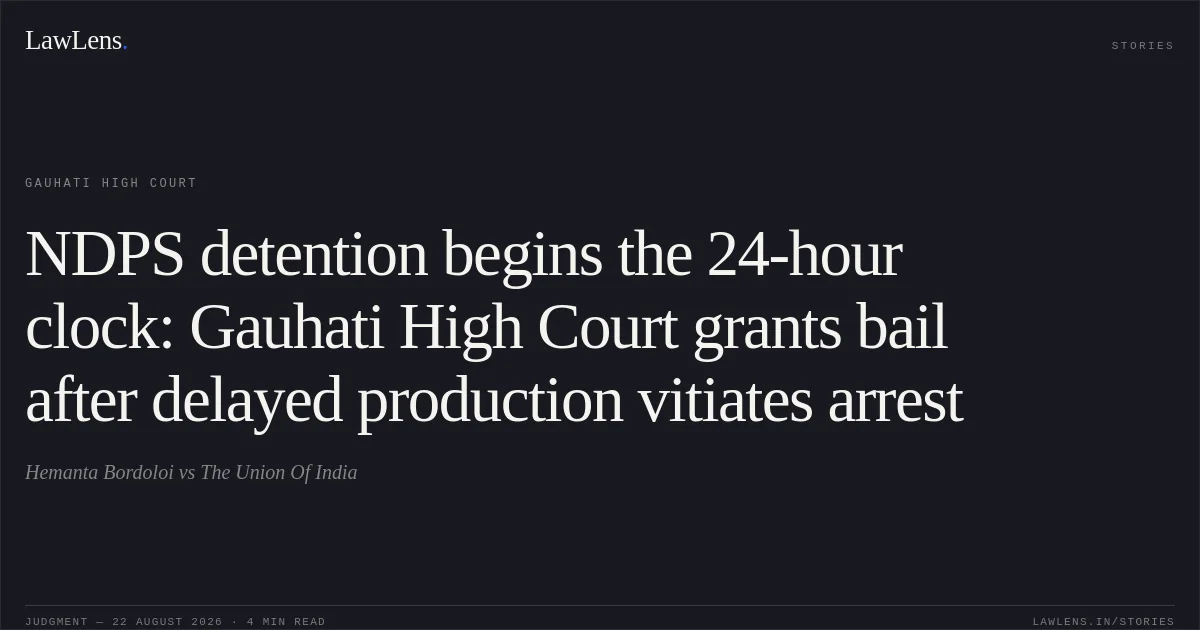
Source reference: p. 2–4The Customs Department stated that the petitioner was detained at approximately 1:30 a.m. on 23 September 2025 and was formally arrested at approximately 4:30 p.m. on the same day under Section 42 of the NDPS Act. He was produced before the Chief Judicial Magistrate, Kamrup (M), only after 10:30 a.m. on 24 September 2025. The petitioner sought bail under Section 483 of the Bharatiya Nagarik Suraksha Sanhita, 2023, contending that his production before the Magistrate occurred beyond the constitutionally permissible period of 24 hours and that the safeguards under Sections 47 and 48 of the BNSS had not been complied with.
Source reference: p. 4–5, 13Issues
1. Whether the period of 24 hours prescribed under Article 22(2) of the Constitution and Section 58 of the BNSS is to be calculated from the petitioner’s initial detention, rather than from the time of his formal arrest
Source reference: p. 6, 8–132. Whether the petitioner’s production before the Magistrate beyond 24 hours rendered his arrest and subsequent detention illegal, thereby entitling him to bail under Section 483 of the BNSS
Source reference: p. 8–14Law Applied
The Court applied Section 483 of the BNSS, which empowers the High Court or Court of Session to release an accused person in custody on bail. Section 58 of the BNSS and Article 22(2) of the Constitution prohibit detention beyond 24 hours, excluding necessary journey time, without production before the nearest Magistrate.
Source reference: p. 6–8Section 42(1)(d) of the NDPS Act authorises an empowered officer to detain and search a person and, if considered proper, arrest that person where there is reason to believe that an NDPS offence has been committed. Relying on Niranjan Singh v. Prabhakar Rajaram Kharote, (1980) 2 SCC 559, and State of Haryana v. Dinesh Kumar, (2008) 3 SCC 222, the Court held that “custody” arises when the law has taken control of the person and cannot be avoided through distinctions between informal detention and formal arrest. It also relied on Directorate of Enforcement v. Subhash Sharma, 2025 SCC OnLine SC 240, which treated delayed production after initial detention as violating Article 22(2) and held that a court considering bail must protect the accused’s fundamental rights under Articles 21 and 22.
Source reference: p. 7–12Reasoning
The Court rejected the Customs Department’s contention that the 24-hour period commenced only upon formal arrest. Section 42(1)(d) of the NDPS Act itself contemplates an initial detention followed by search and, if appropriate, formal arrest; therefore, formal arrest was treated as a continuation of the petitioner’s initial detention.
Source reference: p. 13Since the petitioner was under the effective control of Customs from no later than 1:30 a.m. on 23 September 2025, he was in custody from that time and could not realistically have left at will. The 24-hour period consequently expired at 1:30 a.m. on 24 September 2025. Even after allowing approximately one hour for travel from the airport to the Magistrate’s Court, production after 10:30 a.m. on 24 September 2025 was substantially delayed. Applying Subhash Sharma and the principle that custody cannot be artificially postponed by recording a later formal arrest, the Court held that the constitutional and statutory production requirement had been breached, vitiating the arrest and making continued detention untenable.
Source reference: p. 9–14Holding
The Court held that the petitioner’s custody commenced with his initial detention at approximately 1:30 a.m. on 23 September 2025, not with his formal arrest later that day. As he was produced before the Magistrate beyond the permissible 24-hour period, his arrest and further detention were held to be legally unsustainable.
The bail application was accordingly allowed under Section 483 of the BNSS. The petitioner was directed to be released on bail on furnishing a bond of ₹1,00,000 with two sureties of the like amount, one surety being from Assam, to the satisfaction of the Chief Judicial Magistrate, Kamrup (M). Conditions included availability for trial, non-tampering with evidence, non-commission of further offences, and non-intimidation or influence of witnesses.
Source reference: p. 14–15Acts & Sections Cited
9 provisions across 3 statutes referred to in this judgment. Each provision opens on LawLens.
Bharatiya Nagarik Suraksha Sanhita, 20236
Narcotic Drugs and Psychotropic Substances Act, 19852
Prevention of Money-Laundering Act, 20021
Original Court PDF
Hemanta BordoloivsThe Union Of India
Click to open original judgment
Original judgment, available to read, download and summarize on LawLens.in