Facts
The National Highways Authority of India (NHAI) filed a review petition seeking to recall the Supreme Court’s order dated 04.02.2025 (Tarsem Singh-II), which had dismissed NHAI’s request to apply the judgment in Union of India v. Tarsem Singh (2019) (Tarsem Singh-I) prospectively.
Source reference: para 1Tarsem Singh-I had declared Section 3-J of the National Highways Act, 1956 (NH Act) unconstitutional as it denied ‘solatium’ and ‘interest’ to landowners for acquisitions made between 1997 and 2015, creating an arbitrary distinction from the Land Acquisition Act, 1894.
Source reference: para 5.7, 5.11NHAI’s primary ground for review was a clerical error regarding the financial burden; while Tarsem Singh-II recorded the liability at ₹100 crores, NHAI contended the actual liability is approximately ₹29,000 crores.
Source reference: para 6Several Special Leave Petitions (SLPs) challenging High Court orders for time-bound payments of these benefits were tagged with the review.
Source reference: para 3Issues
1. Whether a clerical error regarding the magnitude of the financial burden (₹29,000 crores vs. ₹100 crores) constitutes a valid ground for reviewing the decision to grant solatium and interest.
Source reference: para 6-72. Whether landowners can reopen stale or concluded compensation claims to seek solatium and interest following the declaration of Section 3-J as unconstitutional.
Source reference: para 11-123. What conditions and cut-off dates govern the entitlement to interest, solatium, and interest on solatium to balance equity with the finality of litigation.
Source reference: para 13-14Law Applied
The Court affirmed that the constitutional guarantee of "just compensation" under Article 300A cannot be contingent upon the magnitude of the financial burden on the State.
Source reference: para 7It relied on the principle of quietus and the doctrine of finality of judgments, noting that a subsequent change in judicial interpretation does not warrant reversing decisions that have attained finality, as held in State (NCT of Delhi) v. K.L. Rathi Steels Ltd.
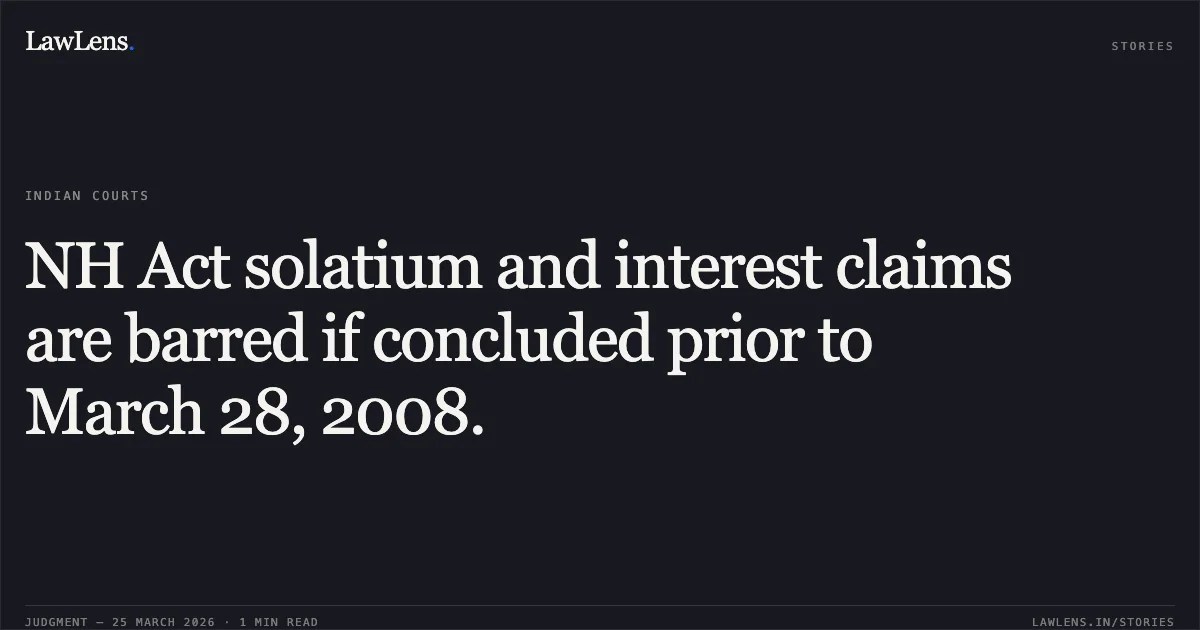
Source reference: para 12The Court further applied the cut-off date of 28.03.2008 (the date of the Golden Iron and Steel Forging judgment) to determine the eligibility of claims, consistent with the precedent in Sunita Mehra v. Union of India.
Source reference: para 5.9, 14Reasoning
The Court held that while the corrected estimate of ₹29,000 crores was taken on record, fiscal implications do not override substantive constitutional entitlements to just compensation.
Source reference: para 7-8However, the Court identified a need to distinguish between active and concluded claims to prevent the reopening of "stale" matters.
Source reference: para 11-12It reasoned that while the declaration of Section 3-J as unconstitutional is settled, the remedy must be balanced against the equities of inordinate delay.
Source reference: para 13By utilizing the 28.03.2008 cut-off, the Court categorized claimants into three groups: those with pending litigations (fully entitled), those who filed belatedly (entitled but deprived of interest for the delay period), and those whose cases were already final (not entitled to reopen).
Source reference: para 14This approach ensures consistency with Tarsem Singh-I while protecting the public exchequer from paying interest accrued due to the landowners' own laches.
Source reference: para 13-14Holding
The Court dismissed the Review Petition regarding the merits of the financial burden but issued clarifying directions.
Landowners with compensation claims alive/pending before any prescribed forum on or after 28.03.2008 are entitled to interest, solatium, and interest on solatium.
Source reference: para 14(i)For claims pending on that date but raised with inordinate delay, no interest (on either compensation or solatium) shall be payable for the period of delay; interest shall only run from the date the claim was raised.
Source reference: para 14(ii)Claims concluded prior to 28.03.2008 without further challenge cannot be reopened or reviewed.
Source reference: para 14(iii)The Court remanded the tagged SLPs to the respective High Courts for recalculation and clarified that NHAI cannot seek refunds of benefits already paid to landowners.
Source reference: para 16-17Acts & Sections Cited
2 provisions across 1 statute referred to in this judgment. Each provision opens on LawLens.
Right to Fair Compensation and Transparency in Land Acquisition, Rehabilitation and Resettlement Act, 20132
Original Court PDF
National Highways Authority Of IndiavsTarsem Singh
Click to open original judgment
Original judgment, available to read, download and summarize on LawLens.in