Facts
The appeals arose from disputes concerning whether employees engaged in the State’s Social Forestry Department and other governmental, statutory, charitable, educational, research and service-oriented establishments were entitled to protection under the Industrial Disputes Act, 1947 (“ID Act”).
Source reference: p. 38–40; paras 64–79A three-Judge Bench noticed an apparent divergence between Chief Conservator of Forests v. Jagannath Maruti Kondhare, (1996) 2 SCC 293, and State of Gujarat v. Pratamsingh Narsinh Parmar, (2001) 9 SCC 713, concerning Social Forestry activities and referred the matter to a larger Bench.
Source reference: p. 38–40; paras 64–79A Five-Judge Bench thereafter expressed doubts regarding the correctness and breadth of Bangalore Water Supply and referred the matter for consideration by a larger Bench.
Source reference: p. 39–40; paras 77–79During its pendency, the ID Act was repealed and the Industrial Relations Code, 2020 (“IR Code”) came into force with effect from 21 November 2025.
Source reference: p. 41; paras 81–83Issues
Whether the “Triple Test” formulated in paragraphs 140–144 of Bangalore Water Supply correctly interprets “industry” under Section 2(j) of the ID Act, and whether the unnotified Industrial Disputes (Amendment) Act, 1982 or the IR Code, 2020 affected that interpretation.
Source reference: p. 41–42; para. 82Whether social-welfare activities, schemes and other enterprises undertaken by Government departments or their instrumentalities could constitute “industrial activities” under Section 2(j).
Source reference: p. 41–42; para. 82What State activities constitute “sovereign functions” and whether such activities fall outside Section 2(j).
Source reference: p. 41–42; para. 82Whether the reference to the Nine-Judge Bench was procedurally maintainable, particularly in light of Central Board of Dawoodi Bohra Community v. State of Maharashtra, (2005) 2 SCC 673, res judicata and stare decisis.
Source reference: p. 42–67; paras 84–140Law Applied
Section 2(j) of the ID Act defines “industry” as any business, trade, undertaking, manufacture or calling of employers and includes any calling, service, employment, handicraft or industrial occupation or avocation of workmen.
Source reference: p. 11; para. 11In Bangalore Water Supply, the governing “Triple Test” was stated to be: systematic activity; organised cooperation between employer and employee; and production or distribution of goods or services calculated to satisfy human wants and wishes; absence of profit motive is irrelevant.
Source reference: p. 15–17; paras 23–28The judgment also recognised the dominant-nature test for composite undertakings and excluded only narrowly understood sovereign functions, while permitting substantially severable industrial units within governmental departments to fall under Section 2(j).
Source reference: p. 21–22; paras 38–41The majority opinions in the present case relied on Article 141, the principles of stare decisis and institutional certainty, and Keshav Mills Co. Ltd. v. CIT, AIR 1965 SC 1636, which requires compelling and substantial reasons before overruling a long-standing precedent.
Source reference: Datta, pp. 30–34; paras 32–37References to larger Benches were assessed under Dawoodi Bohra, which requires adherence to decisions of larger Benches and permits a properly constituted still-larger Bench to reconsider them.
Source reference: p. 44–48; paras 90–96The Court further held that the unnotified 1982 amendment had no operative legal effect, while the IR Code was an independent and prospective enactment to be interpreted on its own terms.
Source reference: p. 146–148; paras 279–284Reasoning
The Court examined the procedural history and held, by the majority, that the reference was validly constituted: the Five-Judge Bench expressed doubts about Bangalore Water Supply, the matter was placed before a co-equal Seven-Judge Bench, and that Bench directed constitution of a Nine-Judge Bench in accordance with Dawoodi Bohra.
Source reference: p. 54–57; paras 109–116Justice Nagarathna and Justices Datta and Bhuyan considered the original conflict between Jagannath Maruti Kondhare and Pratamsingh Parmar to be factual rather than doctrinal, but nevertheless concluded that Bangalore Water Supply remained good law.
Source reference: Nagarathna, pp. 130–136; Datta, pp. 21–30On merits, the majority view was that the Triple Test properly focused on the functional nature of organised activity and employer–employee cooperation rather than ownership, governmental character, charitable purpose or profit motive.
Source reference: Datta, pp. 63–70; Bagchi, pp. 63–70Accordingly, hospitals, educational institutions, research bodies, clubs, charitable projects, professional establishments and governmental welfare schemes could qualify as industries where the statutory tests were satisfied.
Source reference: Datta, pp. 63–70; Bagchi, pp. 63–70Governmental or welfare character did not automatically attract sovereign immunity; only core, inalienable sovereign functions, or activities excluded by a separate constitutional or statutory regime, could fall outside the ID Act.
Source reference: Bagchi, pp. 52–62The Chief Justice’s opinion proposed a prospective and “hypothetical” refinement by introducing commercial character as a relevant consideration and recalibrating the sovereign-function analysis.
Source reference: p. 121–145; paras 220–274However, the other opinions did not adopt that reformulation.
Source reference: no citationThey emphasised that altering the test for legacy proceedings would unsettle accrued rights, cause procedural disruption and potentially deprive pending litigants of the specialised remedies available under the repealed ID Act.
Source reference: Nagarathna, pp. 37–47; Narasimha, pp. 14–17; Datta, pp. 60–64; Bagchi, pp. 78–85Holding
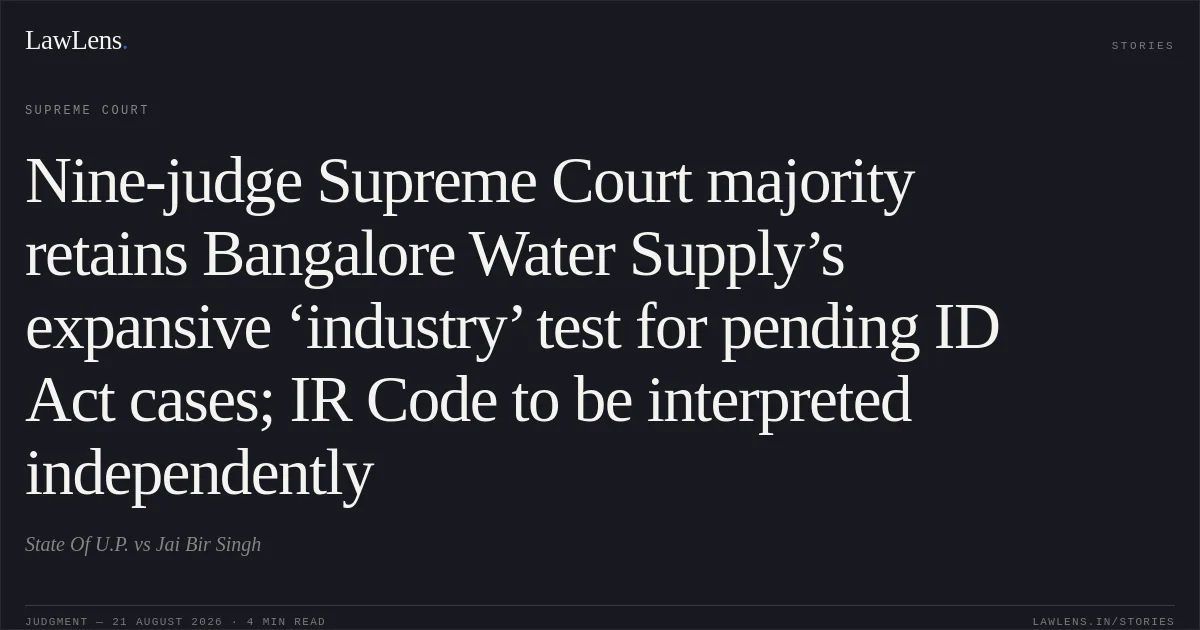
The Court held that the Bangalore Water Supply Triple Test remains the governing law for disputes arising under the repealed ID Act.
The unnotified 1982 amendment had no legal effect, and the IR Code, 2020 neither altered the interpretation of Section 2(j) nor could be used to retrospectively narrow it.
Source reference: Nagarathna, pp. 153–156; Datta, pp. 72–74; Bagchi, pp. 81–85Social-welfare schemes and governmental activities are not excluded merely because they are undertaken by the State; their status depends on the nature of the activity and the existence of systematic employer–employee cooperation.
Source reference: Bagchi, pp. 82–84Sovereign-function immunity remains narrow and does not ordinarily extend to welfare or economic activities.
Source reference: Bagchi, pp. 82–84Although the Chief Justice expressed a view favouring a hypothetical refinement of the Triple Test, the operative consensus was that the existing Bangalore Water Supply principles would continue to govern all pending proceedings under the ID Act, while the IR Code must be interpreted independently on its own text and scheme.
Source reference: p. 148–154; paras 275–288The pending matters were directed to be placed before the appropriate Benches for disposal in accordance with the law applicable before the IR Code came into force; there was no order as to costs.
Source reference: p. 154; paras 287–290Acts & Sections Cited
6 provisions across 6 statutes referred to in this judgment. Each provision opens on LawLens.
Industrial Relations Code, 20201
Code of Civil Procedure, 19081
Dock Workers (Regulation of Employment) Act, 19481
Coir Industry Act, 19531
Advocates Act, 19611
General Clauses Act, 18971
Original Court PDF
State Of U.P.vsJai Bir Singh
Click to open original judgment
Original judgment, available to read, download and summarize on LawLens.in