Facts
Haryana Urban Development Authority, now Haryana Shehri Vikas Pradhikaran (“HSVP”), invited e-auctions for various residential, institutional and commercial properties from 5 August to 28 August 2020.
Source reference: paras. 2–3The auction brochure provided that bidding would commence at the “base price,” calculated with reference to the current Collector rate, while a separate “reserve price” would be confidentially fixed by a competent committee for deciding whether to accept or reject the highest bid.
Source reference: paras. 2–3HSVP reserved the right to accept or reject any bid without assigning reasons.
Source reference: paras. 2–3It further stipulated that the earnest money of unsuccessful bidders would be refunded and that an allotment letter would be issued only after payment of 100% of the bid amount.
Source reference: paras. 2–3The petitioners submitted bids higher than the base prices and deposited 10% of their respective bid amounts.
Source reference: para. 4However, each bid was below the confidential reserve price fixed by HSVP.
Source reference: para. 4In the lead case, the base price was ₹2,47,00,200, the petitioner’s bid was ₹2,72,65,200, and the reserve price was ₹2,86,50,000.
Source reference: para. 4HSVP rejected the bids and refunded the deposited amounts on 9 October 2020.
Source reference: para. 4In four cases, the properties were subsequently allotted at substantially higher prices.
Source reference: para. 4Issues
Whether failure to accept or reject the highest bids within seven working days under Clause 28 resulted in deemed acceptance and formation of a concluded contract between the petitioners and HSVP.
Source reference: paras. 5, 8–9Whether HSVP’s rejection of the bids was invalid because no separate speaking order assigning reasons was communicated to the petitioners.
Source reference: paras. 5, 10Whether the Court should interfere with HSVP’s decision to reject bids that were below the confidential reserve price fixed for the properties.
Source reference: paras. 8–10Law Applied
The Court applied the contractual terms of the e-auction brochure, particularly the provisions distinguishing the base price from the confidential reserve price, reserving HSVP’s right to reject any bid without assigning reasons, requiring acceptance or rejection of the highest bid within seven working days, and providing for issuance of an allotment letter only after payment of 100% of the bid amount.
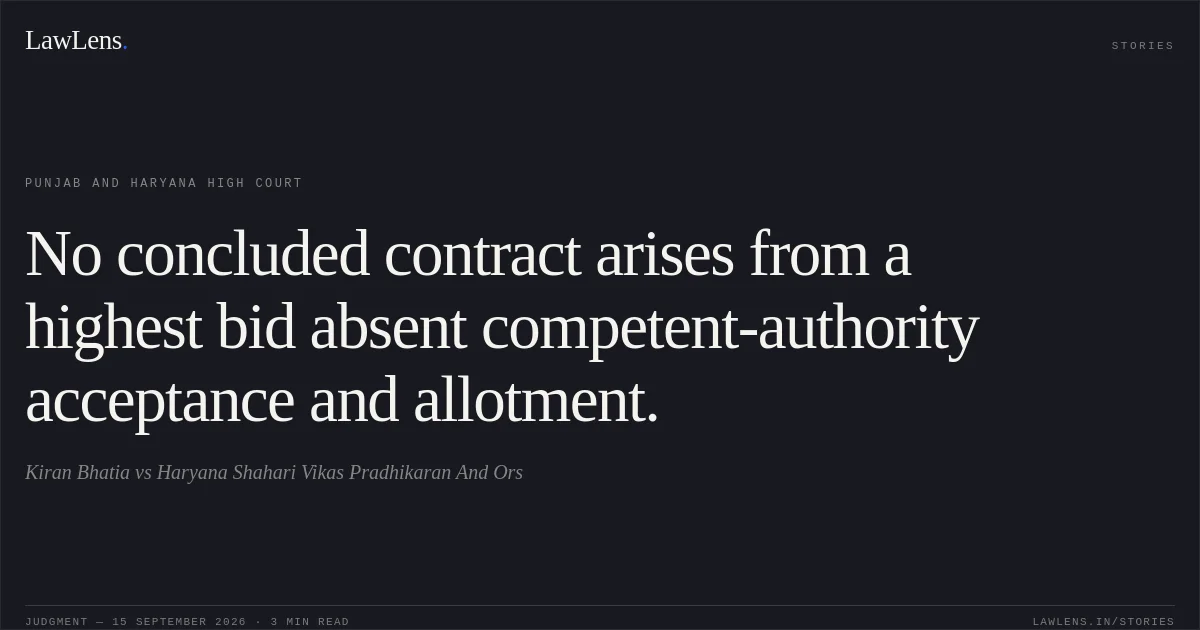
Source reference: paras. 2–3Relying on Mayank Dua v. Haryana Shehri Vikas Pradhikaran, 2022(4) RCR (Civil) 235, the Court held that the seven-day period was intended to prevent administrative delay and could not be invoked to create a concluded contract for disposal of public property in the absence of express acceptance by the competent authority.
Source reference: para. 8It further relied on Trilochan Mishra v. State of Orissa, State of Orissa v. Harinarayan Jaiswal, Union of India v. Blum Sen Walaiti Ram, and State of U.P. v. Vijay Bahadur Singh for the principle that the State is not bound to accept the highest bid.
Source reference: para. 8Under Afcons Infrastructure Ltd. v. Nagpur Metro Rail Corporation Ltd., (2016) 16 SCC 818, judicial interference in a public authority’s tender or auction decision is warranted only where the decision-making process is mala fide, intended to favour someone, perverse, arbitrary, or irrational.
Source reference: para. 8Reasoning
The Court found that the petitioners had participated with full knowledge of the auction conditions and had not challenged them.
Source reference: para. 8Since their bids were below the reserve prices fixed by the competent committee, HSVP was entitled to reject them under Clauses 8, 15 and 16.
Source reference: para. 8The seven-working-day stipulation did not create automatic acceptance or a concluded contract; such a result would undermine the public interest in securing a fair value for public assets.
Source reference: para. 9No Letter of Intent or allotment letter had been issued, and the 10% deposits had been refunded, demonstrating the absence of final acceptance or contractual completion.
Source reference: para. 9The objection regarding a speaking order also failed because Clause 15 expressly permitted rejection without assigning reasons, that clause had not been challenged, and the rejection was consistent with the disclosed auction framework.
Source reference: para. 10The subsequent higher allotment prices further supported the conclusion that interference would cause financial loss to the State.
Source reference: para. 10Holding
The Court answered all issues against the petitioners.
It held that rejection of bids below the confidential reserve price was valid, that expiry of the seven-day period did not result in deemed acceptance or formation of a concluded contract, and that no separate speaking order was required under the unchallenged auction conditions.
Source reference: paras. 8–10All six writ petitions were dismissed as meritless.
Source reference: para. 11Acts & Sections Cited
4 provisions across 1 statute referred to in this judgment. Linked provisions open on LawLens.
the E-auction Policy (alias, unresolved)4
Original Court PDF
Kiran BhatiavsHaryana Shahari Vikas Pradhikaran And Ors
Click to open original judgment
Original judgment, available to read, download and summarize on LawLens.in