Facts
The deceased, Bhurubhai Chauhan, was struck and fatally injured by an Eicher truck while walking home from work near Vatva GIDC on 4 May 2013.
Source reference: paras. 1–3.2, pp. 1–2His legal representatives sought compensation under Section 166 of the Motor Vehicles Act, claiming that he was 45 years old and earned ₹30,000 per month.
Source reference: paras. 1–3.2, pp. 1–2The Motor Accident Claims Tribunal awarded ₹20,94,088 with 7.5% interest.
Source reference: paras. 5–6.2, pp. 3–4The claimants appealed, seeking enhancement, and the insurer appealed, alleging contributory negligence and challenging the future-income increase.
Source reference: paras. 5–6.2, pp. 3–4Issues
Whether the deceased, who was a pedestrian, was contributorily negligent in causing the accident.
Source reference: para. 7, p. 4Whether the Tribunal correctly assessed the deceased’s income and future prospects for calculating dependency compensation.
Source reference: paras. 5, 6.1, 7.1, pp. 3–5Whether compensation under the non-pecuniary heads required enhancement.
Source reference: paras. 5.1, 7.2, pp. 3, 5Law Applied
Under Section 166 of the Motor Vehicles Act, a claimant may recover compensation for death caused by a motor accident.
Source reference: no citationThe Court applied the principles in National Insurance Company Ltd. v. Pranay Sethi, 2017 (16) SCC 680, concerning future prospects and conventional heads of compensation, and Magma General Insurance Company v. Nanu Ram @ Charu Ram & Ors., AIRONLINE 2018 SC 189, concerning compensation for consortium.
Source reference: paras. 7.1–7.2, pp. 4–5The Court held that, given the deceased’s age of 51 and the absence of a permanent source of income, a 10% increase for future prospects was appropriate.
Source reference: paras. 7.1–7.2, pp. 4–5Reasoning
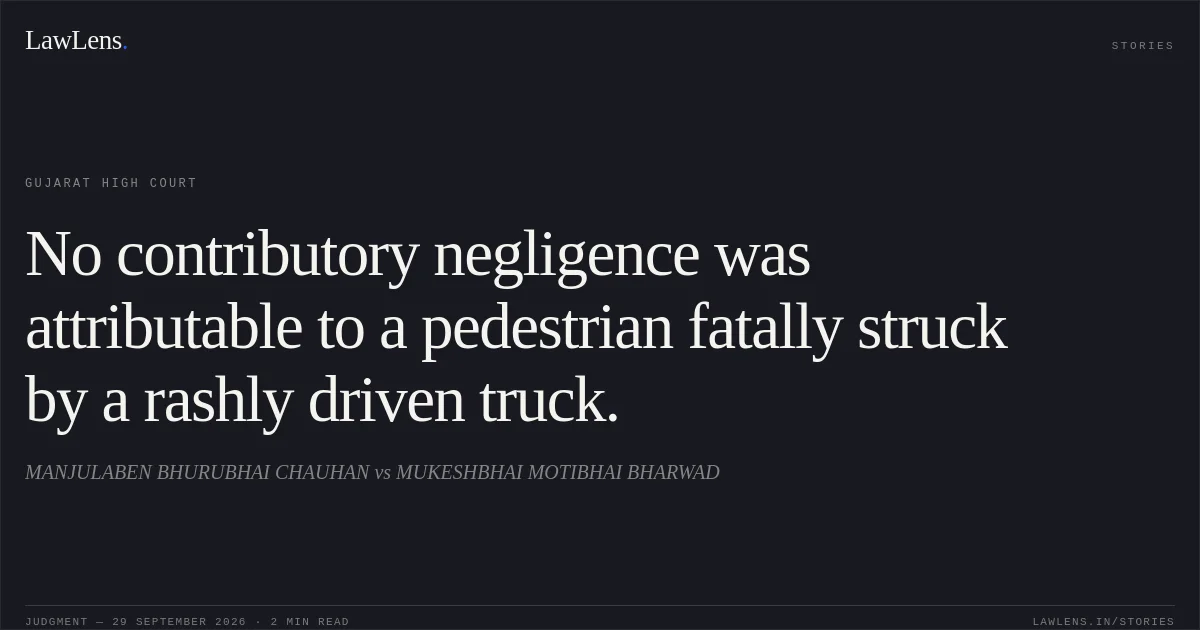
The Court rejected contributory negligence because the deceased was walking on the road and the truck’s front wheel ran over him; the evidence supported the conclusion that the driver’s rash driving caused the fatal accident.
Source reference: para. 7, p. 4On income, the Court treated the employer’s salary slip as direct evidence and distinguished it from the income-tax return. It assessed monthly income at ₹31,641 and applied a 10% increase for future prospects, deducted one-third for personal expenses, and applied a multiplier of 11, resulting in dependency compensation of ₹30,62,928.
Source reference: para. 7.1 and calculation at para. 7.2, pp. 4–6Applying the cited precedents, it also allowed ₹18,150 each for loss of estate and funeral expenses and ₹96,800 for loss of consortium.
Source reference: para. 7.2, p. 5Holding
The Court dismissed the insurer’s contributory-negligence challenge and modified the Tribunal’s award.
It calculated total compensation at ₹31,96,028 and awarded an additional ₹11,01,940, with 7.5% annual interest from the date of the claim petition until realization.
Source reference: paras. 7.3–8.2, pp. 6–7The defendants remained jointly and severally liable, and the insurer was directed to deposit the additional amount within eight weeks; both appeals were disposed of accordingly.
Source reference: paras. 7.3–8.2, pp. 6–7Acts & Sections Cited
1 provisions across 1 statute referred to in this judgment. Each provision opens on LawLens.
Motor Vehicles Act, 19881
Original Court PDF
MANJULABEN BHURUBHAI CHAUHANvsMUKESHBHAI MOTIBHAI BHARWAD
Click to open original judgment
Original judgment, available to read, download and summarize on LawLens.in