Facts
The deceased, Ayush Singh, aged approximately 26 years, died in a motor-vehicle accident on 30 December 2020 allegedly caused by the rash and negligent driving of Truck No. CG-04-MU-9311 by respondent No. 1.
Source reference: para. 1–2The appellant, his mother and legal heir, filed a claim petition seeking compensation and subsequently appealed under Section 173 of the Motor Vehicles Act, 1988, seeking enhancement of the award.
Source reference: para. 1–2The Motor Accident Claims Tribunal assessed the deceased’s monthly income at Rs. 24,165 on the basis of his salary slip, deducted 50% towards personal expenses, applied a multiplier of 17, added 50% towards future prospects, and awarded Rs. 37,74,245 in total compensation.
Source reference: para. 6The insurer opposed enhancement, contending that income tax ought to have been deducted while calculating the deceased’s annual dependency.
Source reference: para. 4Issues
Whether the compensation awarded by the Tribunal was inadequate and required enhancement under the Motor Vehicles Act, 1988.
Source reference: para. 1, 3, 9Whether income tax was required to be deducted from the deceased’s annual income, including future prospects, before calculating the loss of dependency.
Source reference: para. 4, 7Whether the amounts awarded under the conventional heads—loss of estate, funeral expenses, and filial consortium—were inadequate.
Source reference: para. 7Law Applied
The Court applied Section 173 of the Motor Vehicles Act, 1988, governing appeals against awards of Motor Accident Claims Tribunals.
Source reference: no citationFor computation of compensation, it relied on Sarla Verma v. Delhi Transport Corporation, (2009) 6 SCC 121, regarding deduction for personal expenses and application of the appropriate multiplier; National Insurance Co. Ltd. v. Pranay Sethi, (2017) 16 SCC 680, regarding addition of future prospects and conventional heads of compensation; and Magma General Insurance Co. Ltd. v. Nanu Ram @ Chuhru Ram, (2018) 18 SCC 130, regarding consortium.
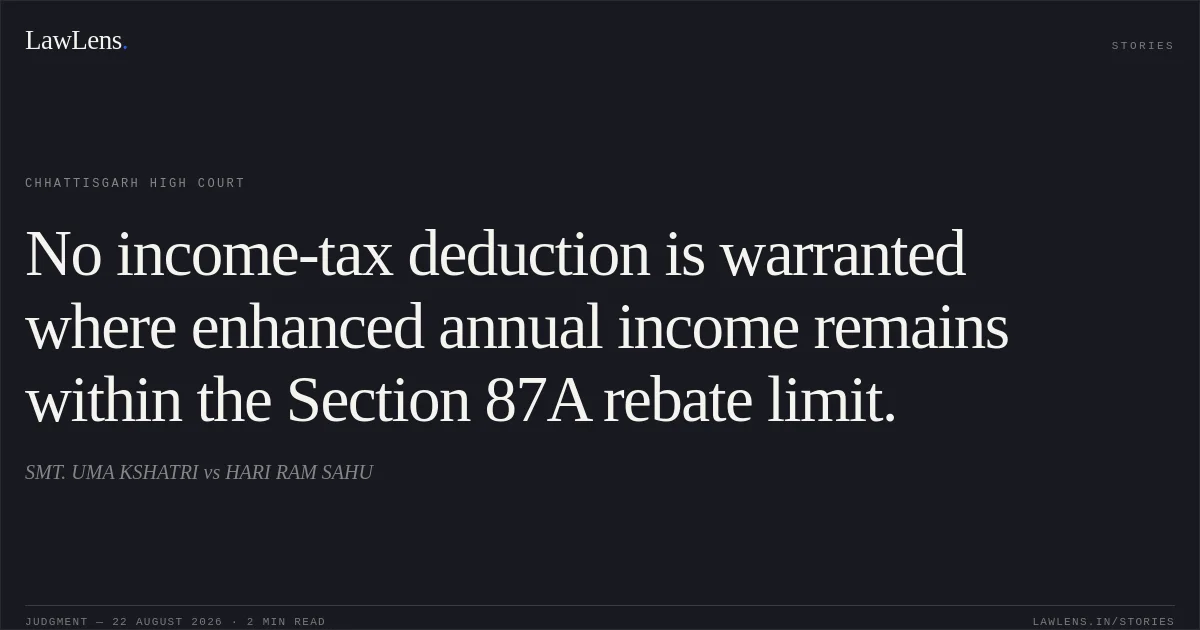
Source reference: para. 7–8The Court further held that, for Assessment Year 2021–2022, income up to Rs. 5,00,000 was eligible for rebate under Section 87A of the Income Tax Act, and therefore no income-tax deduction was required from the deceased’s annual income including future prospects.
Source reference: para. 7–8Reasoning
The Tribunal correctly accepted the salary slip showing a gross monthly income of Rs. 24,165 and calculated the annual income at Rs. 2,89,980.
Source reference: para. 6–7Since the deceased was unmarried, the deduction of 50% towards personal expenses was consistent with Sarla Verma. As he was approximately 26 years old, application of the multiplier of 17 and addition of 50% towards future prospects were consistent with the principles in Pranay Sethi.
Source reference: para. 7–8The resulting annual income, after adding future prospects, was Rs. 4,34,970, which fell below the Rs. 5,00,000 threshold attracting the Section 87A rebate for the relevant assessment year; hence, the insurer’s contention regarding tax deduction was rejected.
Source reference: para. 7The Court also found the awards of Rs. 16,500 each for loss of estate and funeral expenses and Rs. 44,000 for filial consortium to be legally adequate.
Source reference: para. 7Holding
The High Court held that the Tribunal’s award of Rs. 37,74,245 was just, proper, and consistent with the applicable Supreme Court precedents.
No further deduction for income tax was warranted, and the conventional amounts awarded were not inadequate.
Source reference: para. 8–9The appeal seeking enhancement was accordingly dismissed, and the Tribunal’s award was affirmed.
Source reference: para. 10Acts & Sections Cited
2 provisions across 2 statutes referred to in this judgment. Linked provisions open on LawLens.
Motor Vehicles Act, 19881
Income-tax Act, 19611
Original Court PDF
SMT. UMA KSHATRIvsHARI RAM SAHU
Click to open original judgment
Original judgment, available to read, download and summarize on LawLens.in