01Facts
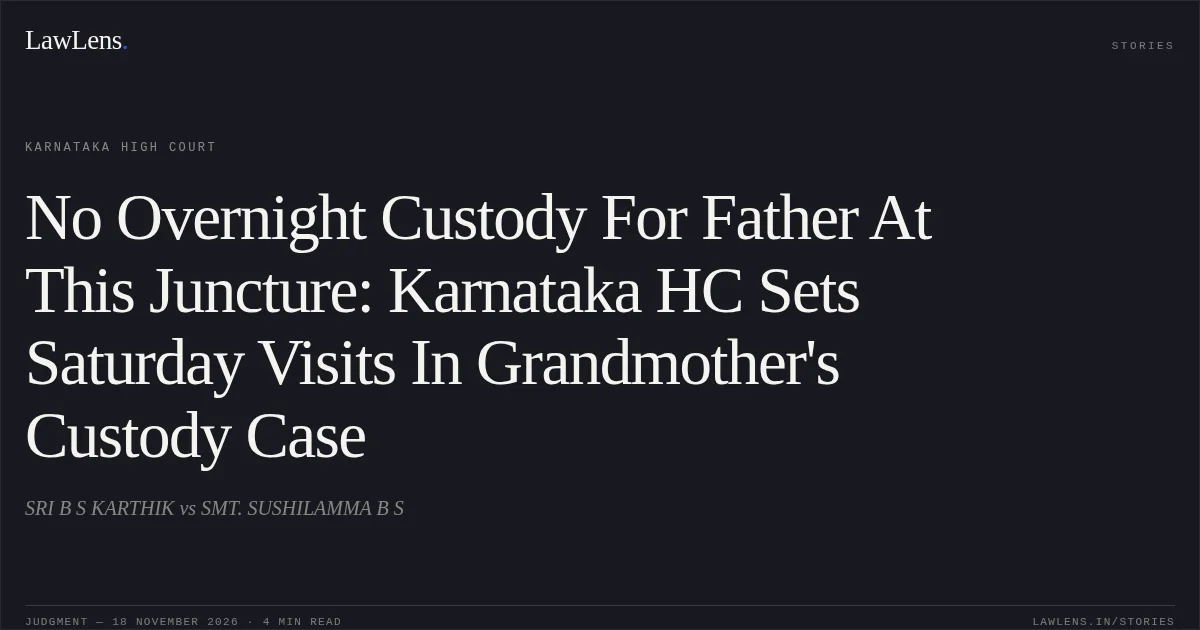
The petitioner, the paternal father, challenged the order dated 30.11.2024 passed by the IV Addl. Principal Judge, Family Court, Bengaluru, on I.A. No. III in G No. 424/2023
p. 2The respondent, the maternal grandmother, filed the custody petition
p. 2, para 2The father sought interim parenting time every Friday to Sunday, from 6:00 p.m. Friday to 6:00 p.m. Sunday
p. 2, para 2The Family Court partly allowed the application, granting parenting time on every 3rd Saturday from 3:00 to 4:00 p.m. in the child visitation room at BMC, Bengaluru, with a 1st Saturday addition after six months
pp. 2–3, para 2A later order dated 15.10.2025 recorded that the visitation had gone well, but the grandmother alleged that the child became withdrawn after visits and lost interest in school
p. 3, quoted order para 1The grandmother further alleged that the father arrived with strangers, that strangers appeared in video calls, and that the father changed the child's clothes during and after visits
p. 4, quoted order para 3The father sought overnight custody
p. 4, quoted order para 2The Court interacted with the child and found her "in a confused state" caused by the poor relations between the parties
p. 4, quoted order para 3The Court observed that the child needed affection from both sides and that the arrangement must proceed gradually
p. 5, quoted order para 402Issues
i.1. Whether the father is entitled to enhanced visitation, including overnight custody, during the pendency of the grandmother's custody petition.
p. 4, quoted order para 2 · p. 5, quoted order para 4ii.2. Whether the complaints regarding strangers accompanying the father, video-call conduct, and clothing changes justify restricting the father's visitation.
p. 4, quoted order para 3 · p. 6, para 5 · pp. 7, para 6(ii)–(iii)iii.3. Whether the interim visitation arrangement should be made final and the Trial Court directed to proceed with the custody petition.
p. 6, para 403Law Applied
The judgment does not expressly cite any statute, precedent, or authority.
The Court's reasoning rests on the implicit principle that the child's welfare governs interim custody and visitation arrangements, a principle underlying the Guardians and Wards Act, 1890, under which the G proceedings were pending.
The Court recognised that a child requires affection from both grandparent and parent, and that transitions in custodial arrangements in such cases must be gradual, with no overnight custody at an interim stage.
p. 5, quoted order para 4The High Court exercised its jurisdiction under Articles 226 and 227 of the Constitution to review an interlocutory order in pending custody proceedings.
p. 2The Court recognised the Trial Court's continuing authority to adjudicate expenditure claims and related applications independently under the law.
p. 8, para 6(vii)Where the grandmother sought enforcement of maintenance and educational-expense directions, the Court pointed to the Trial Court's power under Section 151 CPC.
p. 7, para 6(vi)Provisions in the judgment · 1 · Linked ones open on LawLens
Code of Civil Procedure, 1908 Section 151
04Reasoning
The Court found the father's visitation was progressing well but accepted the grandmother's concerns about the child's emotional state and the parties' hostility.
p. 4, quoted order para 3It declined the father's request for overnight custody because the child's interests required a gradual transition.
p. 5, quoted order para 4To reduce friction and protect the child, the Court expanded daytime visitation to every Saturday from 10:00 a.m. to 6:00 p.m., shifting it to Sunday when school fell on Saturday.
pp. 6, para 6(i)–(ii)The Court directed that the father collect the child alone or with paternal grandparents only, and restricted the grandmother to audio calls during the father's time.
pp. 7, para 6(ii)–(iii)The Court did not treat the complaints about strangers and clothing changes as independent grounds to deny visitation, observing that they did not justify denial of access. Instead, it addressed them through conduct directions.
p. 4, quoted order para 3The Court refused to make the interim arrangement final or to decide the custody petition in the writ jurisdiction, preserving the Trial Court's role.
p. 6, para 4 · p. 8, para 6(vii)05Holding
The High Court held that overnight custody is not appropriate at this stage and that visitation must proceed gradually in the child's best interests.
p. 5, quoted order para 4The Court directed parenting time every Saturday, shifted to Sunday when school is held on Saturday.
p. 6, para 6(i)The Court directed pick-up at 10:00 a.m. and drop-off at 6:00 p.m., with the father accompanied only by paternal grandparents or alone.
p. 7, para 6(ii)The Court directed audio calls only by the grandmother during the father's time.
p. 7, para 6(iii)The Court directed reimbursement by the father of educational expenses borne by the grandmother, upon submission of receipts within two weeks, with payment within eight weeks.
p. 7, para 6(iv)The Court directed payment of ₹5,000 per month by the father for the child's maintenance, by the 5th of each month.
p. 7, para 6(v)The Court granted liberty to move the Trial Court under Section 151 CPC for enforcement and to seek adjudication of expenditure claims.
pp. 7–8, para 6(vi)–(vii)The writ petition was disposed of and pending IAs were closed.
pp. 8, para 6(viii)–(ix)Original Court PDF
SRI B S KARTHIKvsSMT. SUSHILAMMA B S
Click to open original judgment
Original judgment, available to read, download and summarize on LawLens.in