Facts
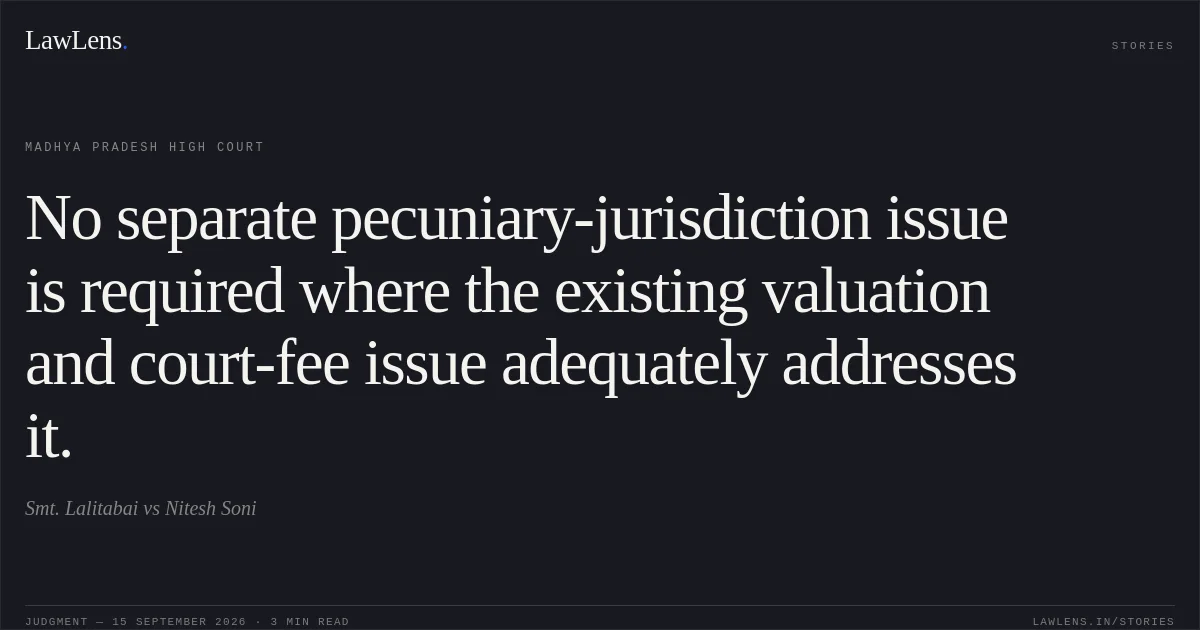
The respondents, as plaintiffs, instituted Civil Suit No. RCS A-11/2025 before the Civil Judge, Junior Division, Maheshwar, seeking declaration that registered Sale Deed No. 227 dated 10 August 2004 was null and void, along with partition, separate possession and permanent injunction in respect of agricultural land at Village Kharadi.
Source reference: paras. 1, 3–5The plaintiffs valued the suit at ₹2,93,100 for court-fee and pecuniary-jurisdiction purposes.
Source reference: paras. 1, 3–5The petitioners, who were defendants, disputed the valuation and jurisdiction in their written statement.
Source reference: paras. 1, 3–5After their application under Order VI Rule 17 CPC was allowed, they amended the written statement and moved an application under Order XIV Rule 5 read with Section 151 CPC seeking an additional issue on whether the suit fell within the pecuniary jurisdiction of the trial court.
Source reference: paras. 1, 3–5The trial court rejected the application on the ground that an issue concerning court fee and valuation had already been framed.
Source reference: paras. 1, 3–5The defendants challenged that order under Article 227 of the Constitution.
Source reference: paras. 1, 3–5Issues
Whether the trial court erred in refusing to frame a separate additional issue regarding the pecuniary jurisdiction of the court after the defendants had specifically raised the objection in their amended written statement?
Source reference: paras. 3–4, 7Whether the High Court should interfere under Article 227 of the Constitution with the trial court’s interlocutory order refusing the additional issue?
Source reference: paras. 5–7, 9Law Applied
The Court applied Order XIV Rules 1 and 5 CPC, under which issues are framed on material propositions of fact or law in dispute and may be added or amended where necessary for determining the controversy.
Source reference: paras. 5–7The Court applied Order XIV Rule 2 CPC concerning preliminary issues; and Order VI Rule 17 CPC concerning amendment of pleadings.
Source reference: paras. 5–7It also considered the supervisory jurisdiction under Article 227 of the Constitution, which is not appellate and is ordinarily exercised only where the subordinate court has acted without jurisdiction, committed a patent procedural error, or returned a perverse finding.
Source reference: paras. 5–7The Court relied on Major S.S. Khanna v. Brig. F.J. Dillon, AIR 1964 SC 497, Ramesh B. Desai v. Bipin Wadilal Mehta, Civil Appeal No. 4766 of 2001, decided on 11 July 2006, Satyanath v. Sarojamani, Civil Appeal No. 3680 of 2022, decided on 6 May 2022, and Shalini Shyam Shetty v. Rajendra Shankar Patil, (2010) 8 SCC 329, particularly on the limited scope of interference under Article 227.
Source reference: paras. 5–7Reasoning
The High Court held that the trial court had provided reasonable grounds for declining to frame a separate issue because an issue concerning court fee and suit valuation was already on record.
Source reference: para. 7In the Court’s view, court-fee, suit valuation and pecuniary jurisdiction were sufficiently interconnected in the circumstances of the case and could be addressed through a common finding.
Source reference: para. 7The defendants would not be deprived of the opportunity to lead evidence or advance submissions on the jurisdictional objection merely because no separate issue had been framed.
Source reference: para. 7Further, the trial had already progressed substantially, and interference at that stage would unnecessarily delay the proceedings.
Source reference: para. 7Since the trial court’s view was neither perverse nor jurisdictionally erroneous, the requirements for exercising supervisory jurisdiction under Article 227 were not satisfied.
Source reference: para. 9Holding
The Court answered the issues against the petitioners.
It held that the existing issue relating to court fee and valuation adequately covered the controversy and that the trial court was not required to frame a separate issue on pecuniary jurisdiction.
Source reference: para. 7Finding no jurisdictional error, perversity or serious prejudice, the High Court declined to interfere under Article 227 and dismissed the miscellaneous petition.
Source reference: paras. 9–10Acts & Sections Cited
2 provisions across 1 statute referred to in this judgment. Each provision opens on LawLens.
Code of Civil Procedure, 19082
Original Court PDF
Smt. LalitabaivsNitesh Soni
Click to open original judgment
Original judgment, available to read, download and summarize on LawLens.in