Facts
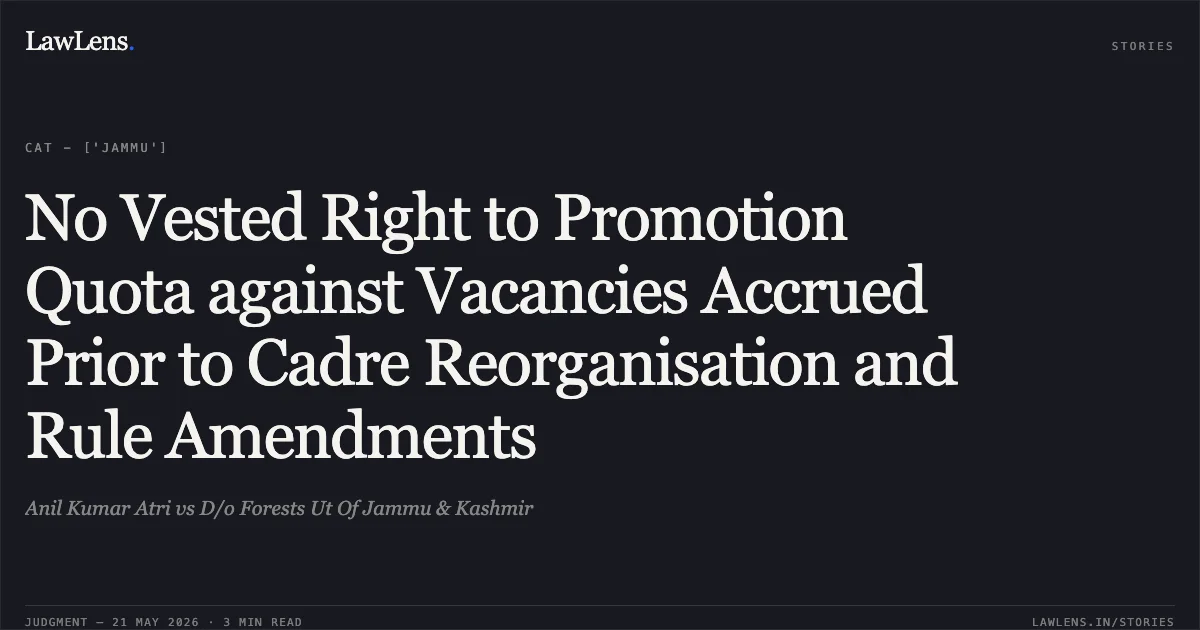
The applicants, appointed as Assistant Conservators of Forests in the J&K Forest Gazetted Service in 2011, sought induction into the Indian Forest Service (IFS).
Source reference: p. 6They contended that prior to the Jammu and Kashmir Re-organisation Act, 2019, 44 promotion quota vacancies existed based on a special 50:50 recruitment ratio (direct recruitment vs. promotion).
Source reference: p. 7They alleged that despite the administration initiating preliminary steps like seeking vigilance clearance, the process was stalled following the 2019 Re-organisation. Subsequently, the Ministry of Home Affairs reduced the promotion quota to 33%.
Source reference: p. 8The respondents argued that the special 50:50 dispensation expired on 31.12.2013 and that no formal proposal for induction had been sent to the UPSC since the 2010-2012 select lists.
Source reference: p. 12-13The definition of the "State Forest Service" was under revision to include allied wings like Wildlife and Soil Conservation, which had led to prior litigation and delays.
Source reference: p. 15Issues
1. Whether the applicants have a vested legal right to be considered for induction against 44 vacancies under the pre-2019 50:50 dispensation.
Source reference: p. 17 / para. 62. Whether internal departmental correspondence and preliminary data collection constitute a formal initiation of the recruitment process under statutory regulations.
Source reference: p. 19-20 / para. 103. Whether the Tribunal can direct the respondents to ignore the current 33% promotion quota policy in favor of a previous arrangement.
Source reference: p. 23-24 / para. 15Law Applied
Induction into the IFS is governed by the Indian Forest Service Recruitment Rules, 1966, and the Indian Forest Service (Appointment by Promotion) Regulations, 1966.
Source reference: p. 10, 18Under Rule 2(g), the "State Forest Service" must be formally defined to determine eligibility.
Source reference: p. 15An employee has no indefeasible right to promotion or a right to be considered against a vacancy at the time it arises; rather, the right is to be considered according to the rules in force when the process is actually undertaken.
Source reference: p. 21-22Judicial review is limited to examining illegality or arbitrariness and cannot extend to cadre management or policy determination, which fall under the executive domain.
Source reference: p. 23-24Reasoning
The Tribunal found that the applicants failed to prove that a complete proposal for the 2013 select list onwards was ever forwarded to the UPSC.
Source reference: p. 19It clarified that internal correspondence regarding vigilance status does not equate to a statutory proposal.
Source reference: p. 20The court reasoned that the determination of vacancies is the exclusive prerogative of the Central Government in consultation with the UT/State, and the Tribunal cannot assume the role of the cadre-controlling authority.
Source reference: p. 20Since the special 50:50 ratio expired in 2013, and the new 33% quota was established post-reorganisation, the applicants could not claim a vested right to an obsolete ratio.
Source reference: p. 21Additionally, the court noted that the process was legally complicated because the State Forest Service had not been formally defined to include allied services, and a proposal for this definition was still pending with the Ministry of Environment.
Source reference: p. 15, 22Holding
The Tribunal dismissed the Original Application, holding that the applicants had no enforceable legal right to be considered against 44 vacancies under the old dispensation.
The court ruled that mere existence of vacancies or eligibility does not grant an automatic right to induction.
Source reference: p. 18However, it observed that once the competent authority finalizes the definition of the State Forest Service and determines current vacancies, all eligible officers, including the applicants, must be considered strictly in accordance with the law.
Source reference: p. 25 / para. 18Acts & Sections Cited
1 provisions across 1 statute referred to in this judgment. Each provision opens on LawLens.
Administrative Tribunals Act, 19851
Original Court PDF
Anil Kumar AtrivsD/o Forests Ut Of Jammu & Kashmir
Click to open original judgment
Original judgment, available to read, download and summarize on LawLens.in