Facts
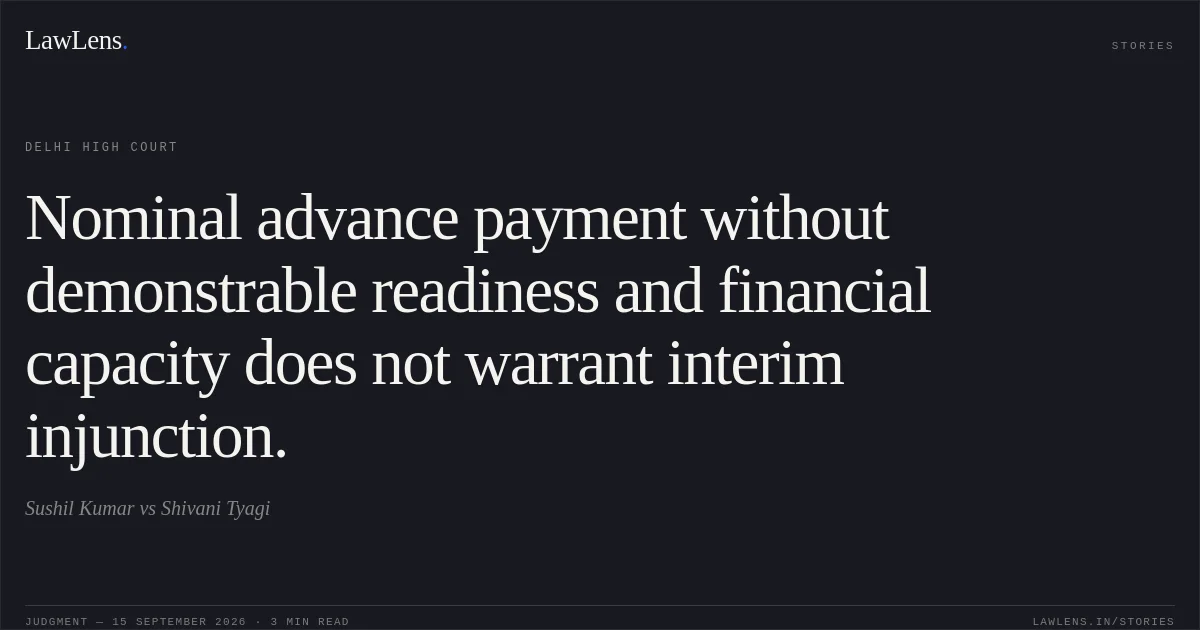
The appellant/plaintiff filed a suit for specific performance of an Agreement to Sell, possession, and permanent injunction concerning agricultural land measuring 3 Bighas 10 Biswas in Khasra No. 1516 (min.), Village Bhati, New Delhi.
Source reference: p.2The parties executed an Advance Receipt-cum-Agreement to Sell dated 03.01.2022 for a total consideration of ₹1,56,29,771/-, against which the appellant paid ₹16,00,000/- as earnest money.
Source reference: p.2The agreement contemplated a stage-wise payment schedule: 20% by 20.01.2022 and the balance amount by 31.03.2022.
Source reference: p.2Alleging that the appellant failed to comply with the payment schedule, the respondent terminated the agreement and forfeited the earnest money by notice dated 01.10.2022.
Source reference: p.2The appellant sought an interim injunction under Order XXXIX Rules 1 and 2 CPC restraining the respondent from alienating the property or creating third-party rights during the pendency of the suit.
Source reference: p.3The Trial Court dismissed the application on the ground that the appellant had not established a prima facie case, financial capacity, or readiness and willingness to pay the balance consideration.
Source reference: p.3In appeal, the appellant relied for the first time on an affidavit and bank statements of a third-party financier, Mr. Rajkumar Kasana, to demonstrate availability of funds.
Source reference: pp.3, 5–6Issues
1. Whether the appellant established a prima facie case, including readiness and willingness and financial capacity, warranting interim protection under Order XXXIX Rules 1 and 2 CPC?
Source reference: paras. 4, 8–122. Whether the balance of convenience and the requirement of irreparable injury justified restraining the respondent from alienating or creating third-party rights in the suit property?
Source reference: paras. 8, 123. Whether the belated production of a third-party financier’s affidavit and bank statements in the appeal could cure the appellant’s failure to establish readiness and willingness before the Trial Court?
Source reference: paras. 5–6, 10–11Law Applied
The Court applied the settled three-fold test for grant of temporary injunctions under Order XXXIX Rules 1 and 2 CPC—prima facie case, balance of convenience, and irreparable injury—as stated in Gujarat Bottling Co. Ltd. v. Coca Cola Co., (1995) 5 SCC 545.
Source reference: para. 8In assessing the appellant’s entitlement to interim relief, the Court relied on Vibhor Kumar Gupta v. Anupama Kapoor, CS(OS) 13/2020, decided on 19.04.2022, where payment of less than 10% of the sale consideration, absent proof of readiness and willingness, was held insufficient to justify interim protection.
Source reference: paras. 9–10The Court also applied Section 52 of the Transfer of Property Act, 1882, holding that any alienation or third-party interest created during litigation would remain subject to the doctrine of lis pendens.
Source reference: para. 12Reasoning
The Court held that the appellant had paid only ₹16,00,000/-, approximately 10% of the total consideration, and had failed to produce bank statements, account records, or other financial documents before the Trial Court showing his capacity to pay the remaining ₹1,40,29,771/- within the contractual timeline.
Source reference: paras. 9–10Mere pleadings asserting readiness and willingness were insufficient to establish a prima facie case where the agreement prescribed specific payment deadlines.
Source reference: para. 10The affidavit and bank statements of a third-party financier, introduced for the first time in appeal, did not demonstrate the appellant’s own financial capacity during the relevant period; rather, they reinforced the inference that the appellant himself lacked the funds necessary to perform the contract.
Source reference: para. 11Since the appellant failed to satisfy the prima facie case requirement, and because any subsequent transfer would be governed by Section 52 of the Transfer of Property Act, the balance of convenience did not favour restricting the respondent’s rights and no irreparable injury was established.
Source reference: para. 12Holding
The High Court dismissed the appeal and upheld the Trial Court’s refusal to grant interim injunction, finding no infirmity, illegality, or perversity in the impugned order.
The respondent was directed, on the appellant’s request, to disclose to the appellant any transfer of the suit property to a third party as and when such transfer occurred.
Source reference: para. 14The appeal and pending applications were disposed of accordingly.
Source reference: para. 15The Court clarified that its observations were confined to the interlocutory appeal and would not influence the Trial Court’s determination of the merits of the underlying suit.
Source reference: para. 16Acts & Sections Cited
1 provisions across 1 statute referred to in this judgment. Each provision opens on LawLens.
Transfer of Property Act, 18821
Original Court PDF
Sushil KumarvsShivani Tyagi
Click to open original judgment
Original judgment, available to read, download and summarize on LawLens.in