01Facts
The sole accused, a Tamil Nadu national, was arrested on 27.04.2009 at about 17:35 hrs near Tharakan School, Perinthalmanna, after police recovered 2 kg of ganja from his bag.
¶ 3, 26He was charged under Section 20(b)(ii)(B) of the NDPS Act.
¶ 3The Special Court (NDPS), Vatakara, in S.C. No. 20/2009, examined PWs 1–7, marked Exts. P1–P12 and MOs 1–5, and admitted Exts. D1 and D2 (contradictions).
¶ 4The Special Court convicted the accused and sentenced him to nine months' rigorous imprisonment and a fine of Rs. 7,500, with one month's default imprisonment and set-off for custody already undergone.
¶ 5On appeal, counsel contended that the accused knows neither Malayalam nor English, that all prosecution evidence was recorded in English, and that this violated Sections 279(1) and 281(1) CrPC, relying on Rasheed K.B. v. State of Kerala.
¶ 6The Public Prosecutor pointed to endorsements on the depositions that the evidence was interpreted and read over to the witnesses in the accused's presence, and that the accused signed them.
¶ 8, 22Counsel alternatively sought reduction of sentence.
¶ 702Issues
i.1. Whether non-compliance with Sections 279(1)/(2) CrPC (and the corresponding Sections 314(1)/(2) BNSS) in recording evidence in a language not understood by the accused vitiates the trial, or is merely an irregularity.
¶ 11(i), 13–17, 23–24ii.2. Whether the purpose of Section 281 CrPC / Section 316 BNSS is to be read in a way that affects the legal consequence of non-compliance.
¶ 11(ii), 18–19iii.3. Whether, absent a showing of prejudice, non-compliance with Section 281 CrPC / Section 314 BNSS has any legal effect on the conviction.
¶ 11(iii), 23–24iv.4. Whether the Special Court's finding that the accused committed an offence under Section 20(b)(ii)(B) NDPS is justifiable.
¶ 11(iv), 25–31v.5. Whether the verdict requires interference.
¶ 11(v), 3203Law Applied
Section 279 CrPC and its parallel, Section 314 BNSS, require interpretation of evidence to an accused who is present in person in a language he understands (sub-s. (1)), and to his pleader where he appears through one (sub-s. (2)). Where the accused is present with counsel, compliance with sub-section (1) is mandatory for the accused and sub-section (2) applies to the pleader.
¶ 12–14, 16–17Sections 281 CrPC and 316 BNSS govern the recording and reading over of the accused's examination in a language he understands.
¶ 12, 18–19Section 465 CrPC and Section 511 BNSS provide that no finding or sentence may be reversed for an error or irregularity unless a failure of justice has in fact occurred. Section 465(2) CrPC asks whether the objection could have been raised earlier.
¶ 23Shivanarayan Kabra v. State of Madras, AIR 1967 SC 986, holds that non-compliance is an irregularity curable absent prejudice.
¶ 6, 18, 21, 23Rasheed K.B. v. State of Kerala, 2022 (4) KHC 435, holds that non-compliance with s. 279(1)/281(4) is an irregularity unless prejudice is shown.
¶ 9, 15–16Iqbal Mansoory v. State, 2018 KHC 2331 (Mad.), holds to the same effect.
¶ 21Sections 42, 50 and 57 of the NDPS Act were considered.
¶ 29–30Provisions in the judgment · 12 · Linked ones open on LawLens
Narcotic Drugs and Psychotropic Substances Act, 1985 Section 20Section 42Section 43Section 50Section 57
Code of Criminal Procedure, 1973 Section 279Section 280Section 281Section 465
Bharatiya Nagarik Suraksha Sanhita, 2023 Section 314Section 316Section 511
04Reasoning
Section 279(1) CrPC and Section 314(1) BNSS are identical in content, as are sub-sections (2) of each, so the analysis under the CrPC applies equally to the BNSS.
¶ 13–14The court accepted that the evidence was recorded in English and that the accused may not have understood it.
¶ 22The endorsements on the depositions recorded that evidence was taken, interpreted and read over to each witness in the accused's presence and admitted as correct, which the court treated as sufficient compliance with Section 279(1) CrPC and Section 281 CrPC.
¶ 22Applying Shivanarayan Kabra and Section 465 CrPC, the court held that even if non-compliance occurred, it is an irregularity. No objection was raised before the trial court, and no failure of justice was shown or arose on the record, so the irregularity could not be entertained on appeal.
¶ 23–24The court accepted the evidence of PW6 (detecting officer), PW1 (accompanying officer) and PW2 (independent witness), who supported the recovery, search, sampling and seizure.
¶ 25–27The contradictions in Exts. D1 and D2 were held immaterial.
¶ 25, 27The court accepted the trial court's finding that Sections 42, 50 and 57 of the NDPS Act were complied with, since the appellant's counsel raised no dispute on this point.
¶ 29–30Ext. P12 confirmed that the samples were ganja.
¶ 30The court found conscious possession of 2 kg of ganja proved beyond reasonable doubt.
¶ 31On sentence, nine months' imprisonment was held reasonable and no reduction was warranted.
¶ 3205Holding
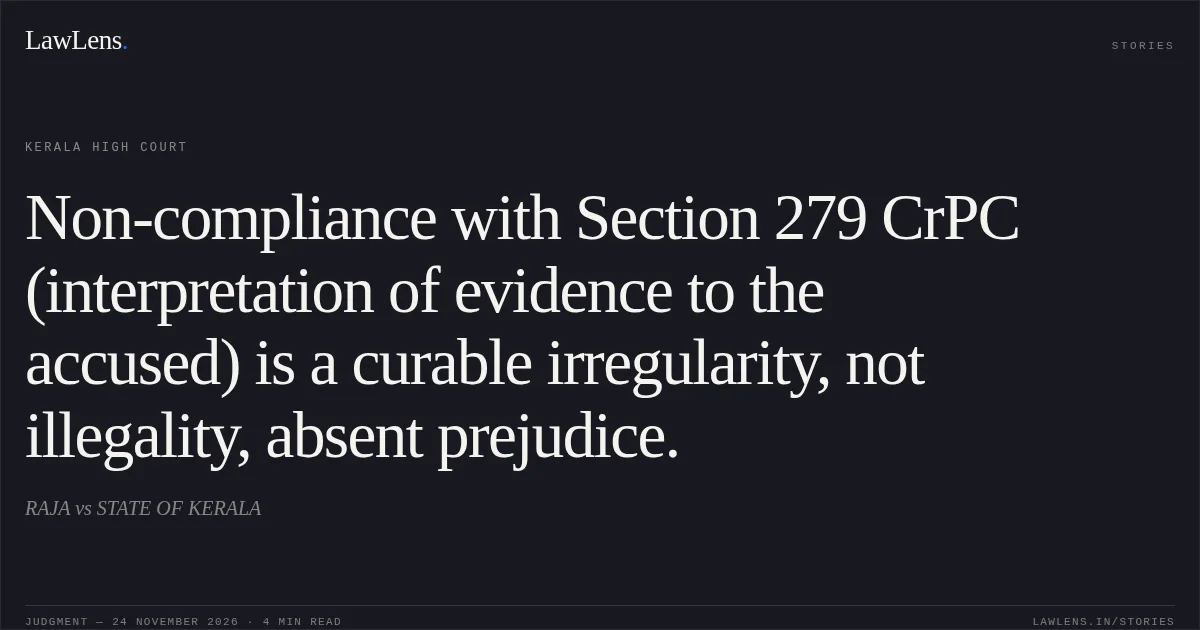
Non-compliance with Sections 279(1)/(2) CrPC and 281 CrPC (corresponding to Sections 314 and 316 BNSS) is an irregularity that does not vitiate the trial absent prejudice, and it cannot be raised for the first time on appeal where no failure of justice has occurred.
¶ 23–24The conviction under Section 20(b)(ii)(B) NDPS was held justified.
¶ 31The verdict requires no interference and the sentence was confirmed.
¶ 32The appeal is dismissed. The conviction and sentence are confirmed, the bail order and bail bond are cancelled, and the accused is directed to surrender before the Special Court forthwith to undergo the sentence, failing which the Special Court is to execute it. The Registry is to forward a copy of the judgment to the Special Court.
¶ 32Original Court PDF
RAJAvsSTATE OF KERALA
Click to open original judgment
Original judgment, available to read, download and summarize on LawLens.in