Facts
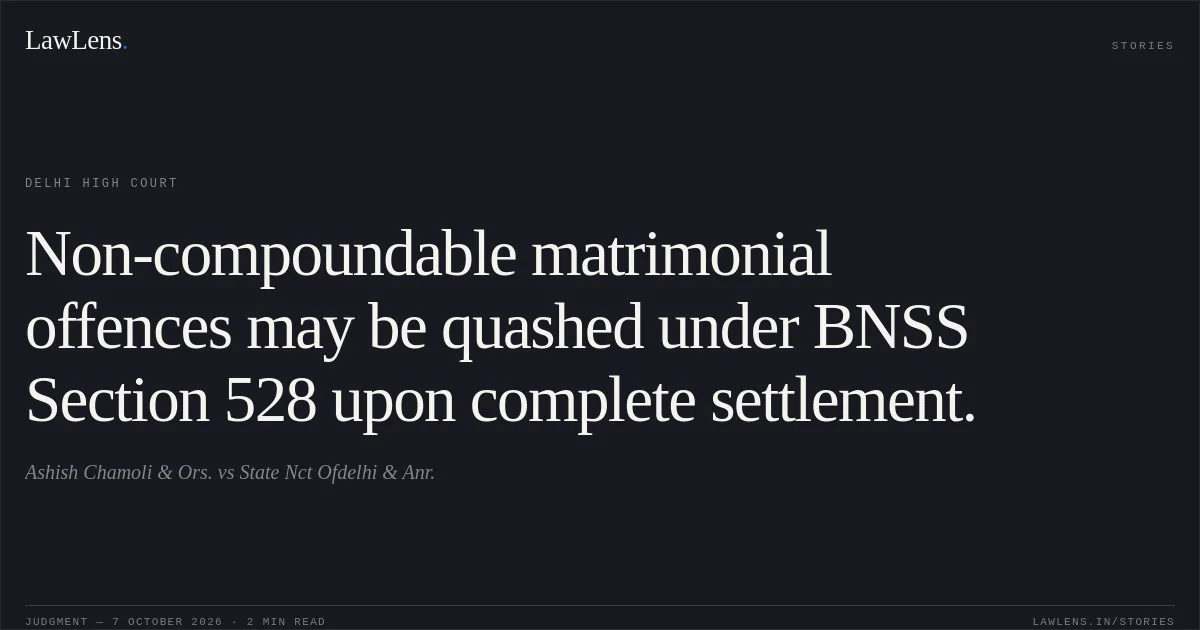
The petitioners sought quashing of FIR No. 527/2024, registered at PS Aman Vihar under Sections 85, 351(2) and 3(5) of the Bharatiya Nyaya Sanhita, 2023, and the proceedings arising from it.
Source reference: pp.1–2, paras 1, 3–4The allegations concerned events between February and May 2024 and arose from a matrimonial dispute.
Source reference: pp.1–2, paras 1, 3–4The parties entered into a Memorandum of Understanding dated 5 October 2024. They informed the Court that their disputes had been resolved, the related proceedings had been withdrawn, and a decree of divorce by mutual consent had been passed.
Source reference: p.2, paras 5–7Respondent no. 2 confirmed receipt of the remaining ₹2 lakh payable under the MOU.
Source reference: p.2, paras 5–7Issues
1. Whether the FIR and consequential proceedings arising from the matrimonial dispute could be quashed under Section 528 of the BNSS, despite the non-compoundable nature of the offence under Section 85 BNS, on the basis of the parties’ settlement.
Source reference: pp.1, 5–6, paras 1, 11–142. Whether, in light of the settlement and the circumstances of the case, continuing the criminal proceedings would serve the ends of justice.
Source reference: pp.3–6, paras 8–14Law Applied
Section 482 of the Code of Criminal Procedure, 1973, and its corresponding provision, Section 528 of the BNSS, confer inherent power on the High Court to quash criminal proceedings to secure the ends of justice or prevent abuse of process; that power is distinct from statutory compounding under Section 320 CrPC and may extend to non-compoundable offences.
Source reference: pp.2–5, paras 8–9Under Gian Singh v. State of Punjab, (2012) 10 SCC 303, and Narinder Singh v. State of Punjab, (2014) 6 SCC 466, the Court must consider the nature and gravity of the offence, whether the dispute is predominantly private or civil in character, whether the parties have settled their entire dispute, and whether conviction is remote and continuation would cause oppression or injustice; serious offences with a societal impact ordinarily cannot be quashed merely on settlement.
Source reference: pp.2–5, paras 8–9In matrimonial disputes, Jitendra Raghuvanshi v. Babita Raghuvanshi, (2013) 4 SCC 58, recognises that a genuine, voluntary settlement may justify quashing even where the offences are non-compoundable.
Source reference: p.5, para 10The Court held that these principles apply equally under Section 528 BNSS, which is pari materia with Section 482 CrPC; Section 85 BNS corresponds to Section 498A IPC.
Source reference: pp.5–6, para 11Reasoning
The FIR arose from a matrimonial dispute that was private in nature, rather than a serious offence having the kind of societal impact that would preclude quashing.
Source reference: pp.2, 6, paras 5–7, 11The parties had resolved their disputes under the MOU; the related proceedings had been withdrawn, a mutual-consent divorce decree had been passed, and respondent no. 2 confirmed both the settlement and receipt of the outstanding amount.
Source reference: pp.2, 6, paras 5–7, 11Applying the principles in Gian Singh, Narinder Singh and Jitendra Raghuvanshi, the Court found the possibility of conviction remote and bleak and concluded that continuation of the proceedings would serve no useful purpose.
Source reference: p.6, paras 11–12The Investigating Officer did not object, and the State raised no objection.
Source reference: p.6, paras 11–12Holding
The Court answered the issues in favour of quashing.
It allowed the petition and quashed FIR No. 527/2024, registered at PS Aman Vihar, together with all proceedings emanating from it.
Source reference: p.6, paras 13–14Acts & Sections Cited
6 provisions across 3 statutes referred to in this judgment. Each provision opens on LawLens.
Code of Criminal Procedure, 19732
Bharatiya Nagarik Suraksha Sanhita, 20231
Bharatiya Nyaya Sanhita, 20233
Original Court PDF
Ashish Chamoli & Ors.vsState Nct Ofdelhi & Anr.
Click to open original judgment
Original judgment, available to read, download and summarize on LawLens.in