Facts
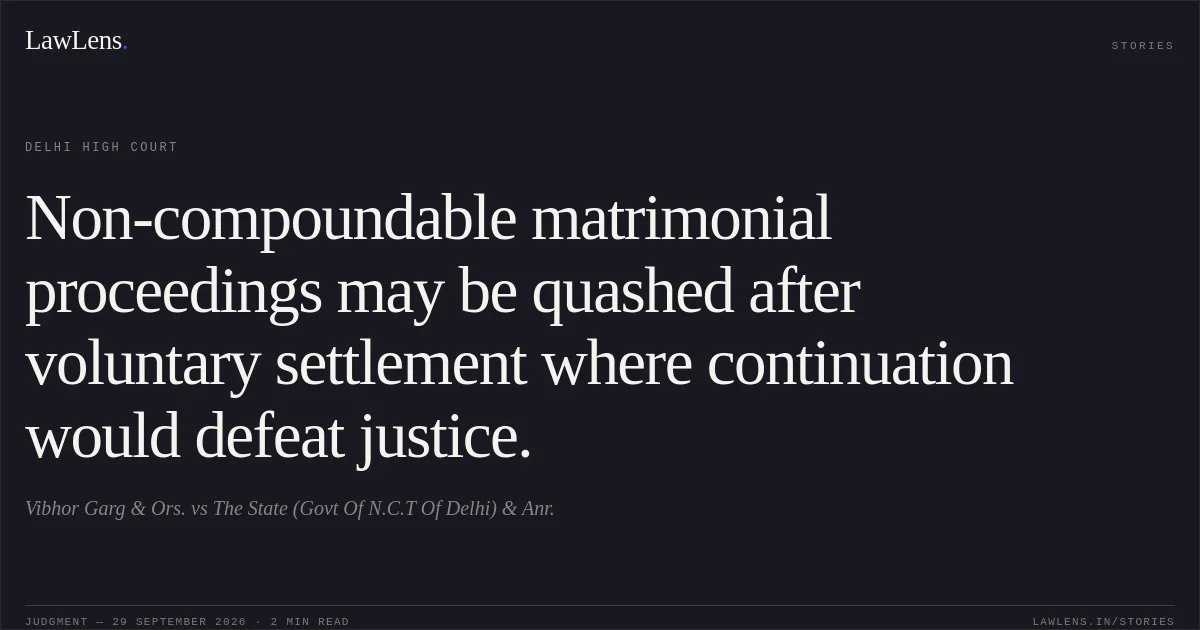
Respondent No. 2 lodged FIR No. 267/2018 at Police Station Pul Prahlad Pur under Sections 498A/406/34 IPC, alleging cruelty, dowry-related demands and retention of her property by her husband and in-laws.
Source reference: p.1–2A charge-sheet was filed against the petitioners.
Source reference: p.2During the proceedings, the parties entered into an MoU dated 3 September 2022, agreeing to dissolve the marriage by mutual consent and for petitioner No. 1 to pay respondent No. 2 ₹9 lakh. The marriage was dissolved by decree dated 3 November 2025; the remaining ₹3 lakh was handed to respondent No. 2 in court, completing payment under the MoU.
Source reference: p.2–3, 8Respondent No. 2 confirmed that the settlement was voluntary and that she did not wish to pursue the case.
Source reference: p.3–4Issues
1. Whether the High Court could quash proceedings for non-compoundable offences under Sections 498A/406/34 IPC on the basis of a settlement arising from a matrimonial dispute.
Source reference: p.4–72. Whether, in the circumstances, continuing the criminal proceedings would serve the interests of justice.
Source reference: p.8Law Applied
Section 528 of the Bharatiya Nagarik Suraksha Sanhita, 2023, corresponding to Section 482 of the Code of Criminal Procedure, preserves the High Court’s inherent power to quash criminal proceedings to secure the ends of justice or prevent abuse of process, including in appropriate cases involving non-compoundable offences.
Source reference: p.4–5Under Gian Singh v. State of Punjab, (2012) 10 SCC 303, matrimonial and other disputes with a predominantly private or civil character may be quashed where settlement makes conviction unlikely and quashing would serve justice; serious offences affecting society are ordinarily excluded.
Source reference: p.4–5Narinder Singh v. State of Punjab, (2014) 6 SCC 466, requires the Court to exercise this power cautiously, considering the nature of the offence, the settlement, the likelihood of conviction and the interests of justice.
Source reference: p.6–7The Court also referred to Deepak Kumar v. State (Govt. of NCT) of Delhi, 2024 SCC OnLine Del 1305, on assessing the facts, gravity of the offence and societal impact.
Source reference: p.7Reasoning
The Court treated the proceedings as arising from a matrimonial relationship that had ended in divorce and found that the parties had resolved their dispute through a voluntary settlement.
Source reference: p.3–4, 8Respondent No. 2 confirmed the settlement and received the full ₹9 lakh payable under the MoU, including the balance ₹3 lakh in court.
Source reference: p.3, 8Applying the principles governing quashing of non-compoundable offences, the Court concluded that continuing the case would be unfair and contrary to the interests of justice in these circumstances.
Source reference: p.8It also advised the petitioners and their family members not to contact or disturb respondent No. 2 or her family.
Source reference: p.4Holding
The High Court allowed the petition and quashed FIR No. 267/2018 under Sections 498A/406/34 IPC, together with all proceedings emanating from it.
The petition and pending application were disposed of accordingly.
Source reference: p.8Acts & Sections Cited
6 provisions across 3 statutes referred to in this judgment. Each provision opens on LawLens.
Bharatiya Nagarik Suraksha Sanhita, 20231
Indian Penal Code, 18603
Code of Criminal Procedure, 19732
Original Court PDF
Vibhor Garg & Ors.vsThe State (Govt Of N.C.T Of Delhi) & Anr.
Click to open original judgment
Original judgment, available to read, download and summarize on LawLens.in