Facts
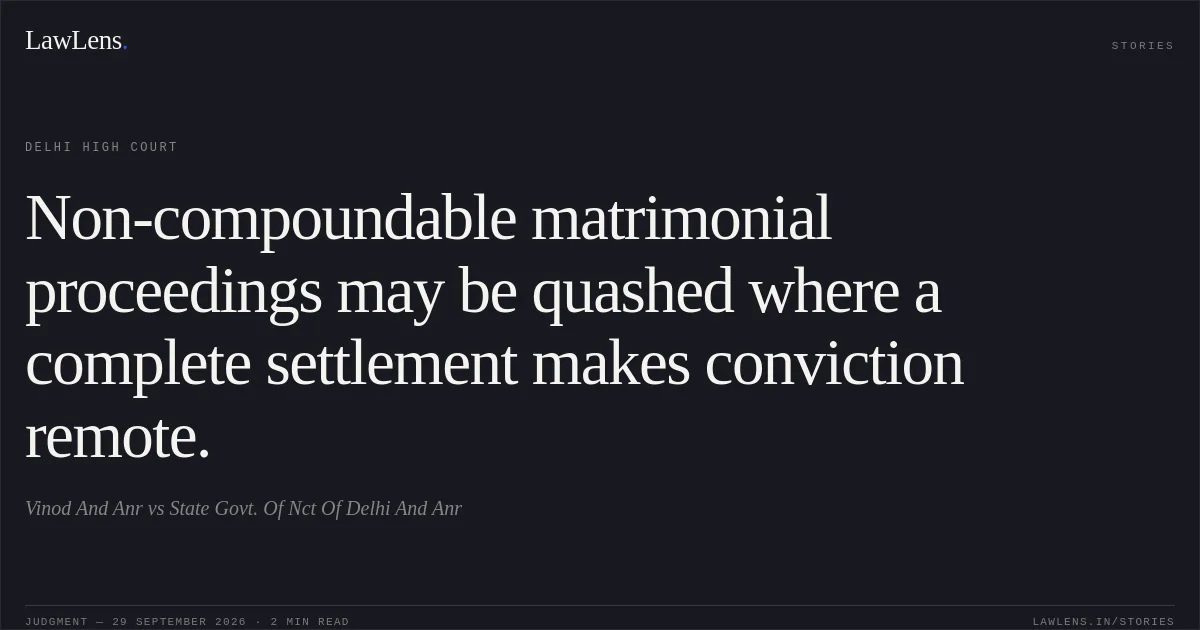
Respondent No. 2, the wife of petitioner No. 1 and daughter-in-law of petitioner No. 2, lodged FIR No. 0788/2021 under Sections 498A/406/34 IPC at Police Station Uttam Nagar, alleging matrimonial offences.
Source reference: p. 2, paras. 4–6The parties had married on 17 June 2018, separated on 27 February 2021, and had no children.
Source reference: p. 2, para. 5A chargesheet was filed on 12 April 2023.
Source reference: p. 2, para. 7The parties later settled their disputes through a settlement dated 26 May 2025; petitioner No. 1 paid respondent No. 2 ₹3 lakh, and their marriage was dissolved by mutual-consent divorce on 8 April 2026.
Source reference: pp. 2–3, paras. 8–12Respondent No. 2 confirmed the settlement and stated that she had no objection to quashing; the State also expressed no objection.
Source reference: p. 3, paras. 13–15Issues
1. Whether the High Court should exercise its inherent jurisdiction under Section 528 BNSS to quash the FIR and consequential proceedings for non-compoundable matrimonial offences after the parties have settled their dispute.
Source reference: pp. 1, 3–4, paras. 1, 16–172. Whether, in light of the settlement and the circumstances of the case, continuing the criminal proceedings would serve the ends of justice.
Source reference: pp. 7–8, paras. 19–21Law Applied
Section 528 of the Bharatiya Nagarik Suraksha Sanhita, 2023, corresponding to Section 482 CrPC, preserves the High Court’s inherent power to quash criminal proceedings to secure the ends of justice or prevent abuse of process, including in appropriate cases involving non-compoundable offences.
Source reference: pp. 1, 5–6, paras. 1, 16In Gian Singh v. State of Punjab, (2012) 10 SCC 303, the Supreme Court held that matrimonial and other predominantly private disputes may be quashed where the parties have fully settled, the possibility of conviction is remote, and continuation would defeat justice; the nature and gravity of the offence must nevertheless be considered.
Source reference: pp. 3–6, para. 16Narinder Singh v. State of Punjab, (2014) 6 SCC 466, reiterates that this power is distinct from compounding under Section 320 CrPC and must be exercised sparingly, with regard to the nature of the offence, the likelihood of conviction, and the interests of justice.
Source reference: pp. 6–7, paras. 17–18Reasoning
The Court treated the dispute as arising from a matrimonial relationship that had ended in divorce, with the parties living separately since 2021 and having resolved their differences by settlement.
Source reference: p. 7, para. 19Respondent No. 2 appeared in Court, confirmed that the settlement was voluntary and free from coercion or undue influence, and did not oppose quashing; the settlement amount had been paid.
Source reference: pp. 2–3, paras. 10–14; p. 7, para. 19Applying the principles in Gian Singh and Narinder Singh, the Court concluded that conviction was unlikely and that continuation of the proceedings would be an empty formality, unnecessarily consuming judicial resources.
Source reference: p. 8, para. 20Holding
The Court allowed the petition under Section 528 BNSS and quashed FIR No. 0788/2021, registered under Sections 498A/406/34 IPC at Police Station Uttam Nagar, Delhi, together with all consequential proceedings.
The petition and pending application were disposed of accordingly.
Source reference: p. 8, para. 22Acts & Sections Cited
5 provisions across 3 statutes referred to in this judgment. Each provision opens on LawLens.
Bharatiya Nagarik Suraksha Sanhita, 20231
Code of Criminal Procedure, 19732
Indian Penal Code, 18602
Original Court PDF
Vinod And AnrvsState Govt. Of Nct Of Delhi And Anr
Click to open original judgment
Original judgment, available to read, download and summarize on LawLens.in