01Facts
The applicant sought quashing of the chargesheet, the order dated 07.05.2024 passed by the Additional Chief Judicial Magistrate, Kotdwara, Pauri Garhwal, in Criminal Case No. 2011 of 2024, and all proceedings arising from it.
¶ 4The charges were under Sections 354, 452, 506 and 504 IPC.
¶ 4The FIR alleged that the applicant forcibly entered the complainant's house and attempted to outrage her modesty.
¶ 5The parties are close relatives. The applicant contended that a misunderstanding had led to the dispute, which was now amicably resolved.
¶ 5A joint compounding application (I.A. No. 1 of 2026), supported by affidavits of both parties, was filed.
¶ 5The complainant appeared by video conferencing, was identified by counsel, and stated that the settlement was voluntary, without pressure or coercion, and that she did not wish to pursue the case.
¶ 6 · ¶ 12The State opposed on the ground that the offences are non-compoundable, but did not dispute the compromise or the filing of the application.
¶ 702Issues
i.1. Whether, in view of the non-compoundable nature of the offences, the High Court can quash criminal proceedings under Section 528 BNSS on the basis of a compromise between the parties.
¶ 7 · ¶ 10ii.2. Whether the compromise was genuine and voluntary, and whether the dispute is predominantly private such that continuation of proceedings would serve no useful purpose.
¶ 9 · ¶ 12 · ¶ 1303Law Applied
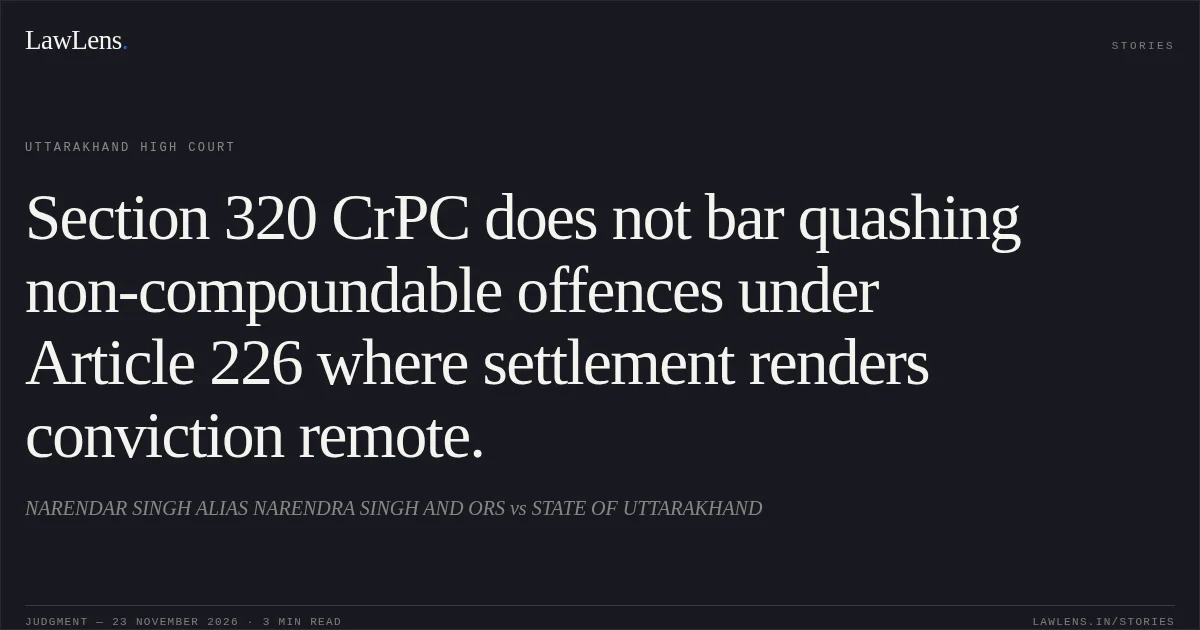
Section 528 BNSS preserves the High Court's inherent jurisdiction to secure the ends of justice and prevent abuse of process, and this jurisdiction is not restricted by the compounding provisions of the Code.
¶ 10Under Gian Singh v. State of Punjab, (2012) 10 SCC 303, and Narinder Singh v. State of Punjab, (2014) 6 SCC 466, criminal proceedings in predominantly private or personal disputes may be quashed on a genuine compromise where continuation serves no purpose, but not in cases involving heinous or serious offences with substantial societal impact.
¶ 11The Court considered the nature and gravity of the offence, its societal impact, and the circumstances of the compromise.
¶ 10The IPC sections invoked, namely Sections 354, 452, 506 and 504, are the charges against which this framework was applied.
¶ 4Provisions in the judgment · 5 · Linked ones open on LawLens
Indian Penal Code, 1860 Section 354Section 452Section 506Section 504
Bharatiya Nagarik Suraksha Sanhita, 2023 Section 528
04Reasoning
The Court treated the dispute as arising from a misunderstanding between close relatives and therefore predominantly private in character.
¶ 9 · ¶ 13The Court relied on the complainant's personal appearance, her identification by counsel, and her unequivocal statement that the compromise was voluntary and uncoerced.
¶ 6 · ¶ 12The joint affidavits corroborated the settlement.
¶ 9 · ¶ 12The Court found the State's non-compoundability objection not decisive, since Section 528 BNSS jurisdiction is independent of compounding provisions.
¶ 10On these facts, the likelihood of conviction was remote and continuation would serve no fruitful purpose.
¶ 13The Court did not expressly discuss the gravity of Section 354 IPC or the societal impact of the offences beyond noting that the case concerned a private dispute, and its reasoning on this point is brief.
¶ 1305Holding
The case was held fit for exercise of inherent jurisdiction under Section 528 BNSS, given the voluntary compromise and the predominantly private nature of the dispute.
¶ 13 · ¶ 14The compounding application (I.A. No. 1 of 2026) was allowed, and the chargesheet, the order dated 07.05.2024 in Criminal Case No. 2011 of 2024, and all criminal proceedings arising from it were quashed on the basis of the compromise.
¶ 14The C-528 application was allowed and pending applications were disposed of.
¶ 16 · ¶ 17Original Court PDF
DALBIR SINGH NEGIvsSTATE OF UTTARAKHAND
Click to open original judgment
Original judgment, available to read, download and summarize on LawLens.in