01Facts
On the complaint of Respondent No. 2 (Somraj Jagannath Patil), Crime No. 99/2023 was registered at Kudachi Police Station against the petitioners for offences under Sections 408, 409, 420, 468 and 120B read with Section 34 IPC.
¶ 3The investigation resulted in a charge-sheet, now registered as C.C. No. 2052/2025 before the Addl. Civil Judge and JMFC, Raibag, and the matter is pending trial.
¶ 2, 3The petitioners sought quashing of the entire proceedings under Section 482 CrPC (Section 528 BNSS).
¶ 2The parties, who are related and belong to Chinchali village, reported that their disputes, arising out of commercial transactions, had been settled with the advice of village elders and family members, without coercion.
¶ 4, 5The settlement terms included mutual withdrawal of multiple civil and criminal cases, issuance of a No Due Certificate, handover of cheques and documents, and withdrawal of consumer appeals.
¶ 5–8Both parties filed joint interlocutory applications and affidavits seeking compounding and quashing.
¶ 4, 5The learned HCGP and counsel for both sides supported acceptance of the compromise.
¶ 702Issues
i.1. Whether criminal proceedings in C.C. No. 2052/2025 for offences under Sections 408, 409, 420, 468 and 120B r/w 34 IPC, which the Court recorded as non-compoundable, may be quashed on the basis of a private settlement between the complainant and the accused.
¶ 8, 11ii.2. Whether, in the circumstances of a predominantly civil/commercial and family dispute at the post-charge-sheet stage, the chances of conviction are remote such that continuation of the prosecution would be an abuse of process.
¶ 9, 1003Law Applied
The Court relied on Section 528 BNSS (corresponding to Section 482 CrPC), which preserves the High Court's inherent power to quash proceedings and prevent abuse of process. It distinguished this inherent power from compounding under Section 320 CrPC (applied via Section 320(2)).
¶ 2, 4, 8Narinder Singh & Ors. v. State of Punjab & Anr., (2014) 6 SCC 466, paras 31–35, holds that inherent power to quash non-compoundable offences exists but must be exercised sparingly and with caution, and that the guiding factors are ends of justice or prevention of abuse of process.
¶ 9Under Narinder Singh, serious, heinous, or special-statute offences are not quashable merely on compromise, whereas cases of predominantly civil character, including commercial, matrimonial, or family disputes, should be quashed when the parties have resolved their entire disputes.
¶ 9Under Narinder Singh, the Court must assess whether conviction is remote and continuation would cause oppression or injustice, and the stage of proceedings is a relevant factor, with greater liberality at early stages.
¶ 9Provisions in the judgment · 12 · Linked ones open on LawLens
Bharatiya Nagarik Suraksha Sanhita, 2023 Section 528Section 319
Code of Criminal Procedure, 1973 Section 482Section 320
Indian Penal Code, 1860 Section 408Section 409Section 420Section 468Section 34Section 307Section 324Section 323
04Reasoning
The Court found that the complainant had filed the case under a misconception of facts and in a fit of anger, and had since realised the error and wished to withdraw it on the advice of elders.
¶ 10Applying Narinder Singh, the Court treated the dispute as predominantly civil, arising from commercial transactions and family relations, which favoured quashing under category (IV).
¶ 9, 10The Court noted that the parties had settled all disputes, including the mutual withdrawal of multiple cases, and had agreed to live peacefully, a factor that weighed in favour of harmony.
¶ 5, 10On the conviction assessment under category (V), the Court held that further investigation was unnecessary, that witnesses were unlikely to support the prosecution after compromise, and that the role of the accused was unclear with no direct nexus alleged against them.
¶ 10The Court concluded that the chances of conviction were "very remote" and that continuing the proceedings would be unnecessary and an abuse of process.
¶ 8, 10The Court acted under its inherent power rather than granting compounding under Section 320, because it had already described the offences as non-compoundable.
¶ 8, 1105Holding
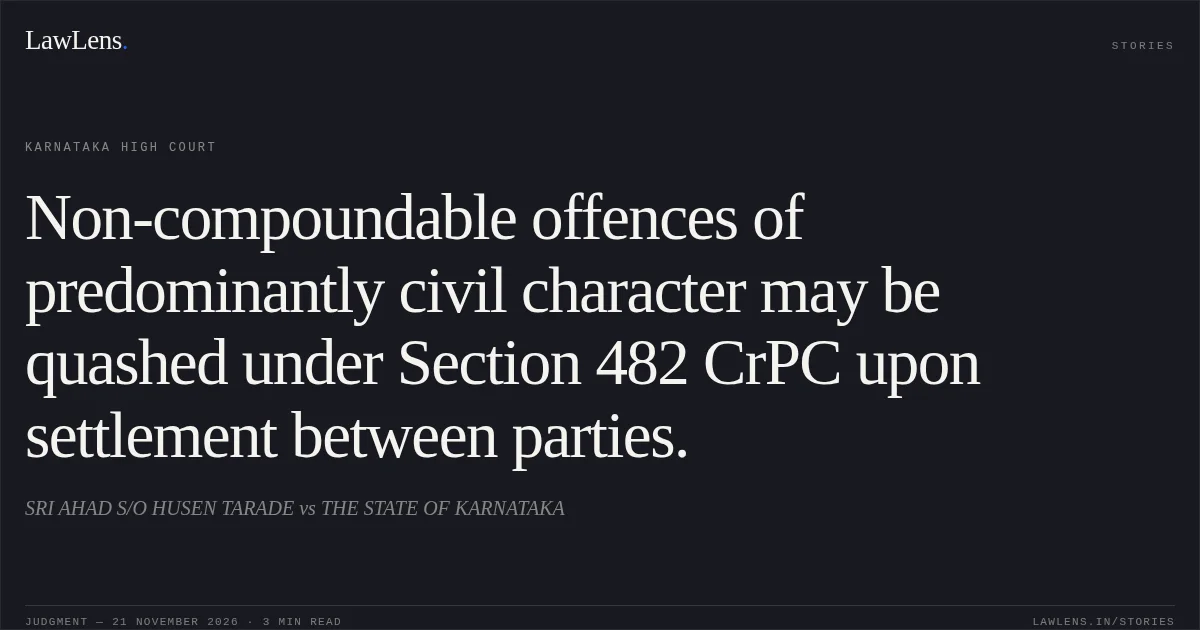
In view of the settlement and the principles in Narinder Singh, the criminal proceedings in C.C. No. 2052/2025 on the file of the Addl. Civil Judge and JMFC, Raibag (arising from Crime No. 99/2023, Kudachi P.S.) are quashed insofar as they relate to Accused Nos. 3 to 6, 7 to 11, 12, 13 and 14. The compromise is accepted.
¶ 11Both criminal petitions are allowed. Pending interlocutory applications are disposed of as not surviving for consideration.
¶ 11Original Court PDF
SRI AHAD S/O HUSEN TARADEvsTHE STATE OF KARNATAKA
Click to open original judgment
Original judgment, available to read, download and summarize on LawLens.in