01Facts
The petitioners, Accused Nos. 1 to 5, sought quashing under Section 528 BNSS (Section 482 CrPC) of the entire proceedings in Crime No. 21/2025 registered at Gajendragad Police Station, Gadag District, for offences under Sections 189(2), 191(1), 115(2), 74, 352, 351(2) and 109 of the BNS, 2023.
p. 2 · ¶ 1The case was registered on the first information of the de facto complainant, Respondent No. 2.
¶ 2At the hearing, both parties filed a compromise petition under Section 359(1) read with Section 528 BNSS, signed by them and their counsel.
¶ 3 · pp. 3–4The complainant's affidavit stated that she would not pursue further fights or allegations against the petitioners, that the matter was settled in the presence of elders, and that there was no pressure, compulsion or coercion.
p. 5The Court noted that the alleged offences are non-compoundable and that the dispute was settled on the advice of elders of both families.
¶ 4 · pp. 5–602Issues
i.1. Whether the High Court can quash criminal proceedings relating to non-compoundable offences under the BNS, on the basis of a settlement between the complainant and the accused, in exercise of its inherent power under Section 528 BNSS.
pp. 6–7 · ¶ 5ii.2. Whether, on the facts of the present case, continuation of the prosecution against the petitioners would be an abuse of process, such that the compromise should be accepted and the proceedings quashed.
pp. 13–14 · ¶ 603Law Applied
The Court relied on Section 528 BNSS (inherent powers of the High Court) and Section 359(1) BNSS (compounding), and on the principles laid down in Narinder Singh & Ors. v. State of Punjab (2014) 6 SCC 466.
p. 6 · ¶ 5Under Narinder Singh, the High Court may quash proceedings for non-compoundable offences on settlement, but this power is to be exercised sparingly and with caution, with the guiding considerations being the ends of justice and prevention of abuse of process.
p. 7 · ¶ 31(I)–(II)Such power is not to be exercised for heinous or serious offences of mental depravity, or for offences against society, but is appropriate for cases of predominantly civil character or family disputes where the parties have resolved their differences.
p. 8 · ¶ 31(III)–(IV)The Court must assess whether conviction is remote or bleak and whether continuation would cause oppression or extreme injustice.
p. 8 · ¶ 31(V)The timing of settlement is relevant: early settlements, before evidence has begun, are viewed more liberally.
pp. 9–10 · ¶ 31(VII)Provisions in the judgment · 15 · Linked ones open on LawLens
Code of Criminal Procedure, 1973 Section 482Section 320
Bharatiya Nagarik Suraksha Sanhita, 2023 Section 528Section 359
Bharatiya Nyaya Sanhita, 2023 Section 189Section 191Section 115Section 74Section 352Section 351Section 109
Indian Penal Code, 1860 Section 307Section 324Section 323Section 34
04Reasoning
The Court applied the Narinder Singh framework to the material before it. It noted that the dispute was essentially interpersonal and arose from a family/village disagreement, and that the complainant had filed the case "with misconception of facts and in a fit of anger" but had since realised her mistake.
p. 13 · ¶ 6The settlement was reached through the intervention of elders of both families, and the parties resolved to live peacefully.
p. 13 · ¶ 6The Court reasoned that, because of the compromise, further investigation was unnecessary and the witnesses were unlikely to support the prosecution, so the chances of conviction were "very remote."
p. 13 · ¶ 6Applying the Narinder Singh factors cumulatively, the Court held that continuing the proceedings would serve no purpose and would be an abuse of process.
pp. 13–14 · ¶ 6The Court's reasoning rests principally on the private, compromisable character of the dispute and the remoteness of conviction; it does not separately analyse the individual BNS provisions or the stage of the proceedings beyond the FIR-stage posture.
05Holding
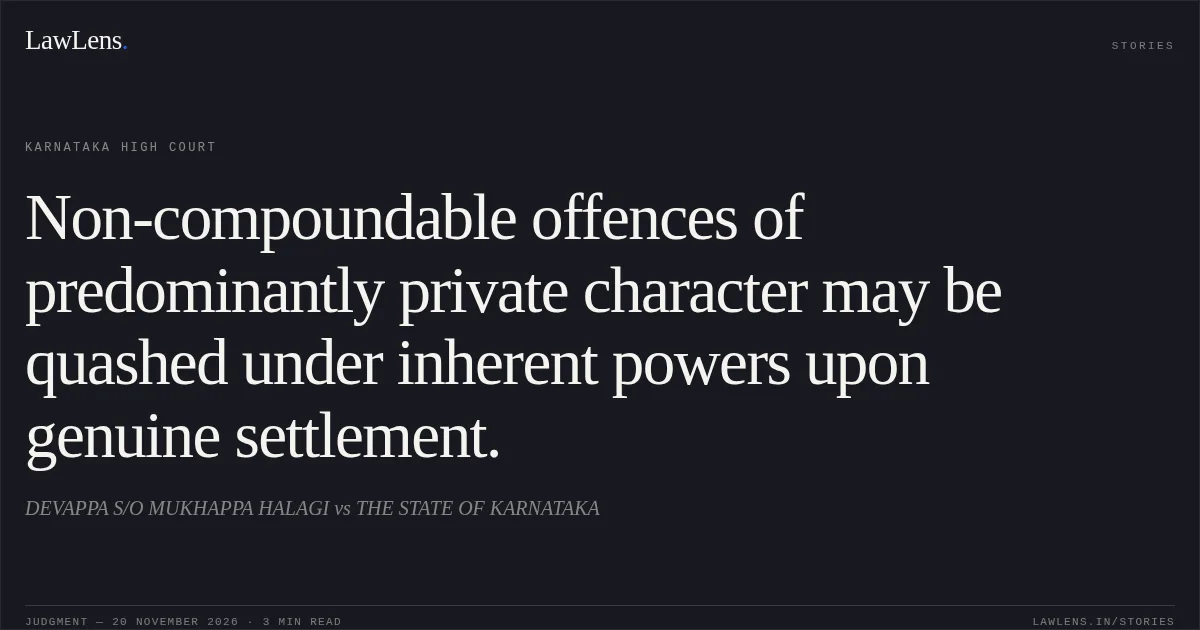
The Court held that the compromise between the parties should be accepted and that the criminal proceedings against the petitioners were liable to be quashed, as continuation would be unnecessary and an abuse of process.
p. 14 · ¶ 6–7The petition was allowed. The entire proceedings in Crime No. 21/2025 (Gajendragad PS), pending before the Principal Civil Judge (Jr. Dn.) and JMFC, Ron, were quashed insofar as Accused Nos. 1 to 5 are concerned. The compromise petition was allowed, and pending I.A.s, if any, were disposed of.
pp. 14–15 · ¶ 7Original Court PDF
DEVAPPA S/O MUKHAPPA HALAGIvsTHE STATE OF KARNATAKA
Click to open original judgment
Original judgment, available to read, download and summarize on LawLens.in