01Facts
The petitioner, Dr. Amareshwara, is a Professor and HOD of Biochemistry at Koppal Institute of Medical Sciences (KIMS). The second respondent, Dr. Vijayanath, is the Director of KIMS and the complainant.
p. 1The complainant lodged a complaint dated 06.11.2023 against the petitioner, leading to Koppal Rural Circle P.S. Crime No. 180/2023 under Sections 504 and 506 IPC, pending before the Additional Civil Judge and JMFC, Koppal.
p. 2 · p. 4The petitioner sought quashing under Section 482 CrPC (Section 528 BNSS).
p. 2During the pendency of the case, the parties, through well-wishers and elders, settled their differences. The complainant agreed to withdraw all allegations unconditionally, and both agreed to maintain professionalism in the institution.
pp. 2–4Both parties filed I.A. No. 1/2026 under Section 320 CrPC seeking compounding, along with affidavits affirming that the compromise was voluntary and without coercion or monetary consideration.
p. 2 · pp. 5–6The court observed that the offences were non-compoundable.
p. 5 · ¶ 3Both counsel and the HCGP for the State supported acceptance of the compromise.
p. 6 · ¶ 202Issues
i.1. Whether the High Court can quash criminal proceedings under Section 482 CrPC (Section 528 BNSS) for offences under Sections 504 and 506 IPC, which are non-compoundable, on the basis of a settlement between the parties.
p. 5 · ¶ 3 · p. 6 · ¶ 4ii.2. Whether the facts and the nature of the dispute, including the possibility of conviction and the effect of the settlement, justify quashing the proceedings in this case.
pp. 11–12 · ¶ 503Law Applied
Section 482 CrPC (Section 528 BNSS) preserves the High Court's inherent power to prevent abuse of process and secure the ends of justice.
p. 2 · p. 5 · ¶ 3Section 320 CrPC governs compounding of compoundable offences and was invoked through I.A. No. 1/2026.
p. 2Under Narinder Singh & Ors. v. State of Punjab & Anr., (2014) 6 SCC 466, para. 31, the inherent power under Section 482 may be used for non-compoundable offences, but sparingly and with caution.
pp. 6–7 · ¶ 4The High Court must assess whether the settlement serves the ends of justice or prevents abuse of process.
p. 7 · ¶ 31(II)Such power should not be used for heinous or serious offences.
p. 7 · ¶ 31(III)The power should be used more readily for cases of predominantly civil character, including family or matrimonial disputes.
p. 8 · ¶ 31(IV)The court must consider whether conviction is remote and whether continuation would cause oppression and injustice.
p. 8 · ¶ 31(V)The timing of the settlement is relevant.
p. 9 · ¶ 31(VII)In Narinder Singh (paras. 33–35), the settlement was accepted because evidence had not begun and conviction was remote.
pp. 10–11 · ¶ 33–35Provisions in the judgment · 9 · Linked ones open on LawLens
Code of Criminal Procedure, 1973 Section 482Section 320
Bharatiya Nagarik Suraksha Sanhita, 2023 Section 528
Indian Penal Code, 1860 Section 504Section 506Section 307Section 324Section 323Section 34
04Reasoning
The court held that the dispute was essentially personal and workplace-related, not a serious offence against society, and that Sections 504 and 506 IPC are of limited gravity.
p. 5 · ¶ 3The court found that the complaint was filed "with misconception of facts and in a fit of anger," and that the complainant now wished to withdraw it on the advice of family elders.
p. 11 · ¶ 5The settlement was voluntary, supported by affidavits from both parties, and aimed at restoring harmony in a shared institution.
pp. 5–6Applying the Narinder Singh factors, the court found that the allegations did not clearly attribute a direct role to the petitioner, and that the complainant had not clearly established a direct nexus.
p. 12 · ¶ 5The court noted that witnesses were unlikely to support the prosecution, so conviction appeared "very remote."
p. 12 · ¶ 5Continuing the proceedings would be unnecessary and an abuse of process, and the compromise should be accepted cumulatively, in line with Narinder Singh.
p. 5 · ¶ 3 · p. 12 · ¶ 5The court did not grant compounding under Section 320 CrPC. Instead, it used its inherent power under Section 482 to quash the proceedings.
p. 12 · ¶ 605Holding
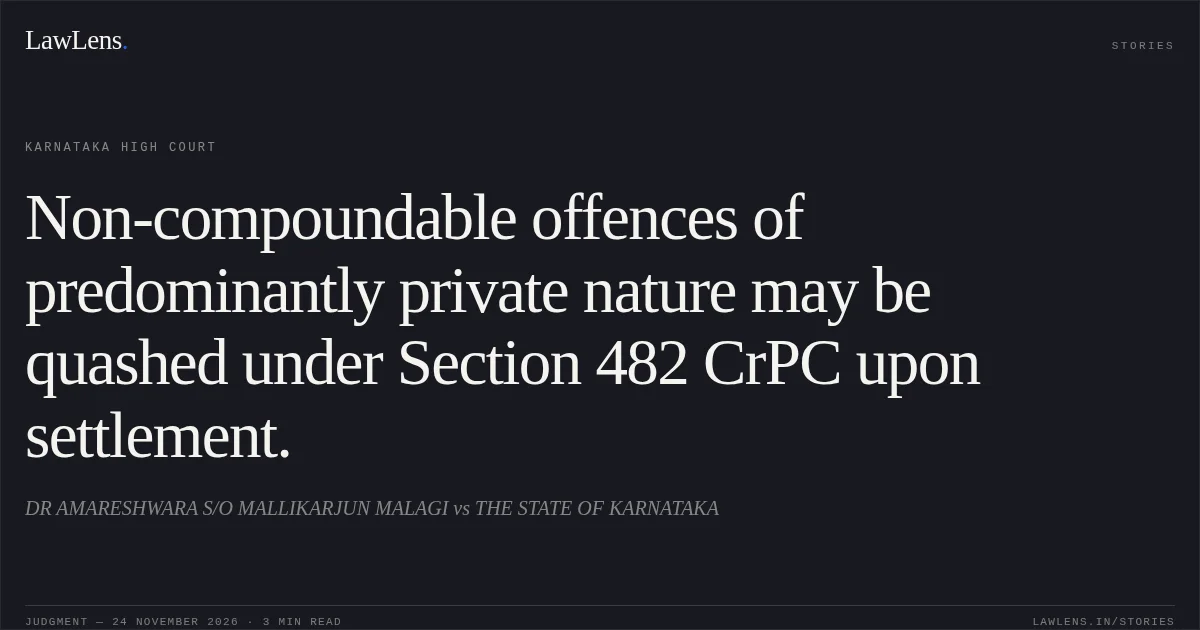
The court answered both issues in the affirmative. Quashing under Section 482 CrPC is permissible for non-compoundable offences under Sections 504 and 506 IPC where the parties have settled a predominantly personal dispute and conviction is remote.
p. 12 · ¶ 5–6The petition was allowed. The entire proceedings in Crime No. 180/2023 of Koppal Rural Circle P.S., pending before the Additional Civil Judge and JMFC, Koppal, were quashed insofar as the petitioner is concerned. Pending I.As. were disposed of as not surviving for consideration.
p. 13Original Court PDF
DR AMARESHWARA S/O MALLIKARJUN MALAGIvsTHE STATE OF KARNATAKA
Click to open original judgment
Original judgment, available to read, download and summarize on LawLens.in