01Facts
Respondent No. 2/Jawaharlal Nehru University (JNU), through its Chief Security Officer, lodged a complaint alleging that the petitioners—students and former students of JNU—had forcibly entered and unauthorisedly occupied the University’s Administrative Block during a protest against implementation of the UGC Gazette Notification, 2016.
¶ 3The petitioners were also alleged to have obstructed University officials, wrongfully confined officials, and threatened or assaulted security personnel.
¶ 3Consequently, FIR No. 83/2017 was registered at Police Station Vasant Kunj under Sections 183, 353, 341, 506, 34 and 323 of the IPC.
¶ 3–4A chargesheet had been filed on 8 November 2023.
¶ 5The Trial Court recorded JNU’s statement that it did not wish to pursue the matter, subject to acceptance of an apology from the petitioners.
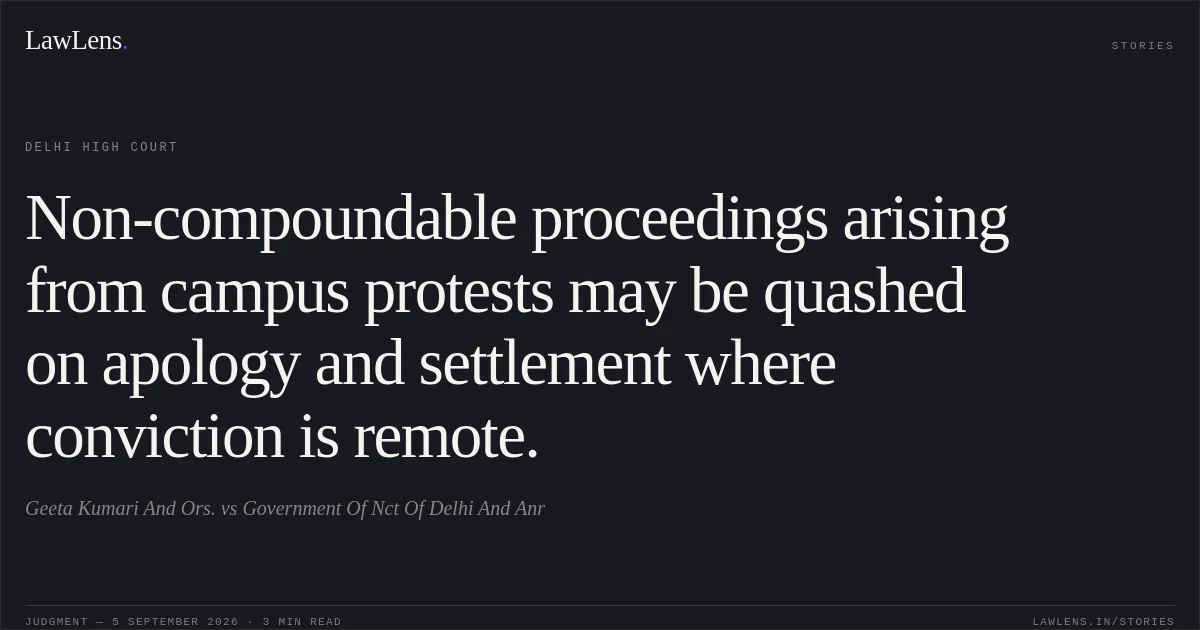
¶ 6Since certain offences were non-compoundable, the petitioners approached the High Court under Section 528 of the BNSS seeking quashing of the FIR and consequential proceedings.
¶ 6JNU’s Registrar filed an affidavit expressing willingness to accept the petitioners’ apology and confirming that the University did not wish to pursue the case, keeping in view the students’ academic and rehabilitative interests.
¶ 7–8The petitioners tendered oral apologies before the High Court.
¶ 902Issues
i.Whether the High Court could exercise its inherent jurisdiction under Section 528 of the BNSS, corresponding to Section 482 of the CrPC, to quash proceedings involving non-compoundable offences on the basis of a settlement and apology?
¶ 1, 6, 11, 15–16ii.Whether, in the circumstances of the campus-related student protest and JNU’s categorical decision not to pursue the matter, continuation of FIR No. 83/2017 would serve any useful purpose?
¶ 13–1503Law Applied
The Court exercised its inherent jurisdiction under Section 528 of the Bharatiya Nagarik Suraksha Sanhita, 2023, corresponding to Section 482 of the CrPC, to secure the ends of justice.
¶ 1, 16–17It applied the principle that even proceedings concerning non-compoundable offences may be quashed on the basis of a settlement where the dispute is essentially private or personal in nature, the complainant no longer wishes to pursue the matter, continuation would serve no meaningful purpose, and the likelihood of conviction is remote, as recognised in Gian Singh v. State of Punjab & Anr., (2012) 10 SCC 303, and Narinder Singh & Ors. v. State of Punjab & Anr., (2014) 6 SCC 466.
¶ 11The Court also relied on Albert Bansala & Ors. v. Government of NCT of Delhi & Anr., CRL.M.C. 5176/2025, decided on 5 February 2026, where similar criminal proceedings arising from a student protest were quashed after the University confirmed that it had no subsisting grievance.
¶ 12Provisions in the judgment · 9 · Linked ones open on LawLens
Bharatiya Nagarik Suraksha Sanhita, 2023 Section 528
Code of Criminal Procedure, 1973 Section 482
Indian Penal Code, 1860 Section 183Section 353Section 341Section 506Section 34Section 323
Prevention of Damage to Public Property Act, 1984 Section 3
04Reasoning
The Court characterised the dispute as arising from a campus-related student agitation concerning implementation of the UGC Gazette Notification, rather than from personal animosity or an independent criminal design.
¶ 13JNU, the complainant, had expressly stated through its Registrar that it did not wish to pursue the proceedings, subject to the petitioners tendering apologies, and had accepted the relevance of academic and rehabilitative considerations.
¶ 8, 14The petitioners accordingly tendered oral apologies before the Court.
¶ 9Applying the principles in Gian Singh and Narinder Singh, the Court held that the complainant’s position substantially weakened the prospect of conviction and that continuation of the prosecution would merely prolong the criminal process without serving a useful purpose.
¶ 15The circumstances therefore justified exercise of the Court’s inherent jurisdiction notwithstanding the non-compoundable nature of some offences.
¶ 11, 15–1605Holding
The High Court answered the issues in favour of the petitioners and held that continuation of the criminal proceedings would not serve the ends of justice.
¶ 16–17Exercising powers under Section 528 of the BNSS, the Court quashed FIR No. 83/2017, registered at Police Station Vasant Kunj, Delhi, under Sections 183, 353, 341, 506, 34 and 323 of the IPC, along with all consequential proceedings.
¶ 16–17The parties’ original affidavits were directed to be filed before the Trial Court within four weeks so that they would form part of the Trial Court record.
¶ 17The petition and pending application were consequently disposed of.
¶ 18Original Court PDF
Geeta Kumari And Ors.vsGovernment Of Nct Of Delhi And Anr
Click to open original judgment
Original judgment, available to read, download and summarize on LawLens.in