Facts
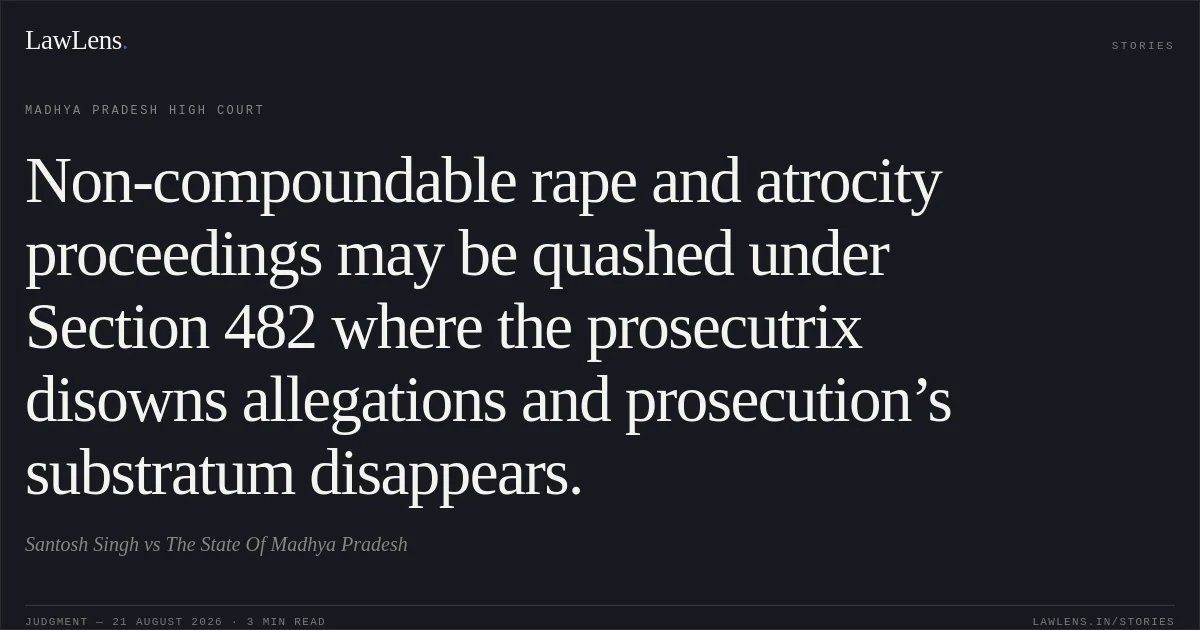
Crime No. 06/2013 was registered at Police Station Garhwa, District Singrauli, against the petitioner for offences under Section 376 of the Indian Penal Code and Sections 3(1)(xii) and 3(2)(v) of the Scheduled Castes and the Scheduled Tribes (Prevention of Atrocities) Act
Source reference: para. 1After the criminal proceedings remained pending for more than thirteen years, the petitioner and respondent No. 2/prosecutrix filed a joint application seeking permission to compromise and quashing of the proceedings
Source reference: para. 2Pursuant to the Court’s order dated 11 August 2026, the Registrar (J-II) recorded and verified the statements of both parties, finding that the compromise was voluntary and free from coercion or inducement
Source reference: para. 4The prosecutrix stated that the petitioner had not committed the alleged act, that she had lodged the complaint at the instance of one Pradeep Singh, under whom she was working, and that she did not wish to pursue the case
Source reference: para. 5Issues
Whether the High Court could exercise its inherent jurisdiction under Section 482 of the Code of Criminal Procedure to quash proceedings for non-compoundable offences under Section 376 IPC and the SC/ST (Prevention of Atrocities) Act on the basis of a compromise and the prosecutrix’s verified statement
Source reference: paras. 5–6Whether, in view of the prosecutrix’s statement that the petitioner was falsely implicated, she could claim or retain compensation under the applicable Victim Compensation Scheme
Source reference: paras. 10–12Law Applied
Section 320 Cr.P.C. governs the compounding of offences, but the High Court’s inherent jurisdiction under Section 482 Cr.P.C. is distinct and may be exercised to secure the ends of justice or prevent abuse of the process of law, including in appropriate cases involving non-compoundable offences
Source reference: para. 6Relying on Gian Singh v. State of Punjab, (2012) 10 SCC 303, the Court held that proceedings may be quashed where the dispute is essentially personal and continuation would serve no useful purpose or amount to abuse of process
Source reference: para. 6Under Narinder Singh v. State of Punjab, (2014) 6 SCC 466, offences of a heinous or serious nature, including rape, ordinarily should not be quashed merely on the basis of compromise; the Court must consider the nature and gravity of the offence, the antecedent facts, the likelihood of conviction, and the broader interests of justice
Source reference: para. 6The Court further held that statutory victim-compensation mechanisms cannot be invoked on the basis of a false or non-bona fide prosecution, and any amount already disbursed may be recovered in accordance with law
Source reference: paras. 10–12Reasoning
Although the alleged offences were serious and non-compoundable, the Court found that the case presented exceptional circumstances warranting Section 482 Cr.P.C. intervention
Source reference: no citationThe prosecutrix’s statement was recorded and verified by the Registrar, was voluntary, and unequivocally disowned the accusation by stating that the petitioner had not committed the alleged act and had been falsely implicated at another person’s instance
Source reference: paras. 4–7In these circumstances, the foundation of the prosecution case had substantially disappeared, making a trial unlikely to serve any meaningful purpose and rendering continuation of the proceedings an abuse of process
Source reference: paras. 7–9The Court nevertheless distinguished the quashing relief from the compensation issue, holding that a person who had stated that the prosecution was false could not claim compensation on the basis of that occurrence; any compensation already paid was liable to be dealt with by the competent authority in accordance with law
Source reference: paras. 10–12Holding
The Court allowed I.A. No. 18087/2026 and quashed Crime No. 06/2013, along with all consequential criminal proceedings, insofar as they concerned the petitioner
The petitioner was relieved from the criminal proceedings
Source reference: para. 13Respondent No. 2 was held disentitled to claim or receive compensation under the applicable Victim Compensation Scheme on the basis of the present occurrence, and the competent authority was directed to take appropriate steps regarding any amount already disbursed
Source reference: paras. 11, 13The application was disposed of accordingly
Source reference: para. 14Acts & Sections Cited
4 provisions across 3 statutes referred to in this judgment. Each provision opens on LawLens.
Indian Penal Code, 18601
Scheduled Castes and the Scheduled Tribes (Prevention of Atrocities) Act, 19891
Code of Criminal Procedure, 19732
Original Court PDF
Santosh SinghvsThe State Of Madhya Pradesh
Click to open original judgment
Original judgment, available to read, download and summarize on LawLens.in