Facts
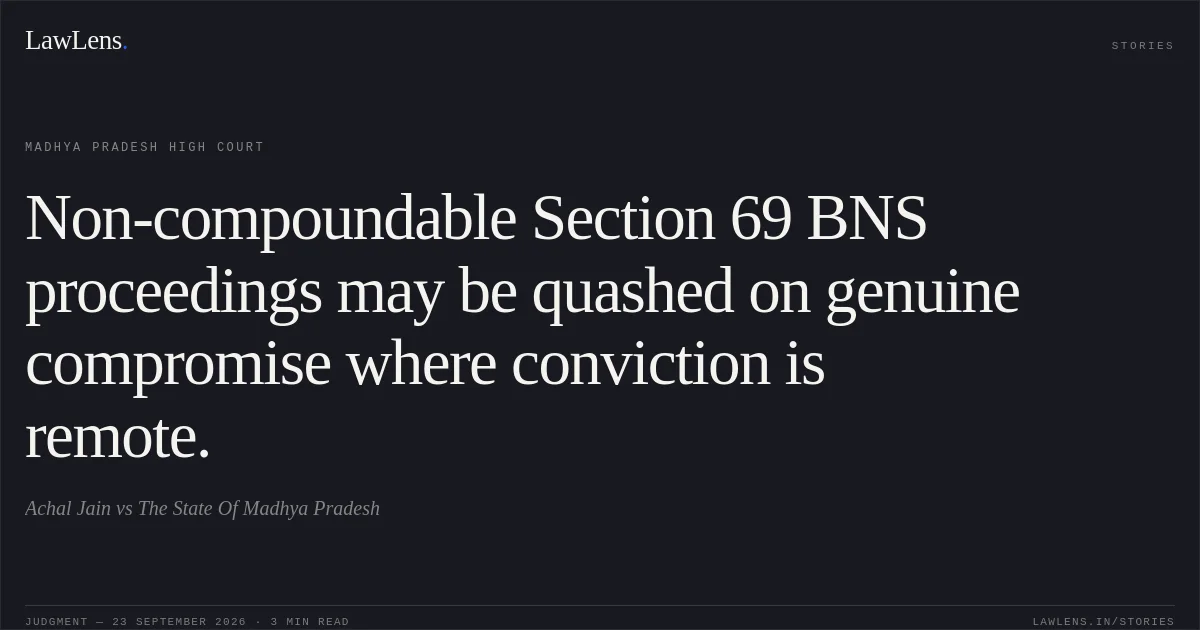
The petitioners invoked Section 528 of the Bharatiya Nagarik Suraksha Sanhita, 2023 (“BNSS”) seeking quashing of FIR No. 142/2026 registered at Police Station Mahila Thana, Indore, for offences under Sections 115(2), 3(5), 351(2), 351(3) and 69 of the Bharatiya Nyaya Sanhita, 2023 (“BNS”), together with all consequential proceedings.
Source reference: para. 2The petition was based on a compromise between the petitioners and the prosecutrix. The compromise was verified by the Principal Registrar, who reported that it had been entered into voluntarily, without threat, inducement or coercion.
Source reference: para. 2The prosecutrix did not oppose the petition, while the State opposed the prayer.
Source reference: paras. 4–5The Court also recorded that the parties had resumed cordial relations and that, as submitted by counsel, the challan had not been filed.
Source reference: para. 13Issues
1. Whether the High Court could exercise its jurisdiction under Section 528 BNSS to quash proceedings involving a non-compoundable offence under Section 69 BNS on the basis of a voluntary compromise between the parties?
Source reference: paras. 3, 7–132. Whether, in view of the compromise, the absence of opposition by the prosecutrix, the early stage of proceedings and the remote possibility of conviction, continuation of the prosecution would serve any useful purpose?
Source reference: paras. 8, 13Law Applied
The Court applied Section 528 BNSS, which preserves the High Court’s inherent power to prevent abuse of process and secure the ends of justice.
Source reference: para. 7It relied on Gian Singh v. State of Punjab, Narinder Singh v. State of Punjab, Jagdish Channa v. State of Haryana, Madan Mohan Abbot v. State of Punjab, Shiji v. Radhika, and Ramavtar v. State of Madhya Pradesh, for the principle that non-compoundable criminal proceedings may, in appropriate cases, be quashed on the basis of a genuine compromise, particularly where the dispute is essentially private and continuation of proceedings is unlikely to result in conviction.
Source reference: para. 7Under Kapil Gupta v. State of NCT of Delhi, the Court may examine whether sufficient material exists to sustain the alleged serious offence, whether the settlement would restore harmony, and the stage of the proceedings; an application made before commencement of trial weighs in favour of quashing.
Source reference: para. 8State of Madhya Pradesh v. Laxmi Narayan limits this power by cautioning that heinous offences, offences involving mental depravity, offences affecting society at large, and offences under special statutes ordinarily should not be quashed merely because of a compromise.
Source reference: para. 9The Court also relied on the principle that the mere invocation of a serious penal provision is not conclusive; the Court may examine the available evidence, the nature of the injury and other surrounding circumstances to assess the likelihood of conviction.
Source reference: paras. 10–12Reasoning
The Court found that the compromise had been independently verified and was voluntary, and that the prosecutrix expressly had no objection to quashing.
Source reference: paras. 2, 4, 6Although Section 69 BNS was non-compoundable, the Court held that the inherent power under Section 528 BNSS was not thereby excluded.
Source reference: para. 13Applying the principles governing quashing on compromise, the Court considered the dispute to be essentially between the parties, noted the restoration of their relations, and found the possibility of conviction to be remote and bleak in light of the settlement.
Source reference: para. 13The early stage of the proceedings, including the submission that the challan had not been filed, further favoured intervention before the matter proceeded to trial.
Source reference: para. 13The Court concluded that continuation of the prosecution could disrupt the parties’ restored relationship and would not advance the interests of justice.
Source reference: para. 13Holding
The High Court allowed the petition and quashed FIR No. 142/2026 registered at Police Station Mahila Thana, Indore, for offences under Sections 115(2), 3(5), 351(2), 351(3) and 69 BNS, along with all consequential proceedings, insofar as they related to the petitioners, on the basis of the compromise between the parties.
The petition was accordingly disposed of.
Source reference: para. 15Acts & Sections Cited
10 provisions across 4 statutes referred to in this judgment. Each provision opens on LawLens.
Bharatiya Nagarik Suraksha Sanhita, 20231
Bharatiya Nyaya Sanhita, 20234
Indian Penal Code, 18603
Code of Criminal Procedure, 19732
Original Court PDF
Achal JainvsThe State Of Madhya Pradesh
Click to open original judgment
Original judgment, available to read, download and summarize on LawLens.in