Facts
On June 17, 2011, Ms. Iti Aggarwal (deceased), a 27-year-old IT Consultant, died in a motor accident involving a Tata Ace vehicle near Naraina flyover
Source reference: p. 2The claimants (parents) filed a petition under Section 166 of the Motor Vehicles Act, 1988 (MV Act).
Source reference: no citationThe Tribunal awarded Rs. 1,04,09,103/- with 7.5% interest, holding the driver of the offending vehicle liable
Source reference: p. 2, 4Both the Insurance Company and the claimants filed cross-appeals challenging the quantum and the finding of negligence.
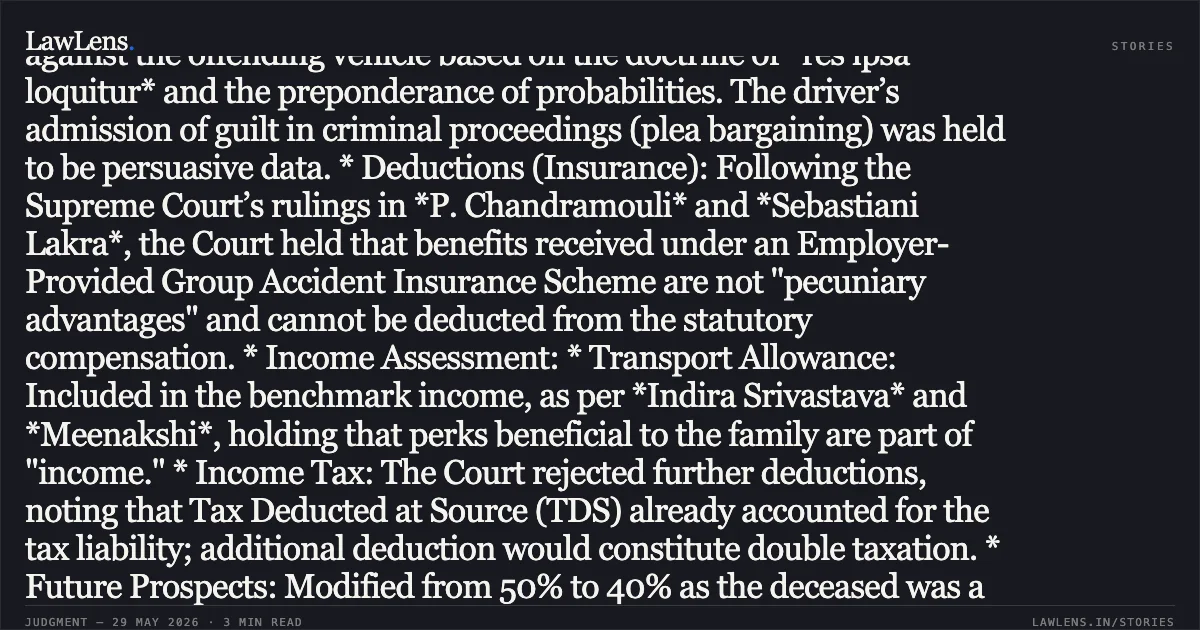
Source reference: no citationNotably, the driver had admitted guilt through plea bargaining in the connected criminal proceedings
Source reference: para. 24Issues
1. Whether the Tribunal correctly established negligence on the part of the offending vehicle's driver in the absence of eyewitnesses
Source reference: para. 182. Whether the amount of Rs. 20 lakhs received by the claimants under a Group Accident Insurance Scheme is liable to be deducted from the compensation
Source reference: para. 11, 263. Whether transport allowance should be included in the monthly income and whether the deduction of TDS was sufficient for tax purposes
Source reference: para. 15, 334. Whether the appropriate rate of interest and future prospects were applied
Source reference: para. 13, 48Law Applied
The court applied the principle of preponderance of probabilities and the doctrine of res ipsa loquitur for negligence in motor accident claims, as affirmed in National Insurance Company Ltd. v. Shehnaj Begum
Source reference: para. 22It relied on Sebastiani Lakra v. National Insurance Co. Ltd. and KSRTC v. P. Chandramouli, which established that contractual benefits like group insurance are not "pecuniary advantages" and cannot be deducted from statutory compensation
Source reference: para. 29, 30Regarding salary, the court followed National Insurance Co. Ltd. v. Indira Srivastava and Meenakshi v. Oriental Insurance Co., holding that all perks/allowances beneficial to the family, including transport allowance, constitute "income"
Source reference: para. 35, 36For future prospects, it followed National Insurance Co. Ltd. v. Pranay Sethi
Source reference: para. 46, 50Reasoning
The Court upheld the finding of negligence, noting that while no eyewitnesses testified, the Mechanical Inspection Reports and the site plan created a strong inference of fault under the doctrine of res ipsa loquitur
Source reference: para. 22Furthermore, the driver’s admission of guilt in criminal proceedings was deemed persuasive
Source reference: para. 24On deductions, the Court rejected the Insurance Company's plea to deduct the Rs. 20 lakh group insurance payout, ruling that such contractual amounts are earned by the deceased and have no nexus with the tortfeasor's statutory liability
Source reference: para. 31, 32The Court added the transport allowance back into the income, reasoning that only statutory taxes—not fixed allowances—should be deducted
Source reference: para. 37, 38For taxes, the Court held that since TDS was already deducted by the employer, further deductions would constitute double taxation
Source reference: para. 42Future prospects were reduced from 50% to 40% as the deceased was in private employment without a "permanent" job status
Source reference: para. 47Holding
Negligence was proved on the basis of preponderance of probabilities [para. 25]; Group Insurance benefits are not deductible [para. 32]; Transport allowance is part of income [para. 38]; Future prospects are 40% for private sector employees [para. 47]; and Interest rate is increased to 8.5% per annum to align with RBI fixed deposit rates at the time of the accident
The Court enhanced the compensation to Rs. 1,06,50,373/-
Source reference: para. 54The Court directed the Insurance Company to deposit the enhanced amount and remaining balance within six weeks
Source reference: para. 56Acts & Sections Cited
7 provisions across 2 statutes referred to in this judgment. Each provision opens on LawLens.
Motor Vehicles Act, 19885
Indian Penal Code, 18602
Original Court PDF
G C Agarwal & OrsvsSomveer Pal & Ors (Relinace General Insurance Co Ltd)
Click to open original judgment
Original judgment, available to read, download and summarize on LawLens.in