01Facts
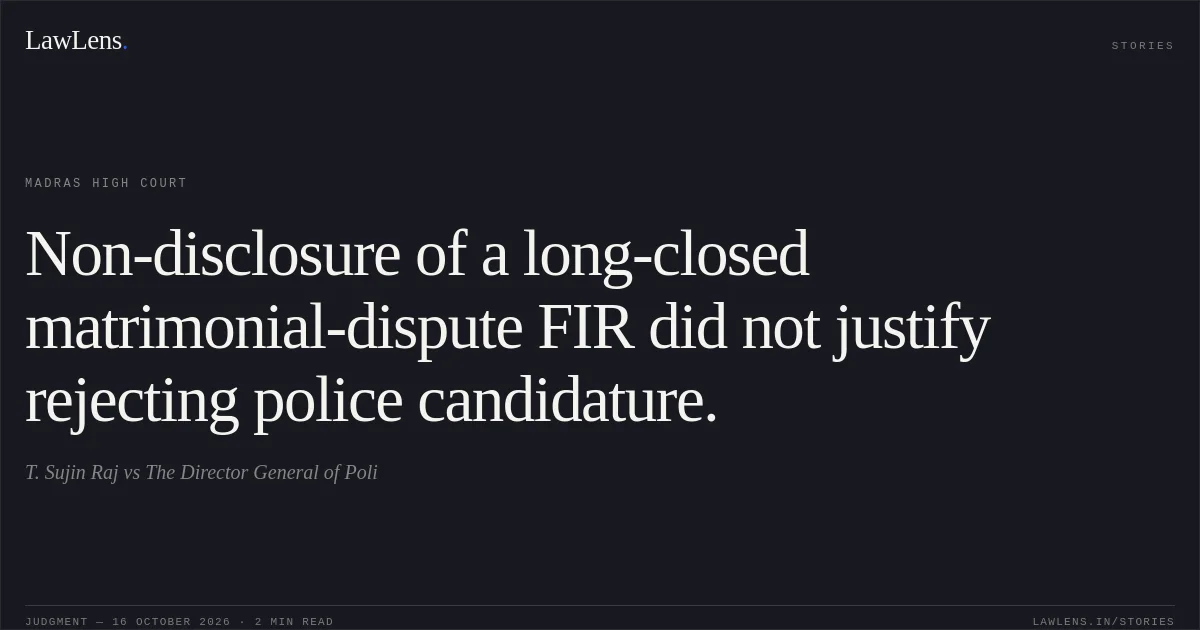
The petitioner, an ex-serviceman, applied for appointment as a Grade-II Police Constable and proceeded through the selection process to provisional selection.
¶ 2In 2016, his wife lodged a complaint that resulted in registration of an FIR under Sections 294(b), 406, 498A and 506(1) IPC and Sections 3, 4 and 6 of the Dowry Prohibition Act.
¶ 3The petitioner stated that action in the case was dropped and that the marriage later ended in divorce by mutual consent.
¶ 3In his 2023 application, he answered “No” to the question about criminal cases, stating that no case was then pending and that he believed a closed case need not be disclosed.
¶ 4The third respondent rejected his candidature for non-disclosure; the petitioner challenged that decision and sought appointment.
¶ 1, 5–602Issues
i.1. Whether the petitioner’s failure to disclose the 2016 FIR, in which action had been dropped before he applied, amounted to suppression warranting rejection of his candidature.
¶ 4, 12–14ii.2. Whether the respondents should consider the petitioner for appointment in light of the matrimonial circumstances and the nature and status of the case.
¶ 13–1503Law Applied
Rule 14(b) of the Tamil Nadu State Police Subordinate Service Rules governs the eligibility of candidates with criminal-case histories and was considered alongside the principles in Director General of Police, Tamil Nadu v. K. Indhu Kumar, W.A.(MD) No. 938 of 2020.
¶ 6, 13Indhu Kumar recognises that, in cases involving petty or trivial matters, including family disputes, an employer may exercise discretion to consider a candidate’s character and antecedents despite non-disclosure; it also identifies offences against women or children as ordinarily not trivial.
¶ 13The judgment also records the Full Bench proposition in Manikandan v. Chairman, Tamil Nadu Uniformed Services Recruitment Board that failure to disclose involvement in a criminal case may be fatal.
¶ 11The petitioner cited Avtar Singh v. Union of India, (2016) 8 SCC 471, for the principle that an employer may consider special circumstances when deciding the consequences of false or suppressed information.
¶ 10Provisions in the judgment · 8 · Linked ones open on LawLens
Indian Penal Code, 1860 Section 294Section 406Section 506Section 325Section 34
04Reasoning
The Court found that the FIR arose from matrimonial discord, that action in it had been dropped, and that the parties subsequently obtained a divorce by mutual consent.
¶ 12It treated the case as trivial in the circumstances and applied Indhu Kumar’s allowance for discretionary consideration of non-disclosure in trivial cases.
¶ 13The Court further reasoned that no case was pending when the petitioner submitted his application and that the case had been closed at least seven years earlier; accordingly, it concluded that the omission did not amount to suppression warranting rejection.
¶ 1405Holding
The Court allowed the writ petition, set aside the rejection challenged by the petitioner, and directed the respondents to consider him for appointment, subject to his fulfilling all other conditions.
¶ 15It did not order immediate appointment.
¶ 15No costs were ordered, and the connected miscellaneous petition was closed.
¶ 15Original Court PDF
T. Sujin RajvsThe Director General of Poli
Click to open original judgment
Original judgment, available to read, download and summarize on LawLens.in