Facts
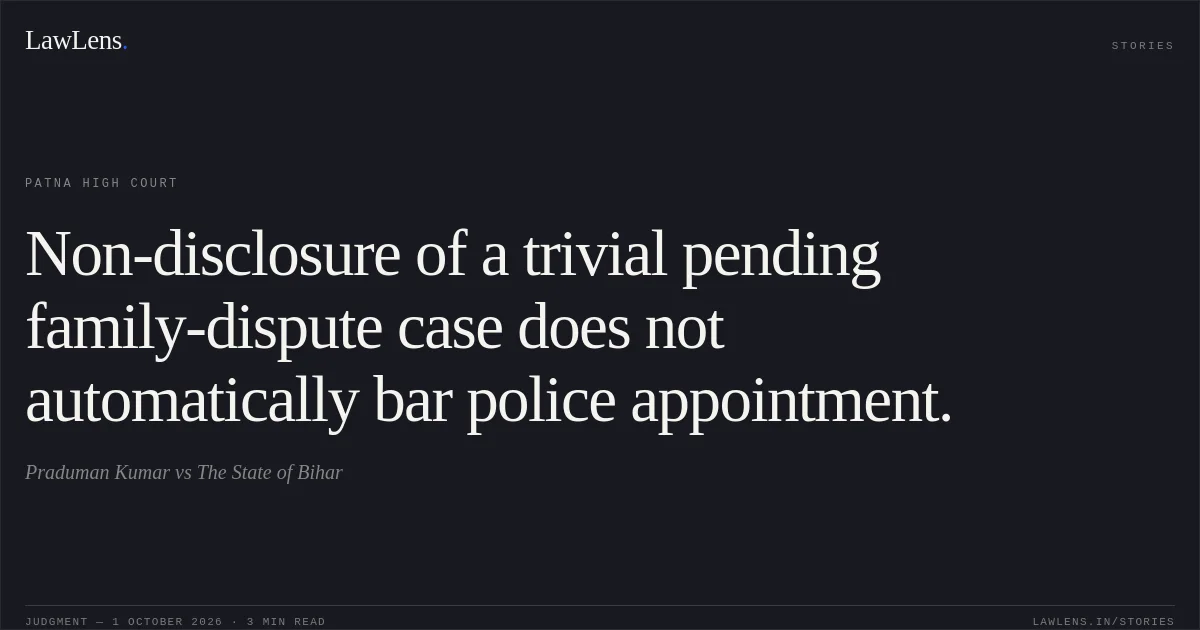
The petitioner was recommended for appointment as a Police Sub-Inspector following the selection process under Advertisement No. 2 of 2023.
Source reference: no citationIn his application, he answered “No” to questions asking whether an FIR or criminal case had ever been registered or was pending against him. In fact, Warisaliganj P.S. Case No. 240 of 2022 had been registered against him in connection with a family property/partition dispute; he was granted bail two days later, and cognizance was taken in 2022.
Source reference: p.3–6The petitioner’s challenge to the cognizance order resulted in a stay of that order and further proceedings.
Source reference: p.5The appointing authority cancelled his candidature on 30 December 2024 because of the pending case, and his subsequent request for an appointment letter was rejected on 17 March 2025. He sought to set aside both orders and obtain appointment.
Source reference: p.2–4Issues
1. Whether the petitioner’s failure to disclose the FIR and pending criminal case warranted cancellation of his candidature, in the circumstances of the case
Source reference: p.10–112. Whether the impugned cancellation and rejection orders should be set aside and the respondents directed to accept the petitioner’s joining as a Police Sub-Inspector
Source reference: p.11Law Applied
The Court applied the principles in Avtar Singh v. Union of India, (2016) 8 SCC 471, that suppression of material information may affect candidature, but does not give an employer unfettered authority to act arbitrarily; the decision must be reasonable, objective, and based on the relevant facts.
Source reference: p.9–10Suppression must concern information that is material, rather than merely technical or trivial.
Source reference: p.9–10Relying on Ravindra Kumar v. State of Uttar Pradesh, (2024) 5 SCC 264, and the principles discussed in Commissioner of Police v. Sandeep Kumar, (2011) 4 SCC 644, the Court stated that suitability and relief require a holistic, case-specific assessment, including the nature of the offence, the circumstances and timing of the case, the candidate’s age, and the contents of the cancellation order.
Source reference: p.6–9The Court also referred to Ram Kumar v. State of Uttar Pradesh, (2011) 14 SCC 709, and Pawan Kumar v. Union of India, (2023) 12 SCC 317, among the authorities considered on suppression of criminal-case information.
Source reference: p.6Reasoning
The Court accepted that the petitioner had given an incorrect answer despite the FIR, charge-sheet, and cognizance order predating his application.
Source reference: p.5–6, 10It nevertheless found the suppression not fatal on the particular facts: the petitioner was 23 when he completed the form; the allegations arose from a family property/partition dispute and were considered trivial; he had been released on bail two days after the FIR; and further proceedings had been stayed after he challenged the cognizance order.
Source reference: p.10–11Applying the requirement of an objective and context-sensitive assessment, the Court concluded that cancellation based solely on the non-disclosure was not justified in these circumstances.
Source reference: p.9–11Holding
The Court held that the petitioner had made out a case for relief.
It set aside the candidature-cancellation order dated 30 December 2024 and the rejection order dated 17 March 2025, and directed the respondents to accept his joining as a Police Sub-Inspector pursuant to his selection under Advertisement No. 2 of 2023. The writ application was allowed.
Source reference: p.11Acts & Sections Cited
8 provisions across 1 statute referred to in this judgment. Each provision opens on LawLens.
Indian Penal Code, 18608
Original Court PDF
Praduman KumarvsThe State of Bihar
Click to open original judgment
Original judgment, available to read, download and summarize on LawLens.in