Facts
The appellant was convicted under Section 302 IPC for stabbing his wife, who died after receiving treatment for her injuries.
Source reference: paras. 8–10, 16–21, 26–27The prosecution relied principally on the testimony of PWs.2 and 3, who the Court treated as eyewitnesses, evidence of marital discord and motive, and medical and forensic material.
Source reference: paras. 8–10, 16–21, 26–27The Sessions Court sentenced the appellant to life imprisonment and a fine of Rs.50,000; he appealed, challenging the reliability and sufficiency of the evidence, including the non-examination of the post-mortem doctor and the delay in obtaining the FSL report.
Source reference: paras. 1, 11–12Issues
Whether the evidence on record established the appellant’s guilt under Section 302 IPC and supported the conviction.
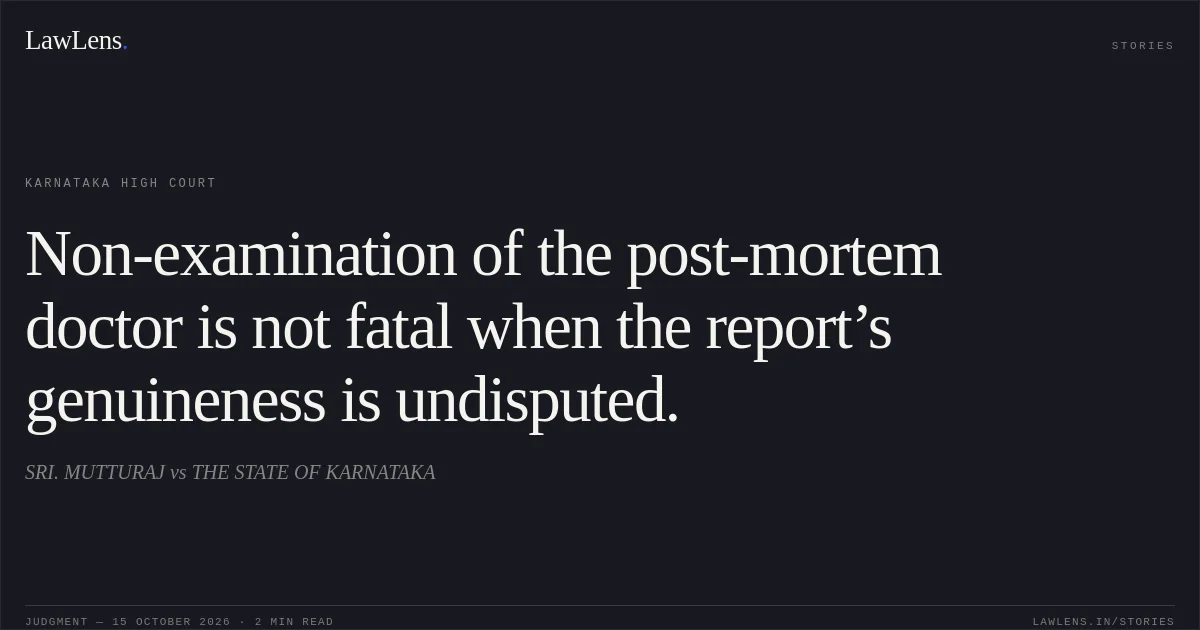
Source reference: para. 14Whether the non-examination of the post-mortem doctor, alleged investigative lapses, or delay in obtaining the FSL report rendered the conviction unsafe.
Source reference: paras. 12, 28–34Law Applied
Section 302 IPC governs the offence of murder.
Source reference: no citationThe Court applied the principle that witness evidence is assessed for its quality and credibility, not by the number of witnesses; it relied on Ajai alias Ajju v. State of Uttar Pradesh, 2023 INSC 127.
Source reference: para. 23It further held, relying on Edakkandi Dineshan alias P. Dineshan v. State of Kerala, (2025) 3 SCC 273, that defective investigation alone does not entitle an accused to acquittal if the remaining evidence proves the charge.
Source reference: para. 24Under Section 293 CrPC, qualifying reports by Government scientific experts may be used in evidence without examining their authors; the Court also relied on Section 294 CrPC and Akhtar v. State of Uttaranchal, (2009) 13 SCC 722, and Boraiah alias Shekar v. State by Ramanagaram Police, 2002 Cri LJ 1031, concerning the evidentiary use of an undisputed post-mortem report.
Source reference: paras. 29–33The Court also considered the appellant’s failure, when examined under Section 313 CrPC, to explain how his wife sustained the injuries.
Source reference: para. 25Reasoning
The Court found that PWs.2 and 3 consistently described the stabbing and that their evidence was supported by evidence of the preceding marital discord, the injuries recorded in the inquest and post-mortem materials, and the other circumstances on record.
Source reference: paras. 15–18, 23, 26–27.1It considered the appellant’s failure to explain the injuries significant because the relevant circumstances were within his knowledge, and held that the evidence of PW.4 concerning the transportation of the deceased to hospital did not materially undermine the prosecution case.
Source reference: para. 25The Court further held that non-examination of the doctor and the delay in obtaining the FSL report were not, by themselves, fatal; it found no infirmity warranting appellate interference.
Source reference: paras. 28–34Holding
The High Court answered the appeal against the appellant, holding that the prosecution evidence supported the conviction and that the challenged evidentiary and investigative matters did not make it unsafe.
It dismissed the appeal and left in place the conviction under Section 302 IPC and the sentence imposed by the trial court.
Source reference: paras. 1, 35Acts & Sections Cited
7 provisions across 2 statutes referred to in this judgment. Each provision opens on LawLens.
Code of Criminal Procedure, 19734
Indian Penal Code, 18603
Original Court PDF
SRI. MUTTURAJvsTHE STATE OF KARNATAKA
Click to open original judgment
Original judgment, available to read, download and summarize on LawLens.in