Facts
The complainant, Sanjay Chauhan, alleged that the petitioner entered into an agreement dated 6 October 2012 to sell 1 Katha 10 Dhurs of land at ₹6,50,000 per Katha and received an aggregate amount of ₹6,43,000 through various payments made between 6 October 2012 and 8 August 2014. The petitioner allegedly failed to execute the sale deed despite receipt of the amount, leading the complainant to issue a legal notice and institute a complaint alleging cheating and misappropriation
Source reference: p.2, para. 3Cognizance was taken for an offence under Section 406 of the Indian Penal Code. After examination of three prosecution witnesses, the petitioner sought discharge under Section 245 of the Code of Criminal Procedure. The Magistrate rejected the discharge application on 26 October 2018, and the Sessions Court dismissed the petitioner’s revision on 3 January 2019
Source reference: pp.2–3, para. 4The petitioner approached the High Court contending that the dispute was essentially civil in nature, particularly because the complainant had already instituted Title Suit No. 26 of 2015 seeking specific performance of the alleged agreement for sale
Source reference: p.3, para. 5Issues
Whether the failure to execute a sale deed after receipt of the alleged sale consideration constituted the offence of criminal breach of trust under Section 406 of the IPC?
Source reference: pp.3–4, paras. 6, 9Whether continuation of the criminal complaint, in the circumstances of a pending civil suit for specific performance, amounted to an abuse of the process of court?
Source reference: pp.4–5, paras. 8–11Whether the petitioner was entitled to discharge and quashing of the criminal proceedings in exercise of the High Court’s inherent jurisdiction?
Source reference: p.5, paras. 10–12Law Applied
Section 406 of the IPC requires proof of entrustment of property and dishonest misappropriation or conversion; payment made as sale consideration under an agreement for sale does not, without more, constitute entrustment
Source reference: p.4, para. 9A mere breach of an agreement for sale cannot ordinarily be converted into a criminal prosecution unless fraudulent or dishonest intention existed from the inception of the transaction, and criminal proceedings cannot be used to exert pressure in an essentially civil dispute. The Court relied on Rikhab Birani & Anr. v. State of Uttar Pradesh & Anr., 2025 SCC OnLine SC 823, for these principles
Source reference: p.4, para. 7At the stage of discharge, detailed appreciation of evidence is impermissible; however, the High Court may exercise its inherent jurisdiction where the allegations, even if accepted at face value, do not disclose the ingredients of the alleged offence and continuation of the prosecution would constitute abuse of process
Source reference: p.5, para. 10Reasoning
The Court found that the allegations arose directly from the petitioner’s alleged failure to perform an agreement for sale and that the complainant had already pursued the civil remedy of specific performance through Title Suit No. 26 of 2015
Source reference: pp.3–4, paras. 5–6The amount allegedly paid was described as sale consideration, not property entrusted to the petitioner for a specific purpose. Consequently, the essential element of entrustment required for Section 406 IPC was absent
Source reference: p.4, para. 9The Court further found no allegation or material demonstrating that the petitioner possessed dishonest intention from the inception of the transaction; mere non-execution of the sale deed could not, by itself, establish criminality
Source reference: p.4, para. 8Since the complaint essentially sought to enforce a civil contractual claim through criminal proceedings, continuation of the prosecution was held to be an abuse of the process of court
Source reference: p.5, paras. 10–11Holding
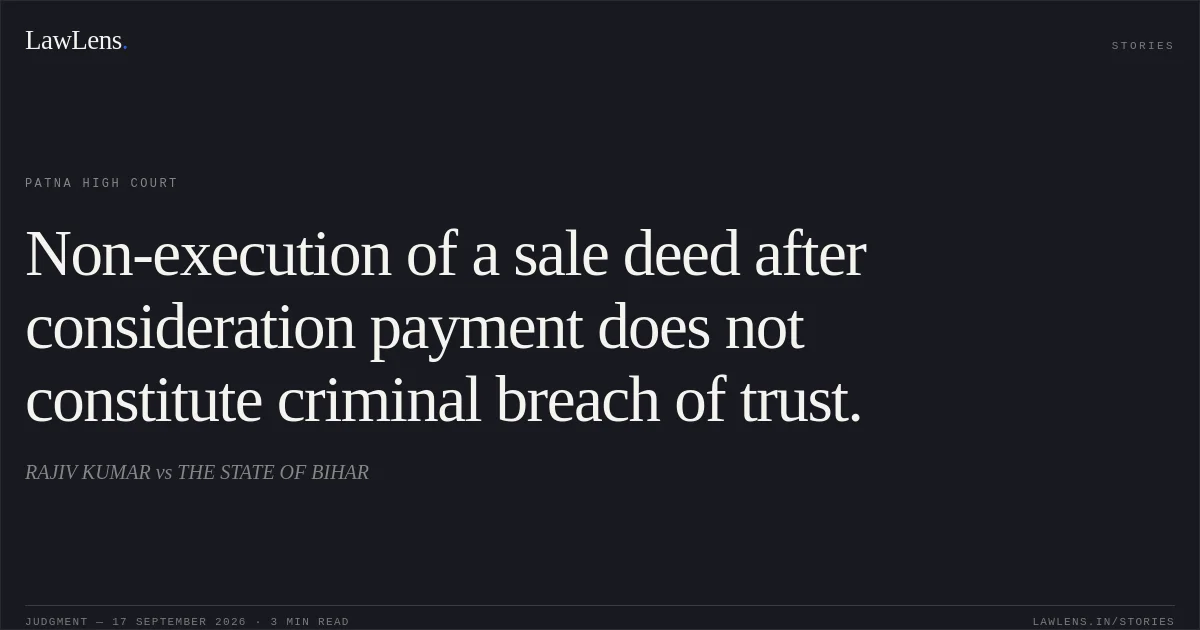
The High Court held that the alleged non-execution of the sale deed, despite receipt of sale consideration, did not constitute criminal breach of trust under Section 406 IPC and that the dispute was essentially civil in nature
It therefore quashed and set aside the order dated 3 January 2019 passed in Criminal Revision No. 630 of 2018, the order dated 26 October 2018 passed by the A.C.J.M.-14, Patna, and all consequential criminal proceedings against the petitioner
Source reference: p.6, para. 12The application was allowed, and the trial court record was directed to be returned
Source reference: p.6, paras. 13–14Acts & Sections Cited
2 provisions across 2 statutes referred to in this judgment. Each provision opens on LawLens.
Indian Penal Code, 18601
Code of Criminal Procedure, 19731
Original Court PDF
RAJIV KUMARvsTHE STATE OF BIHAR
Click to open original judgment
Original judgment, available to read, download and summarize on LawLens.in