Facts
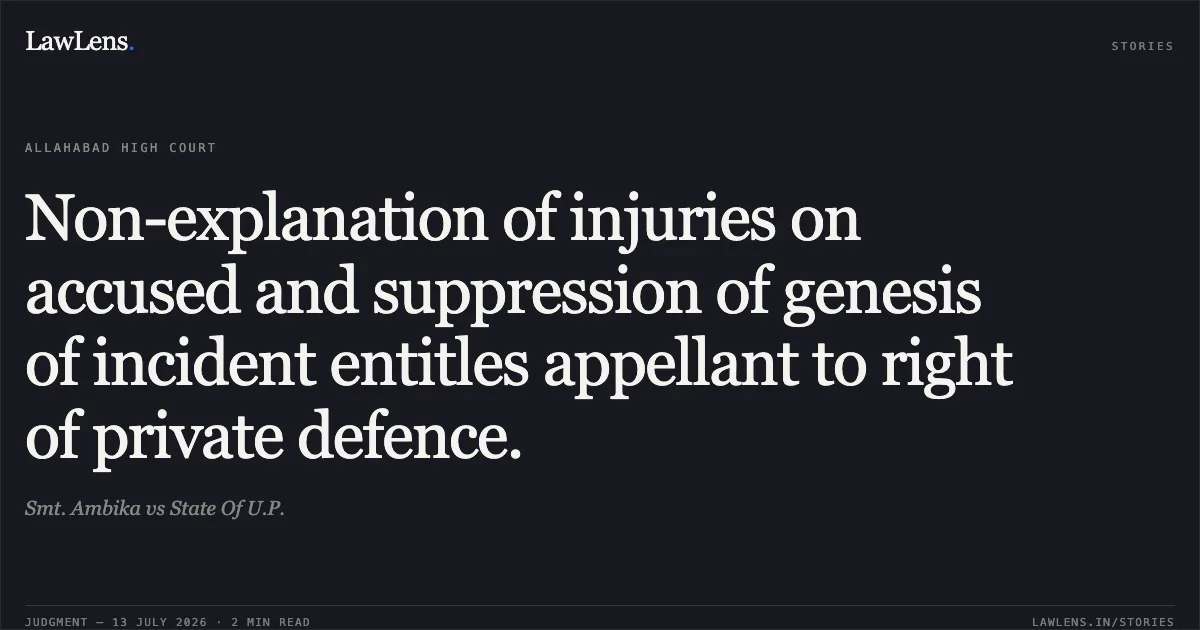
The Appellant, Ambika, was convicted by the learned trial court under Section 304(1) of the IPC and sentenced to 5 years' rigorous imprisonment.
Source reference: para. 2The prosecution alleged that on May 12, 1981, a quarrel erupted between the women of the families of the deceased (Rajjan) and the accused.
Source reference: para. 3When Rajjan intervened, Ambika allegedly struck him on the head with a moosal (wooden pestle), leading to his death.
Source reference: para. 3, 11The Appellant pleaded not guilty, asserting that Rajjan was the aggressor who entered their house and committed maarpeet, and that any injuries sustained by him occurred while the accused were exercising their right of private defense.
Source reference: para. 19, 27Medical evidence confirmed that all four accused persons sustained various injuries during the incident, which the prosecution witnesses denied or failed to explain.
Source reference: para. 33, 36Issues
1. Whether the prosecution’s failure to explain the injuries sustained by the accused persons is fatal to the prosecution case.
Source reference: para. 35, 372. Whether the Appellant is entitled to the benefit of the right of private defense under the General Exceptions of the IPC.
Source reference: para. 40, 42Law Applied
The court primarily applied the principle regarding non-explanation of injuries from Lakshmi Singh v. State of Bihar, holding that such failure suggests the prosecution has suppressed the genesis of the incident.
Source reference: para. 37It further applied Sections 96, 97, and 100 of the Indian Penal Code (IPC) regarding the right of private defense of the body.
Source reference: para. 40The court also relied on the principles from Darshan Singh v. State of Punjab, which established that a person facing imminent threat cannot be expected to modulate their defense with "arithmetical exactitude" and that self-preservation is a basic human instinct.
Source reference: para. 41Reasoning
The court found that the prosecution witnesses (P.W.3 and P.W.4) were unreliable as they categoricaly denied that the accused persons sustained any injuries, despite medical reports (Ext. Kha 3 to 6) proving that all four accused suffered lacerated wounds and contusions.
Source reference: para. 33, 38This suppression indicated that the prosecution did not present the true version of the incident.
Source reference: para. 38The Investigating Officer’s testimony further admitted that the deceased was the aggressor who "reached at Ambika’s house" to commit assault.
Source reference: para. 33The court reasoned that since the deceased and his wife raided the accused's house and caused injuries to the Appellant’s family, a reasonable apprehension of death or grievous hurt existed.
Source reference: para. 43The single blow with the moosal was deemed a proportionate response in the "heat of the moment" and did not constitute an excess of the right of private defense, especially given the injuries sustained by the four accused.
Source reference: para. 43Holding
The court held that the prosecution failed to prove its case beyond reasonable doubt as it suppressed the genesis of the incident and that the Appellant’s actions were found to be protected under the right of private defense.
The High Court allowed the appeal, setting aside the judgment and order dated February 9, 1984, acquitting Smt. Ambika of the charge under Section 304(1) IPC and discharging her bail bonds.
Source reference: para. 45, 46Acts & Sections Cited
12 provisions across 3 statutes referred to in this judgment. Each provision opens on LawLens.
Code of Criminal Procedure, 19735
Indian Penal Code, 18606
Bharatiya Nagarik Suraksha Sanhita, 20231
Original Court PDF
Smt. AmbikavsState Of U.P.
Click to open original judgment
Original judgment, available to read, download and summarize on LawLens.in